



IndoAsia Defense
  • Home
  • Air
    • All
    • Air Defence
    • Drones
    • Fighters
    • ISR & Mobility
    A 250-km Missile Means Nothing If the Kill Chain Breaks

    India’s 250-km Missile Debate Is Not About Outmatching the PL-15

    Rafale F5 vs AMCA

    Rafale F5 vs AMCA: If India Buys Rafale F5, What Happens to AMCA?

    BrahMos Advantage

    BrahMos Missile Explained: The Missile That Enables India’s Stand-Off Strike Strategy

    Ghatak UCAV stealth, autonomy, integration

    Inside India’s Ghatak UCAV Program: Stealth, Autonomy, and the Integration Gap

    The F414 engine co-production agreement between Hindustan Aeronautics Limited and GE Aerospace

    India-US F414 Engine Deal Explained: Technology Transfer, Tejas Mk2, and AMCA

    What is the Su-57M1 India deal

    Su-57M1 for India: A Fifth-Generation Shortcut or a Strategic Dependency Trap?

    India indigenous long range surveillance radar with X-band drone detection capability

    450km Eyes, Machine-Speed Decisions: How India’s Indigenous Long Range Surveillance Radar Is Rewriting Air Defence

    Why Software Defined Radios Are the IAF’s Most Consequential Upgrade

    IAF Signs BEL Deal for Software Defined Radios: Rewiring India’s Air Combat Network

    How the Ghatak UCAV Stealth Design Redefines India’s Drone Warfare Doctrine

    Ghatak UCAV: India’s Carbon Composite Stealth Strategy Dissected

  • Land
    • All
    • Armour & Artillery
    • China Front
    • Future Combat
    • Pakistan Front
    Rafale F5 vs AMCA

    Rafale F5 vs AMCA: If India Buys Rafale F5, What Happens to AMCA?

    Missiles and Manufacturing Why Production Depth Defines India’s Strike Power

    Why Missile Production Depth Matters More Than Range for India

    Why Operation Sindoor's Victory Raises Harder Questions Than It Answers

    Operation Sindoor: The Uncomfortable Questions India Hasn’t Answered

    The Indo-Pacific Is Fragmenting, Not Uniting Against China

    Why the Indo-Pacific Will Not Unite Against China

    The India-South Korea defence deal

    The India-South Korea Defence Deal Through China’s Operational Lens

    Railways as War Arteries Can India Match China’s Military Mobility Before the Next Crisis

    Railways as War Arteries: Can India Match China’s Military Mobility Before the Next Crisis?

    China maritime front in Indian Ocean

    What If China Opens a Maritime Front in the Indian Ocean During a LAC Conflict?

    What is Indian military modernization strategy in 2026?

    Indian Military Modernization: Systems, Doctrine, and Capability Architecture (2026-27)

    Tank launching loitering munition in battle

    From Smoke to Strike: India’s Indigenous Loitering Munitions for T-72, T-90, and Arjun Tanks

  • Navy
    • All
    • Fleet Expansion
    • Indian Ocean
    • Maritime Security
    • Submarines
    Japan Mogami-class frigate deal overview

    Japan’s Mogami-Class Frigate Offer to India: What the Transfer Terms Reveal About Tokyo’s Indo-Pacific Calculus

    China maritime front in Indian Ocean

    What If China Opens a Maritime Front in the Indian Ocean During a LAC Conflict?

    The Strait of Hormuz Crisis

    India’s Oil Artery Under Threat: Strategic Implications of a Hormuz Crisis

    India’s VL-Shtil Missile Deal with Russia

    India’s VL-Shtil Missile Deal with Russia: Strengthening Naval Air Defense in the Indo-Pacific

    Andaman & Nicobar Command Sleeping Giant of India’s Maritime Strategy

    Andaman & Nicobar Command: Sleeping Giant of India’s Maritime Strategy

    Maritime Surveillance 2.0: Why EO/IR Modernisation Matters for India’s Ocean Security

    Maritime Surveillance 2.0: Why EO/IR Modernisation Matters for India’s Ocean Security

    2030 Will Decide the India ASEAN Maritime Equation

    2030 Will Decide the India ASEAN Maritime Equation

    India Military Transformation Series — Part 3: Maritime Power and the Indian Ocean Imperative

    India Military Transformation Series — Part 3: Maritime Power and the Indian Ocean Imperative

    Indian Navy TEDBF PPP Model: China Factor and 2030–2040 Carrier Strategy

    Indian Navy TEDBF PPP Model: China Factor and 2030–2040 Carrier Strategy

  • Indo-Pacific
    • All
    • 2035 Outlook
    • China Strategy
    • India Strategy
    • Pakistan Outlook
    General Upendra Dwivedi Smart Power

    The Army Chief Upendra Dwivedi’s “Smart Power” Speech Was a Confession, Not a Doctrine

    India defence budget

    The Two Armies India Cannot Afford to Keep Funding at Once

    The Sindoor Dividend 2.0: How India’s $93.5 Billion Defence Budget Is Rewiring Military Power for 2030

    The Sindoor Dividend 2.0: How India’s $93.5 Billion Defence Budget Is Rewiring Military Power for 2030

    Rafale F5 vs AMCA

    Rafale F5 vs AMCA: If India Buys Rafale F5, What Happens to AMCA?

    DRDO-developed Guided Pinaka

    At ₹70 Lakh Per Rocket, DRDO-developed Guided Pinaka May Represent India’s Shift Toward Scalable Precision Warfare

    The Indo-Pacific Is Fragmenting, Not Uniting Against China

    Why the Indo-Pacific Will Not Unite Against China

    Japan Mogami-class frigate deal overview

    Japan’s Mogami-Class Frigate Offer to India: What the Transfer Terms Reveal About Tokyo’s Indo-Pacific Calculus

    The India-South Korea defence deal

    The India-South Korea Defence Deal Through China’s Operational Lens

    Railways as War Arteries Can India Match China’s Military Mobility Before the Next Crisis

    Railways as War Arteries: Can India Match China’s Military Mobility Before the Next Crisis?

  • Joint
    • All
    • Integrated Ops
    • Procurement Reform
    • Theater Commands
    General Upendra Dwivedi Smart Power

    The Army Chief Upendra Dwivedi’s “Smart Power” Speech Was a Confession, Not a Doctrine

    Why Operation Sindoor's Victory Raises Harder Questions Than It Answers

    Operation Sindoor: The Uncomfortable Questions India Hasn’t Answered

    India's strategic challenge sustainability first

    India Can Strike in 22 Minutes. Can It Sustain for 22 Weeks?

    Ballistic Missile Defense system intercepting incoming missile during midcourse phase

    How Ballistic Missile Defense Works: Inside Modern Missile Interception Systems

    DAP 2026 India’s Quiet Revolution in Defence Procurement

    DAP 2026: India’s Quiet Revolution in Defence Procurement

    Integrated Battle Groups vs China’s Western Theater Command

    Integrated Battle Groups vs China’s Western Theater Command: Can Doctrine Survive the Himalayan Reality?

    Andaman & Nicobar Command Sleeping Giant of India’s Maritime Strategy

    Andaman & Nicobar Command: Sleeping Giant of India’s Maritime Strategy

    India Military Transformation Series — Part 2: The Theatre Command Reckoning

    India Military Transformation Series — Part 2: The Theatre Command Reckoning

    India AI C4ISR modernization

    India Military Transformation Series — Part 1: India AI C4ISR Modernization

  • Tech
    • All
    • AI & Autonomous Systems
    • Cyber
    • Electronic Warfare
    • Space
    Why Software Defined Radios Are the IAF’s Most Consequential Upgrade

    IAF Signs BEL Deal for Software Defined Radios: Rewiring India’s Air Combat Network

    Source Code or ICD India’s Source Code Negotiation Explained

    Source Code or ICD: India’s Source Code Negotiation Explained

    Supply Chain Weaponization

    Supply Chain Weaponization: Strategic Autonomy Meets Semiconductor Reality

    AI-driven battlefield in India's military

    The Algorithm of Borders: What India’s Military AI Push Actually Looks Like on the Ground

    India AI C4ISR modernization

    India Military Transformation Series — Part 1: India AI C4ISR Modernization

    PRAHAR Explained India Counter Terror Policy Prahaar

    PRAHAAR Explained: Why ‘PRAHAAR’ India’s National Counter-terrorism Doctrine, Signals the End of Traditional Warfare

    The Weapons Making the AMCA Unbeatable

    The Weapons Making the AMCA Unbeatable

    India’s Aerospace Ecosystem After Rafale: The 2026–2030 Industrial Test

    India’s Aerospace Ecosystem After Rafale: The 2026–2030 Industrial Test

    PLA’s Cyber Warfare Units and the Question of Indian Critical Infrastructure Resilience

    PLA’s Cyber Warfare Units and the Question of Indian Critical Infrastructure Resilience

  • Industry
    • All
    • Budget
    • Exports
    • Make in India
    • Supply Chains
    General Upendra Dwivedi Smart Power

    The Army Chief Upendra Dwivedi’s “Smart Power” Speech Was a Confession, Not a Doctrine

    India defence budget

    The Two Armies India Cannot Afford to Keep Funding at Once

    The Sindoor Dividend 2.0: How India’s $93.5 Billion Defence Budget Is Rewiring Military Power for 2030

    The Sindoor Dividend 2.0: How India’s $93.5 Billion Defence Budget Is Rewiring Military Power for 2030

    Rafale F5 vs AMCA

    Rafale F5 vs AMCA: If India Buys Rafale F5, What Happens to AMCA?

    BrahMos Advantage

    BrahMos Missile Explained: The Missile That Enables India’s Stand-Off Strike Strategy

    Missiles and Manufacturing Why Production Depth Defines India’s Strike Power

    Why Missile Production Depth Matters More Than Range for India

    India’s Defence MSME Blind Spot Could Become a Wartime Liability

    India’s Defence MSME Blind Spot Could Become a Wartime Liability

    India's strategic challenge sustainability first

    India Can Strike in 22 Minutes. Can It Sustain for 22 Weeks?

    India-UAE defence pact and Gulf strategy

    India-UAE Defence Pact: Why Abu Dhabi Is Becoming India’s Western Strategic Depth

  • Global
    • All
    • China-Pak
    • Emerging Tech
    • Middle Eeast
    • Regional Trends
    • US-India
    • US-Israel
    Rafale F5 vs AMCA

    Rafale F5 vs AMCA: If India Buys Rafale F5, What Happens to AMCA?

    India-UAE defence pact and Gulf strategy

    India-UAE Defence Pact: Why Abu Dhabi Is Becoming India’s Western Strategic Depth

    The Indo-Pacific Is Fragmenting, Not Uniting Against China

    Why the Indo-Pacific Will Not Unite Against China

    Ghatak UCAV stealth, autonomy, integration

    Inside India’s Ghatak UCAV Program: Stealth, Autonomy, and the Integration Gap

    The F414 engine co-production agreement between Hindustan Aeronautics Limited and GE Aerospace

    India-US F414 Engine Deal Explained: Technology Transfer, Tejas Mk2, and AMCA

    india military integration gap

    Is India Building Military Power Faster Than It Can Integrate It?

    India indigenous long range surveillance radar with X-band drone detection capability

    450km Eyes, Machine-Speed Decisions: How India’s Indigenous Long Range Surveillance Radar Is Rewriting Air Defence

    What is Indian military modernization strategy in 2026?

    Indian Military Modernization: Systems, Doctrine, and Capability Architecture (2026-27)

    India’s 6th-Gen Fighter Strategy FCAS vs GCAP Explained

    India’s 6th-Gen Fighter Strategy: FCAS vs GCAP Explained

  • Resources
    • India Military Capability Index
    • India vs China Military Balance
    • China Western Theater Command Guide
    • Pakistan Military Tracker 2026-27
    • India’s Military Doctrine Library
    • India vs China vs Pakistan Missile Arsenal Comparison
    • India’s Missile List
    • India Missile Range Map
    • Indo-Pacific Military Power Map
    • Indo-Pacific Defense Timeline
    • Global Military Balance Dashboard
    • Global Weapons Systems Database
    • Global Missile Systems Database
  • What If
    • China India Naval Conflict
No Result
View All Result
  • Home
  • Air
    • All
    • Air Defence
    • Drones
    • Fighters
    • ISR & Mobility
    A 250-km Missile Means Nothing If the Kill Chain Breaks

    India’s 250-km Missile Debate Is Not About Outmatching the PL-15

    Rafale F5 vs AMCA

    Rafale F5 vs AMCA: If India Buys Rafale F5, What Happens to AMCA?

    BrahMos Advantage

    BrahMos Missile Explained: The Missile That Enables India’s Stand-Off Strike Strategy

    Ghatak UCAV stealth, autonomy, integration

    Inside India’s Ghatak UCAV Program: Stealth, Autonomy, and the Integration Gap

    The F414 engine co-production agreement between Hindustan Aeronautics Limited and GE Aerospace

    India-US F414 Engine Deal Explained: Technology Transfer, Tejas Mk2, and AMCA

    What is the Su-57M1 India deal

    Su-57M1 for India: A Fifth-Generation Shortcut or a Strategic Dependency Trap?

    India indigenous long range surveillance radar with X-band drone detection capability

    450km Eyes, Machine-Speed Decisions: How India’s Indigenous Long Range Surveillance Radar Is Rewriting Air Defence

    Why Software Defined Radios Are the IAF’s Most Consequential Upgrade

    IAF Signs BEL Deal for Software Defined Radios: Rewiring India’s Air Combat Network

    How the Ghatak UCAV Stealth Design Redefines India’s Drone Warfare Doctrine

    Ghatak UCAV: India’s Carbon Composite Stealth Strategy Dissected

  • Land
    • All
    • Armour & Artillery
    • China Front
    • Future Combat
    • Pakistan Front
    Rafale F5 vs AMCA

    Rafale F5 vs AMCA: If India Buys Rafale F5, What Happens to AMCA?

    Missiles and Manufacturing Why Production Depth Defines India’s Strike Power

    Why Missile Production Depth Matters More Than Range for India

    Why Operation Sindoor's Victory Raises Harder Questions Than It Answers

    Operation Sindoor: The Uncomfortable Questions India Hasn’t Answered

    The Indo-Pacific Is Fragmenting, Not Uniting Against China

    Why the Indo-Pacific Will Not Unite Against China

    The India-South Korea defence deal

    The India-South Korea Defence Deal Through China’s Operational Lens

    Railways as War Arteries Can India Match China’s Military Mobility Before the Next Crisis

    Railways as War Arteries: Can India Match China’s Military Mobility Before the Next Crisis?

    China maritime front in Indian Ocean

    What If China Opens a Maritime Front in the Indian Ocean During a LAC Conflict?

    What is Indian military modernization strategy in 2026?

    Indian Military Modernization: Systems, Doctrine, and Capability Architecture (2026-27)

    Tank launching loitering munition in battle

    From Smoke to Strike: India’s Indigenous Loitering Munitions for T-72, T-90, and Arjun Tanks

  • Navy
    • All
    • Fleet Expansion
    • Indian Ocean
    • Maritime Security
    • Submarines
    Japan Mogami-class frigate deal overview

    Japan’s Mogami-Class Frigate Offer to India: What the Transfer Terms Reveal About Tokyo’s Indo-Pacific Calculus

    China maritime front in Indian Ocean

    What If China Opens a Maritime Front in the Indian Ocean During a LAC Conflict?

    The Strait of Hormuz Crisis

    India’s Oil Artery Under Threat: Strategic Implications of a Hormuz Crisis

    India’s VL-Shtil Missile Deal with Russia

    India’s VL-Shtil Missile Deal with Russia: Strengthening Naval Air Defense in the Indo-Pacific

    Andaman & Nicobar Command Sleeping Giant of India’s Maritime Strategy

    Andaman & Nicobar Command: Sleeping Giant of India’s Maritime Strategy

    Maritime Surveillance 2.0: Why EO/IR Modernisation Matters for India’s Ocean Security

    Maritime Surveillance 2.0: Why EO/IR Modernisation Matters for India’s Ocean Security

    2030 Will Decide the India ASEAN Maritime Equation

    2030 Will Decide the India ASEAN Maritime Equation

    India Military Transformation Series — Part 3: Maritime Power and the Indian Ocean Imperative

    India Military Transformation Series — Part 3: Maritime Power and the Indian Ocean Imperative

    Indian Navy TEDBF PPP Model: China Factor and 2030–2040 Carrier Strategy

    Indian Navy TEDBF PPP Model: China Factor and 2030–2040 Carrier Strategy

  • Indo-Pacific
    • All
    • 2035 Outlook
    • China Strategy
    • India Strategy
    • Pakistan Outlook
    General Upendra Dwivedi Smart Power

    The Army Chief Upendra Dwivedi’s “Smart Power” Speech Was a Confession, Not a Doctrine

    India defence budget

    The Two Armies India Cannot Afford to Keep Funding at Once

    The Sindoor Dividend 2.0: How India’s $93.5 Billion Defence Budget Is Rewiring Military Power for 2030

    The Sindoor Dividend 2.0: How India’s $93.5 Billion Defence Budget Is Rewiring Military Power for 2030

    Rafale F5 vs AMCA

    Rafale F5 vs AMCA: If India Buys Rafale F5, What Happens to AMCA?

    DRDO-developed Guided Pinaka

    At ₹70 Lakh Per Rocket, DRDO-developed Guided Pinaka May Represent India’s Shift Toward Scalable Precision Warfare

    The Indo-Pacific Is Fragmenting, Not Uniting Against China

    Why the Indo-Pacific Will Not Unite Against China

    Japan Mogami-class frigate deal overview

    Japan’s Mogami-Class Frigate Offer to India: What the Transfer Terms Reveal About Tokyo’s Indo-Pacific Calculus

    The India-South Korea defence deal

    The India-South Korea Defence Deal Through China’s Operational Lens

    Railways as War Arteries Can India Match China’s Military Mobility Before the Next Crisis

    Railways as War Arteries: Can India Match China’s Military Mobility Before the Next Crisis?

  • Joint
    • All
    • Integrated Ops
    • Procurement Reform
    • Theater Commands
    General Upendra Dwivedi Smart Power

    The Army Chief Upendra Dwivedi’s “Smart Power” Speech Was a Confession, Not a Doctrine

    Why Operation Sindoor's Victory Raises Harder Questions Than It Answers

    Operation Sindoor: The Uncomfortable Questions India Hasn’t Answered

    India's strategic challenge sustainability first

    India Can Strike in 22 Minutes. Can It Sustain for 22 Weeks?

    Ballistic Missile Defense system intercepting incoming missile during midcourse phase

    How Ballistic Missile Defense Works: Inside Modern Missile Interception Systems

    DAP 2026 India’s Quiet Revolution in Defence Procurement

    DAP 2026: India’s Quiet Revolution in Defence Procurement

    Integrated Battle Groups vs China’s Western Theater Command

    Integrated Battle Groups vs China’s Western Theater Command: Can Doctrine Survive the Himalayan Reality?

    Andaman & Nicobar Command Sleeping Giant of India’s Maritime Strategy

    Andaman & Nicobar Command: Sleeping Giant of India’s Maritime Strategy

    India Military Transformation Series — Part 2: The Theatre Command Reckoning

    India Military Transformation Series — Part 2: The Theatre Command Reckoning

    India AI C4ISR modernization

    India Military Transformation Series — Part 1: India AI C4ISR Modernization

  • Tech
    • All
    • AI & Autonomous Systems
    • Cyber
    • Electronic Warfare
    • Space
    Why Software Defined Radios Are the IAF’s Most Consequential Upgrade

    IAF Signs BEL Deal for Software Defined Radios: Rewiring India’s Air Combat Network

    Source Code or ICD India’s Source Code Negotiation Explained

    Source Code or ICD: India’s Source Code Negotiation Explained

    Supply Chain Weaponization

    Supply Chain Weaponization: Strategic Autonomy Meets Semiconductor Reality

    AI-driven battlefield in India's military

    The Algorithm of Borders: What India’s Military AI Push Actually Looks Like on the Ground

    India AI C4ISR modernization

    India Military Transformation Series — Part 1: India AI C4ISR Modernization

    PRAHAR Explained India Counter Terror Policy Prahaar

    PRAHAAR Explained: Why ‘PRAHAAR’ India’s National Counter-terrorism Doctrine, Signals the End of Traditional Warfare

    The Weapons Making the AMCA Unbeatable

    The Weapons Making the AMCA Unbeatable

    India’s Aerospace Ecosystem After Rafale: The 2026–2030 Industrial Test

    India’s Aerospace Ecosystem After Rafale: The 2026–2030 Industrial Test

    PLA’s Cyber Warfare Units and the Question of Indian Critical Infrastructure Resilience

    PLA’s Cyber Warfare Units and the Question of Indian Critical Infrastructure Resilience

  • Industry
    • All
    • Budget
    • Exports
    • Make in India
    • Supply Chains
    General Upendra Dwivedi Smart Power

    The Army Chief Upendra Dwivedi’s “Smart Power” Speech Was a Confession, Not a Doctrine

    India defence budget

    The Two Armies India Cannot Afford to Keep Funding at Once

    The Sindoor Dividend 2.0: How India’s $93.5 Billion Defence Budget Is Rewiring Military Power for 2030

    The Sindoor Dividend 2.0: How India’s $93.5 Billion Defence Budget Is Rewiring Military Power for 2030

    Rafale F5 vs AMCA

    Rafale F5 vs AMCA: If India Buys Rafale F5, What Happens to AMCA?

    BrahMos Advantage

    BrahMos Missile Explained: The Missile That Enables India’s Stand-Off Strike Strategy

    Missiles and Manufacturing Why Production Depth Defines India’s Strike Power

    Why Missile Production Depth Matters More Than Range for India

    India’s Defence MSME Blind Spot Could Become a Wartime Liability

    India’s Defence MSME Blind Spot Could Become a Wartime Liability

    India's strategic challenge sustainability first

    India Can Strike in 22 Minutes. Can It Sustain for 22 Weeks?

    India-UAE defence pact and Gulf strategy

    India-UAE Defence Pact: Why Abu Dhabi Is Becoming India’s Western Strategic Depth

  • Global
    • All
    • China-Pak
    • Emerging Tech
    • Middle Eeast
    • Regional Trends
    • US-India
    • US-Israel
    Rafale F5 vs AMCA

    Rafale F5 vs AMCA: If India Buys Rafale F5, What Happens to AMCA?

    India-UAE defence pact and Gulf strategy

    India-UAE Defence Pact: Why Abu Dhabi Is Becoming India’s Western Strategic Depth

    The Indo-Pacific Is Fragmenting, Not Uniting Against China

    Why the Indo-Pacific Will Not Unite Against China

    Ghatak UCAV stealth, autonomy, integration

    Inside India’s Ghatak UCAV Program: Stealth, Autonomy, and the Integration Gap

    The F414 engine co-production agreement between Hindustan Aeronautics Limited and GE Aerospace

    India-US F414 Engine Deal Explained: Technology Transfer, Tejas Mk2, and AMCA

    india military integration gap

    Is India Building Military Power Faster Than It Can Integrate It?

    India indigenous long range surveillance radar with X-band drone detection capability

    450km Eyes, Machine-Speed Decisions: How India’s Indigenous Long Range Surveillance Radar Is Rewriting Air Defence

    What is Indian military modernization strategy in 2026?

    Indian Military Modernization: Systems, Doctrine, and Capability Architecture (2026-27)

    India’s 6th-Gen Fighter Strategy FCAS vs GCAP Explained

    India’s 6th-Gen Fighter Strategy: FCAS vs GCAP Explained

  • Resources
    • India Military Capability Index
    • India vs China Military Balance
    • China Western Theater Command Guide
    • Pakistan Military Tracker 2026-27
    • India’s Military Doctrine Library
    • India vs China vs Pakistan Missile Arsenal Comparison
    • India’s Missile List
    • India Missile Range Map
    • Indo-Pacific Military Power Map
    • Indo-Pacific Defense Timeline
    • Global Military Balance Dashboard
    • Global Weapons Systems Database
    • Global Missile Systems Database
  • What If
    • China India Naval Conflict
No Result
View All Result
IndoAsia Defense
No Result
View All Result
Home Joint Integrated Ops

India Can Strike in 22 Minutes. Can It Sustain for 22 Weeks?

Operation Sindoor demonstrated that India can strike with speed and precision. But General Upendra Dwivedi’s larger message was about something far more difficult: whether the Indian state can sustain economic, industrial, technological, and strategic coherence during prolonged pressure.

IndoAsia Defense by IndoAsia Defense
May 19, 2026
in Integrated Ops, Supply Chains
0
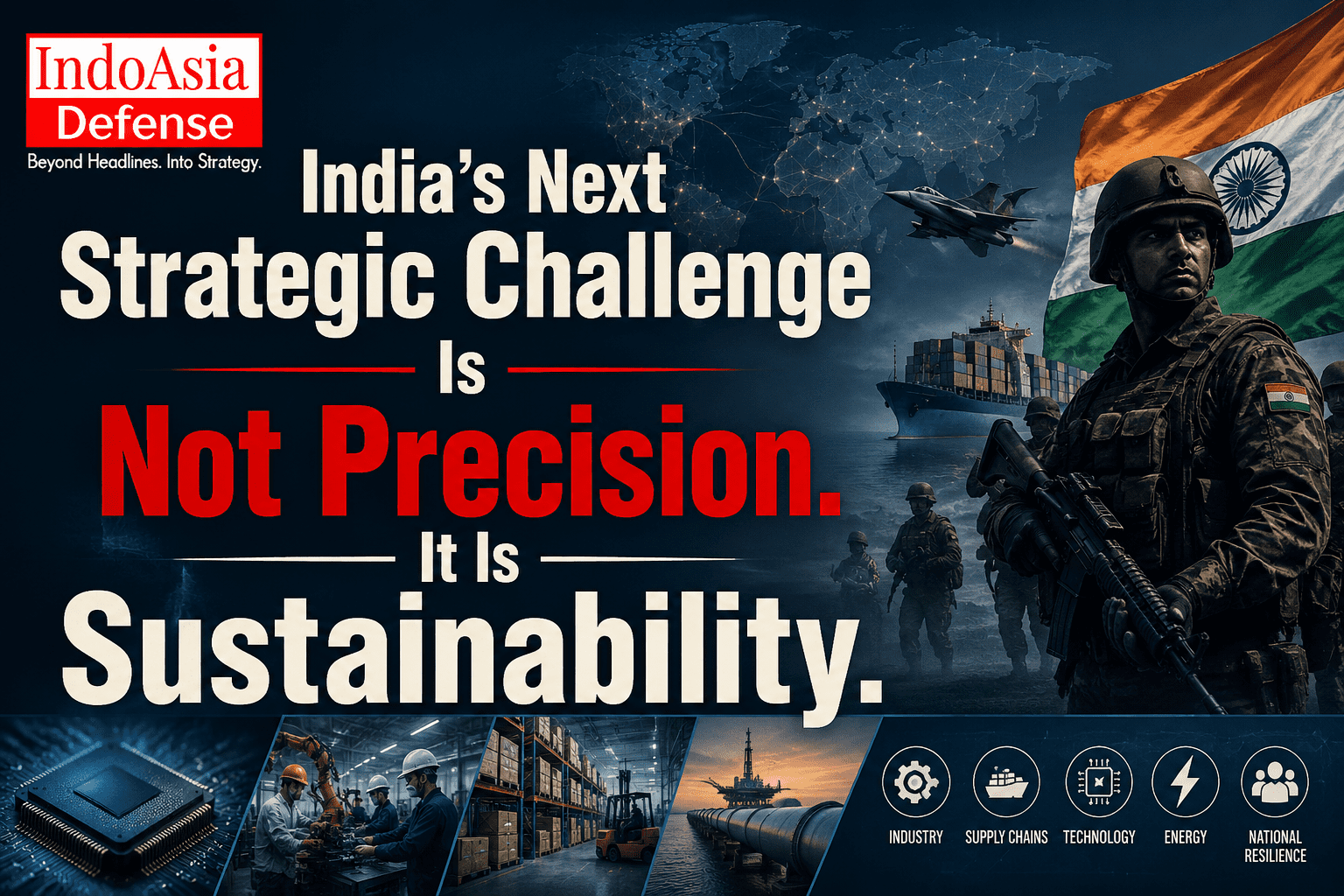
India's strategic challenge sustainability first

India Can Strike Fast. But Can It Endure Long Wars?

0
SHARES
9
VIEWS
Share on LinkedinShare on FacebookShare on Twitter

The Address Beneath the Address

New Delhi. 19 May 2025. A seminar hall at the Manekshaw Centre.

Army Chief General Upendra Dwivedi spoke for the better part of an hour.

He invoked Joseph Nye. He cited Operation Sindoor. He named the Strait of Hormuz, semiconductor chokepoints, supply chain coercion.

Reporters noted the SMART acronym. Analysts filed their commentary. By the next morning, the news cycle had moved on.

But there was a second address running underneath the first.

Quieter. More unsettling.

What Dwivedi was actually announcing – if you read past the seminar format and the careful diplomatic phrasing – was a fundamental shift in how India’s security establishment is beginning to think about the nature of threat.

Not just what threatens India, but where threat now lives and what kind of state India must become to withstand it.

The question he asked publicly was: how does India expand its smart power?

The question he didn’t ask, but which his entire address implied, is harder: what kind of state is India being forced to become, and is it capable of becoming that fast enough?

The Bet That Lost

The post-Cold War strategic order was built on a thesis. Deep economic interdependence, the argument went, would make great-power conflict irrational. The more countries traded, the less they would fight. The denser the supply chains, the more stable the peace. Nations would be too entangled to risk pulling the thread.

That thesis didn’t just fail. It inverted.

The same trade networks are now leverage points.

The same supply chains are pressure instruments.

Technology that was once exchanged freely is now withheld deliberately.

Minerals that once moved through open markets are now rationed by whoever controls the extraction.

Shipping routes that once existed purely for commerce now carry strategic risk assessments alongside cargo manifests.

When Dwivedi named the Strait of Hormuz, he wasn’t offering a geography lesson.

When he named semiconductors, he wasn’t making a procurement argument. He was describing a new map of power – one where the decisive terrain is no longer the border ridge or the maritime chokepoint in the traditional military sense, but the nerve points of a modern economy: the passages through which energy flows, chips move, data travels, and financial systems operate.

Old strategic thinking placed power at borders. New strategic reality places power at systems – and at the vulnerabilities of those systems.

That shift changes every planning assumption downstream.

The Next Conflict Will Not Announce Itself

Here is where much of India’s public strategic discourse still hasn’t caught up.

A significant portion of the Indian security debate — in think tanks, in the press, in official commentary — still operates on a 20th-century conflict template. Border tension builds. Forces mobilize. A limited exchange occurs. Back-channels open. A ceasefire holds. Status quo, more or less, is restored.

That template is not wrong for certain scenarios. But it is increasingly insufficient as a planning baseline.

Consider a more probable near-future pressure campaign against India – not a declared war, but a structured coercion sequence. It begins without announcement. Power plant control systems start behaving erratically – not a blackout, just enough to create uncertainty.

Shipping insurance for vessels transiting toward Indian ports quietly becomes more expensive, disrupting supply chains before a single shot is fired.

Social media simultaneously fills with unverifiable casualty figures, manufactured political crises, financial panic rumours. GPS accuracy degrades over selected regions. A border incident occurs – calibrated to demand a response but not large enough to justify one cleanly.

By the time formal escalation arrives, the country is already operating under significant internal stress: economic uncertainty, information chaos, political pressure, public anxiety.

This is not a hypothetical. This is the architecture of modern strategic coercion, demonstrated with increasing sophistication across multiple theatres over the past decade. It is layered, deniable, and deliberately designed to stay below the threshold of a triggering response while accumulating strategic effect.

Against this kind of pressure, the question is not whether India’s army can fight. It can. The question is whether India’s system – its governance machinery, its industrial base, its information environment, its decision architecture – can continue to function coherently under sustained, multi-directional stress that never quite crosses into declared conflict.

That is a different problem entirely. And it is the problem Dwivedi was circling, without quite naming it directly.

The Fragmentation Problem India Won’t Talk About Plainly

India is not a weak state. But it is a structurally fragmented one, and that fragmentation carries serious strategic costs that rarely get addressed honestly in public.

The Indian Army operates in one institutional world. The defence industrial base operates in another. The technology ecosystem operates in a third. The bureaucracy runs at its own pace, shaped by processes designed for peacetime administration.

Universities function largely disconnected from national capability requirements. The private sector responds to market incentives that only partially align with security imperatives.

These worlds do not, in normal circumstances, converge around a common strategic purpose. They can be made to – briefly, under extreme pressure – but the coordination costs are high and the decay back toward fragmentation begins almost immediately after the crisis passes.

China’s structural advantage over India is frequently mischaracterised. The gap is not primarily in military hardware, or even in defence spending, though both matter.

The more consequential gap is in strategic integration – the degree to which industrial policy, technology acquisition, infrastructure investment, military modernisation, and AI development all pull in the same direction, coordinated by a governing will that can sustain that direction across decades rather than election cycles.

The PLA’s Western Theater Command doesn’t just have more troops than India faces across the LAC. It has a logistics network, an infrastructure buildup, a drone production pipeline, and an AI-enabled command architecture that were all developed as parts of a single, long-duration strategic design.

Each element reinforces the others. The whole is considerably more capable than the sum of its parts.

India’s equivalent pieces exist. But they are not yet a whole.

This is not a military problem. It is a state architecture problem. And the honest version of the “Whole of Nation” framework that Dwivedi invoked at the seminar is ultimately a demand that India solve it.

What Operation Sindoor Actually Proved — and What It Didn’t

Dwivedi positioned Operation Sindoor as the clearest recent demonstration of India’s smart power concept — twenty-two minutes of precision strikes on the night of 6-7 May 2025, dismantling terrorist infrastructure, then a deliberate halt at 88 hours that he described as a calculated strategic choice rather than a limitation.

On the terms he defined, the assessment holds. The military execution was precise. The information management, while imperfect, was considerably better than India’s historical performance in similar situations. The diplomatic signalling — striking deep while stopping short of full escalation — communicated something that mattered.

But it is worth being careful about what Sindoor proved, and equally careful about what it left unresolved.

Any military action of this kind operates on three levels simultaneously.

The first is the physical effect – were the targets destroyed, was the operational objective achieved?

On this level, Sindoor succeeded. The second is the signalling effect – did the international community and the adversary receive the intended strategic message? Here the picture is more mixed.

The third, and most important, is the behavioural effect – has the adversary’s fundamental calculus changed in a durable way? This question will be answered not in the coming weeks, but across the coming years.

More to the point: Sindoor was a twenty-two-minute operation against a specific target set, executed in favourable conditions. The strategic challenge India will face is not the twenty-two-minute version of itself.

It is the version that has to make continuous decisions under sustained pressure, on multiple fronts simultaneously, with degraded information, economic disruption, and political complexity running in parallel.

Sindoor showed that India can strike precisely. The more important and still open question is whether India can hold – strategically, industrially, institutionally – across a conflict that doesn’t end in 88 hours.

The China Competition Is Not What People Think It Is

The India-China competition is habitually framed as a border dispute that occasionally goes kinetic, with military modernisation as the primary variable. This framing understates the actual competition by a considerable margin.

The real contest operates on three levels, and only one of them is military.

The first is industrial depth. China’s manufacturing density – its ability to produce drones, missiles, electronics, vehicles, and ammunition at scale and surge that production rapidly under demand – is not matched by any other state and significantly exceeds India’s current capacity.

In a sustained conflict, wars are won in factories as much as on frontlines. This was the central lesson Ukraine delivered to every military planner paying attention, and India should be absorbing it more urgently than the public discourse suggests.

The second is technology trajectory. China has built a pipeline – from state-directed R&D investment through to military-grade application – in artificial intelligence, autonomous systems, electronic warfare, and space-based ISR that represents a decade of sustained effort. India has talent, and it has ambition.

What it is still building is the institutional machinery that converts both into fielded capability at speed and scale.

The third is strategic patience. China operates on planning horizons that most democracies structurally cannot match. The infrastructure buildup opposite the LAC, the port development across the Indian Ocean littoral, the semiconductor dominance strategy – these were designed across fifteen to twenty-year timelines.

India’s political cycle is five years. That asymmetry has consequences for the kind of strategic investments a democracy can sustain.

None of this means India cannot compete. It means India needs to be clear-eyed about where the competition actually is, rather than measuring the wrong variables.

The border is a symptom. The competition is systemic.

The Two-Adversary Trap

There is a structural problem in India’s security position that doesn’t receive sufficient analytical attention: India faces two adversaries simultaneously, but they require fundamentally different strategic responses.

Pakistan is a disruptive adversary — unpredictable, nuclear-armed, willing to absorb economic punishment in pursuit of asymmetric leverage, and operating through proxy instruments that make attribution and response legally and politically complex.

Against Pakistan, India needs rapid punitive capacity, credible escalation control, and the ability to impose costs at a tempo that Pakistan’s economy cannot sustain.

China is a systemic adversary – patient, strategically coherent, capable of sustained pressure across multiple domains simultaneously, and primarily interested in shaping the regional order rather than triggering a kinetic conflict that would be costly for both sides.

Against China, India needs long-duration strategic endurance, industrial depth, technology sovereignty, and alliance relationships that remain viable under pressure.

These are not the same preparation. They are not even the same kind of state readiness.

The danger is a strategic attention trap in which Pakistan’s constant low-level provocation – terrorism, proxy activity, nuclear signalling, diplomatic friction – consumes the bandwidth that ought to be directed toward the China challenge.

Every time India’s strategic community is absorbed by the latest Pakistan crisis, the longer-term work of building the capabilities and institutions needed to manage China’s systemic pressure falls further behind.

Dwivedi did not name this trap explicitly. But the SMART framework he outlined — and the emphasis on industrial capacity, technology sovereignty, and whole-of-nation integration — is implicitly a response to it.

Democratic Speed and the Question Nobody Asks in Public

There is an uncomfortable question sitting at the centre of India’s smart power ambitions that does not get asked at seminars.

Democracies make decisions slowly. That is not a design flaw – it is a feature, built into democratic systems deliberately to prevent the concentration of power that leads to worse outcomes over time. Procurement decisions go through review processes.

Defence policy gets debated in parliament. Crisis coordination involves multiple ministries, each with their own institutional prerogatives. The media environment is open, which means information — including damaging information — circulates freely and immediately.

Authoritarian systems don’t have these constraints. They can redirect industrial capacity by executive order. They can control the information environment during a crisis. They can make force posture decisions at a pace that a democratic system structurally cannot match.

Operation Sindoor demonstrated that India can, in specific circumstances, achieve decisive speed within democratic constraints. The military planning was tight, the political decision was made quickly, the execution was precise, and the communication — while not perfect — was managed reasonably well.

But Sindoor was a short, discrete operation under conditions that were relatively favourable for Indian decision-making. The real test is not the 22-minute version. It is the sustained-pressure version — weeks or months of multi-domain coercion, with economic disruption, information warfare, and political complexity running simultaneously — where the question of whether a democracy can maintain strategic coherence becomes genuinely difficult.

Can India maintain both democratic openness and strategic speed? Can it integrate its national instruments without the authoritarian efficiency that makes integration easier for its primary adversary?

These questions don’t have clean answers. But they are the right questions. And until India’s strategic discourse starts asking them plainly, the gap between the ambition stated in seminar halls and the capacity that exists in practice will remain wider than it should be.

The Technology Gap That the Transition Creates

Dwivedi called for India to move beyond absorbing emerging technologies to indigenising, operationalising, and leading in them. That is the correct direction of travel.

But there is a specific vulnerability that this aspiration creates, and it deserves more attention than it typically receives.

Countries in transition — moving from dependence toward autonomy — occupy a particular strategic position. They are no longer fully reliant on foreign suppliers, but they have not yet achieved the depth of indigenous capability that genuine autonomy requires. They are between states. And that in-between position is where strategic risk concentrates.

India’s semiconductor ambitions are real, but the fabrication ecosystem will take years to reach meaningful scale. Its AI development is genuine, but the compute infrastructure and data advantage that underpin AI capability at a strategic level remain limited.

Its drone manufacturing is growing rapidly, but high-end sensors, propulsion systems, and electronics still carry significant import dependence. Its space capabilities are impressive, but military-space integration is still in early development.

None of these gaps are permanent. But they are real, they are current, and they define the window of maximum vulnerability through which India must pass on its way to the strategic autonomy it is pursuing.

The question for planners is not only whether India will eventually achieve technology sovereignty. It is whether, during the transition, India is managing its existing dependencies carefully enough to prevent them from being used as leverage at a critical moment.

What Kind of State Is India Becoming?

Dwivedi’s seminar was, at its core, a statement about identity as much as capability.

India’s security establishment is reaching a conclusion that its political economy has been slow to accept: security and prosperity are not competing priorities to be balanced against each other. They are the same thing, expressed through different instruments.

A state that cannot defend its supply chains, protect its digital infrastructure, sustain its industrial base under pressure, and hold its decision-making architecture together during a crisis is not prosperous — it is merely temporarily undisturbed.

That conclusion, if institutionalised, changes the kind of state India needs to build. Not a garrison state. Not a security state that sacrifices democratic openness on the altar of strategic efficiency.

But a state that has genuinely integrated security logic into economic planning, industrial policy, technology investment, and institutional design — not as an add-on, but as a core organising principle.

Whether India can build that state while simultaneously maintaining democratic pluralism, sustaining economic growth, managing coalition politics, and meeting the day-to-day demands of governing 1.4 billion people in highly varied conditions is an open question.

There is no historical precedent for what India is attempting. Most states that achieved this kind of strategic integration did so under considerably simpler political conditions.

But the alternative — continuing to treat security as a separate department, defence procurement as a vendor relationship, and industrial policy as economically distinct from military readiness — is a strategy for managed decline in an environment that is becoming less forgiving by the year.

Dwivedi’s speech pointed toward the right destination.

The harder work — the institutional redesign, the procurement reform, the industrial deepening, the technology pipeline, the decision-speed improvements — happens not in seminar halls but in the procurement files, the factory floors, the university labs, and the ten thousand daily decisions that shape what a state actually is versus what it says it wants to be.

India is moving. The question General Dwivedi didn’t answer – and perhaps couldn’t – is whether it is moving at the speed the situation requires.

Tags: Explainer
Previous Post

India-UAE Defence Pact: Why Abu Dhabi Is Becoming India’s Western Strategic Depth

Next Post

India’s Defence MSME Blind Spot Could Become a Wartime Liability

IndoAsia Defense

IndoAsia Defense

IndoAsia Defense Team is a specialist research and analysis group focused on India’s military modernization and Indo-Pacific strategic dynamics. The platform delivers structured, data-driven insights on doctrine, force posture, defense technology, and regional power balance.

Next Post
India’s Defence MSME Blind Spot Could Become a Wartime Liability

India’s Defence MSME Blind Spot Could Become a Wartime Liability

Leave a Reply Cancel reply

Your email address will not be published. Required fields are marked *

Category

  • Air
  • Global
  • Indo-Pacific
  • Industry
  • Joint
  • Land
  • Navy
  • Tech

Defence Capabilities

  • Air Defence
  • Drones
  • Fighters
  • ISR & Mobility
  • China Military
  • Emerging Tech
  • Regional Trends
  • U.S. Posture

Strategy

  • 2035 Outlook
  • China Strategy
  • India Strategy
  • Pakistan Outlook
  • Budget
  • Exports
  • Make in India
  • Supply Chains

Operations

  • Integrated Ops
  • Procurement Reform
  • Theater Commands
  • Armour & Artillery
  • China Front
  • Future Combat
  • Pakistan Front
  • Fleet Expansion

Resources

  • India vs China Military Balance
  • Indo-Pacific Military Power Map
  • Global Military Balance Dashboard
  • Global Weapons Systems Database
  • Global Missile Systems Database
  • Indo-Pacific Defense Timeline
  • India Military Capability Index
  • About
  • Contact
  • Privacy & Policy
  • Editorial Policy
  • Cookie Policy
  • Disclaimer
  • Terms And Conditions
Facebook Linkedin X-twitter
© 2026 IndoAsia Defense. All Rights Reserved.
No Result
View All Result
  • Home
  • Air
    • Air Defence
    • Drones
    • Fighters
    • ISR & Mobility
  • Land
    • Armour & Artillery
    • China Front
    • Future Combat
    • Pakistan Front
  • Navy
    • Fleet Expansion
    • Indian Ocean
    • Maritime Security
    • Submarines
  • Indo-Pacific
    • 2035 Outlook
    • China Strategy
    • India Strategy
    • Pakistan Outlook
  • Joint
    • Integrated Ops
    • Procurement Reform
    • Theater Commands
  • Tech
    • AI & Autonomous Systems
    • Cyber
    • Electronic Warfare
    • Space
  • Industry
    • Budget
    • Exports
    • Make in India
    • Supply Chains
  • Global
    • China-Pak
    • Emerging Tech
    • Regional Trends
    • US-India