












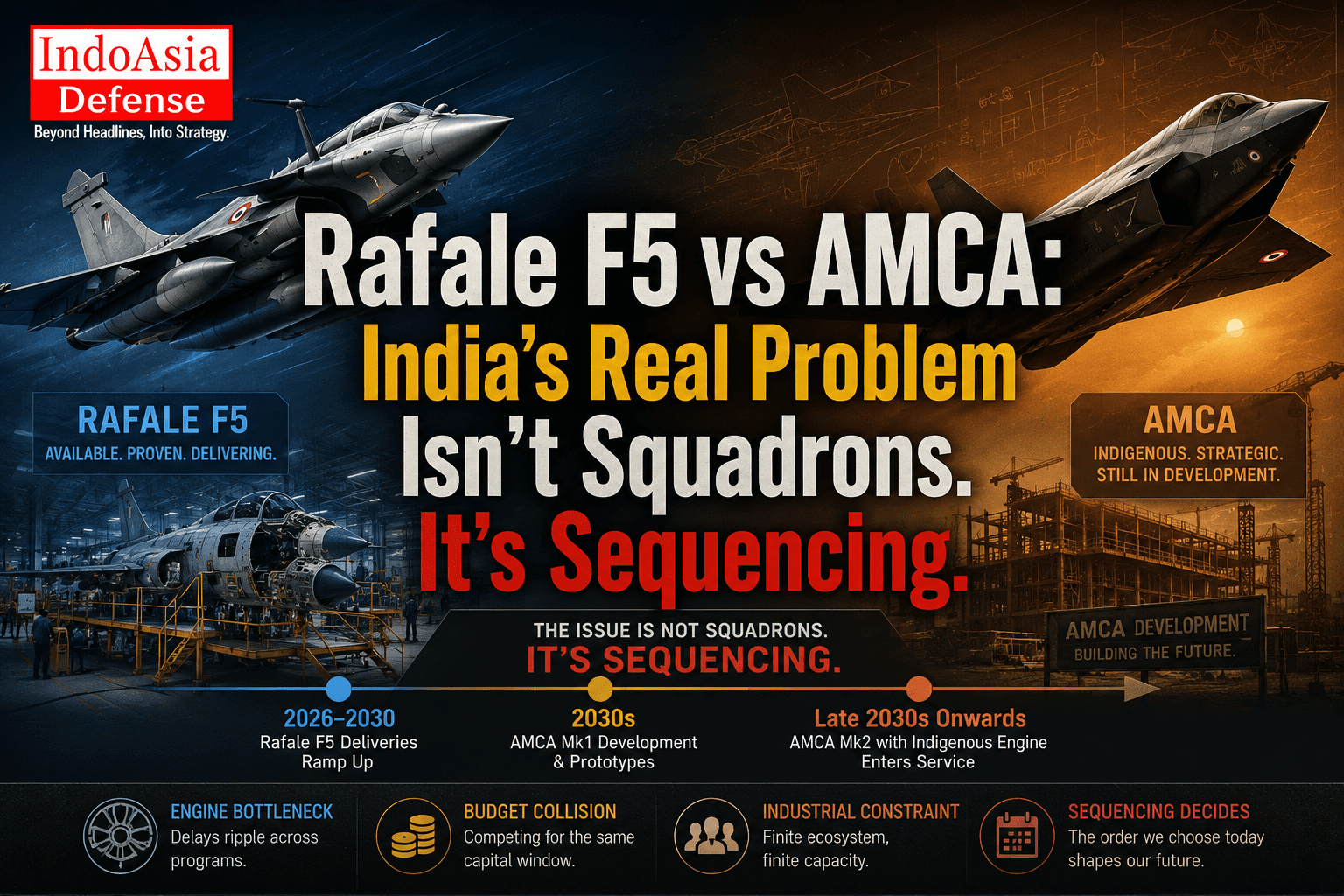
If India Buys the Rafale F5, the AMCA Doesn’t Die. It Gets Starved.
The debate has been framed as squadrons versus sovereignty. The real contest is over something scarcer than either: the narrow pool of engineers, suppliers, and capital that both programmes draw from at exactly the same moment.
On 12 February 2026, the Defence Acquisition Council cleared one of the largest fighter buys in Indian history: 114 aircraft under the long-stalled Multi-Role Fighter Aircraft programme.
The shape of it is roughly 90 Rafale in the F4 standard, with an option for some two dozen more in the future F5 configuration.
Fifteen days later, on 27 May, the Ministry of Defence issued the prototype Request for Proposal for the Advanced Medium Combat Aircraft to three private consortia.
For the first time in six decades, India’s home-grown fighter was being pushed out of Hindustan Aeronautics Limited’s exclusive grip.
Two procurement tracks. Three months apart.
Both real, both funded in principle, both chasing the same hole in the Indian Air Force’s order of battle.
Most of the coverage has read them as complementary, the import buying time while the home-grown jet grows up. It is a comfortable story and a mostly wrong one.
The question worth asking is not whether India needs the Rafale F5. It is whether the Indian aerospace base can take on a second high-end Rafale tranche without quietly gutting the programme it keeps calling its future.
The contrast in how the two programmes begin tells you most of what you need to know.
Build the Rafale in India and it plugs into something that already runs: an assembly line going up at Nagpur, an in-service fleet at Ambala and Hasimara, a maintenance cadre that has been turning wrenches on the type for years.
The AMCA starts from a field. The winning consortium has to build five flying prototypes and one structural test specimen at a brand-new 650-acre site at Puttaparthi in Andhra Pradesh, with a separate flight-test centre being raised alongside it for around ₹2,000 crore.
The three contenders, Tata Advanced Systems alone, an L&T-BEL-Dynamatic group, and a Bharat Forge-BEML-Data Patterns group, have two to three months to bid.
The contract is not expected to be awarded before early 2027. First flight could come as late as 2032. One programme bolts new capability onto a machine that is already running.
The other is pouring the foundations, literally, of the base it needs just to exist.
The Bottleneck Is the Engine, and It Always Has Been
Start with the bottleneck the whole debate keeps tiptoeing around. It is not stealth shaping. Not the coatings, not the flight-control software. It is the engine. And on engines, the Indian record speaks for itself.
Consider where the Tejas Mk1A sits right now. HAL has built, flown, and tested roughly 30 airframes. It has handed over almost none of them. The reason is the engine.
The GE F404-IN20 that powers the jet has not arrived on schedule, and the story behind that is almost absurd. GE shut the F404 line down around 2016 after finishing an earlier order of 65.
When India came back in 2021 wanting 99 more, the line had to be restarted from cold, mid-pandemic, and it has limped ever since. The March 2026 deadline for the next batch came and went with no engines.
HAL has been cannibalising a handful of Category-B test engines to fly the same airframes through trials, and has reportedly started fining GE for the delay.
Sit with that picture. Thirty modern fighters, basically finished, parked on the ground because the one part India cannot build at home did not turn up.
There is no China angle here. No LAC pressure, no Beijing chess move.
Just a single foreign supplier, a production line that was switched off and could not be switched back on cleanly, and an air force that cannot turn finished airframes into flying squadrons.
The IAF is down to about 30 fighter squadrons against a sanctioned 42, and the hole is opening faster than the factories can fill it.
The AMCA inherits this exact weakness, just at a higher thrust class. The Mk1 will fly on the GE F414, which is a known quantity and actually available.
But the programme’s whole strategic case rests on the Mk2 and its planned 120-kilonewton engine.
That one is to be built with France’s Safran under a roughly $7 billion deal, and India has held a hard line on the terms: full intellectual property, 100 percent transfer of technology, right down to the single-crystal turbine blades and hot-section processes that maybe five countries on earth have cracked.
On paper it is the most ambitious engine deal India has ever signed. In practice, the timeline reads ten to twelve years to an operational engine.
Call it the late 2030s, and that is the optimistic read, on a class of technology India has never once gotten right. The Kaveri spent three decades trying. It never powered a fighter into service.
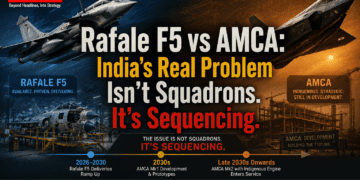
So the sequencing problem is baked in, not bad luck. Through the 2030s, the Rafale F5 will be showing up as finished, fightable hardware.
Over the very same years, the AMCA Mk2 will be a handful of prototypes flying on a borrowed American engine while its real powerplant is still on a test bench in Bengaluru. One programme is generating sorties.
The other is generating test data.
Air Forces Marry What Flies, Not What Is Promised
This is where the two programmes stop competing over money and start competing over something harder to win back. Institutional habit.
Air forces build doctrine around the aircraft they actually fly.
Pilots log the hours, maintainers build the muscle memory, planners write the tactics, and the whole basing and logistics apparatus quietly sets like concrete around the platform sitting on the ramp.
By the time the AMCA Mk2 is a real operational aircraft in the late 2030s, the F5, if it has come in at scale, will already be woven into IAF doctrine, training, and weapons.
So the choice in front of air staff at that point is not a clean one. It is between scaling a proven, familiar jet that is already flying, and ramping a latecomer whose engine has not yet survived a full service life.
Put that way, the decision almost makes itself.
History tells you which way it usually breaks. The Tejas lost its momentum through the big Su-30MKI induction years in the 2000s.
Not because the Tejas was a bad aircraft, but because the IAF already had a mature, hard-hitting import soaking up the attention and the budget. Imports come with hard obligations: payment schedules, delivery contracts, the political cost of a deal going sour.
The home-grown programme is the soft variable, the line you can push to next year because pushing it annoys no foreign government and trips no penalty clause.
There is a quieter trap underneath all this. The F5 deepens India’s dependence on the Safran ecosystem at the exact moment India is leaning on that same Safran to deliver the AMCA’s sovereign engine.
A Rafale tranche that gets the IAF comfortable with French propulsion, French sustainment, French upgrade cycles, takes the urgency right out of cracking the indigenous engine.
And the engine is the one thing that cannot survive being a part-time priority. It needs relentless focus and protected money, for a decade or more.
The moment it becomes the programme that gets attention only when there is attention to spare, it dies. That has been the story of every Indian engine effort so far.
Where the Money Collides
India’s defence capital budget gets discussed as one big number, which hides the thing that actually bites: timing. The Rafale F5 and the AMCA do not collide on total cost. They collide on when the bills land.
The squeeze sits roughly between 2028 and 2035. That is when Rafale payments peak, in euros, exposed to whatever the currency does.
It is also when the AMCA stops being a paper-and-prototype exercise and turns into the genuinely expensive part: production infrastructure, stealth tooling, a sustainment base built more or less from nothing.
The MRFA deal runs somewhere around $36 billion. The AMCA prototype phase alone is funded at about ₹15,000 crore, and series production is still a separate bill waiting down the line.
A stretched capital budget does not swallow both of these at once without something giving.
The asymmetry is what turns a tight budget into a dangerous one. Lay the two programmes side by side:
| Variable | Rafale F5 | AMCA Mk2 |
|---|---|---|
| Payment profile | Front-loaded, foreign-currency, contractually fixed | Long-tail, R&D-heavy, domestically funded |
| Obligation type | Hard, externally enforced, penalty-backed | Soft, internally adjustable, politically deferrable |
| Infrastructure demand | Moderate; leverages an existing Rafale base at Ambala and Hasimara | High; requires new stealth tooling and a clean-sheet sustainment ecosystem |
| Political visibility | High; a signed deal with a head-of-state photo opportunity | Moderate; milestones are technical and invisible to the public |
| Currency exposure | Euro-denominated, absorbs FX volatility directly | Rupee-funded, but loses budget share when FX costs rise |
You can see how this breaks before it breaks. When the rupee slides against the euro in a peak payment year, the Rafale bill still has to be paid, in full, on time, or there are penalties and an embarrassed government.
The thing that flexes instead is the indigenous programme nobody outside the building will miss if it slips a year. So the AMCA does not get cancelled.
It gets stretched. And in aerospace, where the fixed costs run whether you move fast or slow, stretching is not a free delay. It piles on cost, and it raises the odds that the jet is half a generation behind the day it finally enters service.
The Supplier Base Is Too Thin to Feed Both
Most takes treat the Rafale and the AMCA as two separate production lines running side by side. At the prime-contractor level, fine, they are.
Drop down to the supplier level and it falls apart, because India’s aerospace base simply is not deep enough to feed two high-end fighter ecosystems at once.
The pool of firms that can do stealth-relevant work is genuinely small. Radar-absorbent coatings, precision drilling for low-observable structures, composite layup held to fifth-generation tolerances: none of this is improvised.
It needs certified processes, trained people, and tooling that costs a fortune and takes years to stand up. The three shortlisted AMCA consortia, Tata Advanced Systems, the L&T-BEL group, the Bharat Forge group, are exactly the private firms with the money and the appetite to build that capability.
They are also exactly the firms a big Rafale “Make in India” tranche, with all its assembly and deep-MRO work, will be bidding for at the same time.
And here the damage gets done with nobody acting in bad faith.
Rafale work pays predictably, runs to an established standard, carries low technical risk.
AMCA work wants heavy money up front, endless prototyping, and a payoff a decade out, and it asks a firm to learn fifth-generation manufacturing on a bare site with no muscle memory to fall back on.
Any sane company puts its best engineers and its scarce certified capacity on the Rafale line first. Do that for a few years and the AMCA does not just slow down.
It ends up getting built by whatever talent the Rafale work did not want. That is not two programmes sharing a base. That is one programme eating the base the other one needed.
The same logic hits the one resource no budget line ever captures: attention. India’s aerospace establishment is already juggling Tejas Mk1A production, Tejas Mk2 development, the AMCA itself, and a growing pile of drone programmes.
All of them pull on the same thin bench of senior engineers and program managers. Drop a second Rafale tranche on top, with its own integration, training, and sustainment load, and you have not added a single engineer. You have just split the ones you had.
Aerospace programmes fail from scattered attention more often than from a shortage of cash or technology. So the real danger to the AMCA is not that it gets less money. It is that it gets less of the thing you cannot line-item: someone senior thinking hard about it, week after week, for a decade.
Co-Production Is Not Control, and the Difference Is Operational
The word doing the heaviest lifting in this whole debate is “autonomy.” A big Rafale tranche bolted together in Nagpur with local content gets sold as a step toward strategic autonomy.
It is not, at least not in the way that counts, because it quietly swaps design authority for assembly work and hopes nobody notices the difference.
The F5, however much of it gets built in India, leaves the heart of the aircraft exactly where it has always been. Flight-control laws, mission software, source code, the authority to integrate a weapon: all of it stays with Dassault and the French chain.
India gets jobs, assembly skill, a sustainment base. What it does not get is the right to bolt on its own missile without a sign-off, push a software update on its own schedule, or sell the jet to a partner without somebody in Paris able to say no.
The AMCA, for all its delays, is built to hand India exactly those rights.
This is not an abstract sovereignty point. It has a hard operational edge in the Indo-Pacific, where India wants to be the security provider to smaller states in the Indian Ocean and Southeast Asia.
An indigenous jet can be offered to a partner, fitted with an Indian missile, and patched mid-conflict on India’s own clock. A foreign-dependent fleet carries strings that go taut at the worst moment.
When you need a software fix in the middle of a crisis. When a weapon has to be integrated faster than the supplier feels like moving.
When the supply chain runs through a capital that has its own views on your war.
So the F5 trade is not really about technology. It swaps faster capability now for a dependency that only shows its teeth later. That can be a smart trade.
It is only smart if you make it on purpose, and if you protect the indigenous option instead of quietly letting it wither.
Two Futures, Separated Only by Sequencing Discipline
Project out to the late 2030s and two futures fork apart. What separates them is not whether the technology works. It is whether anyone holds the line on policy.
In the first, the F5 comes in open-ended, treated as a long-term fleet in its own right rather than a bridge with an expiry date. The IAF flies an advanced but import-dependent force into the 2040s.
The AMCA survives, but thinned out and pushed back, its sovereign engine forever a few years away, its suppliers the B-team because the A-team went to Rafale. Indigenous capability creeps forward and never quite arrives.
India ends the decade with an air force that can fight but cannot fully control its own upgrades, its own weapons, or what it is allowed to sell.
In the second, the F5 is capped, sequenced tight, and explicitly chained to AMCA milestones, with the indigenous programme’s money ring-fenced through that 2028-to-2035 crunch.
The import buys the time it was meant to buy and not a year more.
By the late 2030s India fields a real indigenous fifth-generation fighter, with an engine that is finally its own, built by a private base that cut its teeth on the AMCA instead of on Rafale assembly.
The distinction barely shows up in procurement language. A “bridge” and a “parallel programme” read almost the same in a press release. A decade on, they have built completely different countries.
And the honest read is that India’s defaults all lean the wrong way here.
The procurement culture, the services fighting over the same rupees, the political pull of a signed deal with a photo op over a milestone nobody can see.
Left alone, the system drifts toward the first future. The second one has to be engineered, deliberately, against the grain.
Which is the question the next ten years will actually answer, and it is not the one filling the headlines. F4 or F5, how many squadrons: that is a capability question, and capability was always the easy part.
The hard question is whether India can run a giant foreign buy and a sovereign fifth-generation programme at the same time without the first quietly drinking the oxygen the second needs to breathe.
India has never pulled that off. The Su-30 era smothered the Tejas without anyone deciding it should.
The worry is not that the Rafale F5 fails. It is that it works beautifully, and the AMCA never gets the room to find out whether it could have.

