


























The annual ritual of India’s defence budget is a closed loop. Headlines magnify the total. A few procurement announcements get recycled.
Comparisons with China surface and submerge. The conversation exhausts itself before the structural question is posed.
The question is not whether ₹6.81 lakh crore is large or small. It is whether the budget is funding the army India has, the army India needs, or some uneasy compromise between the two.
The honest answer is the third. And the cost of that compromise compounds every year.
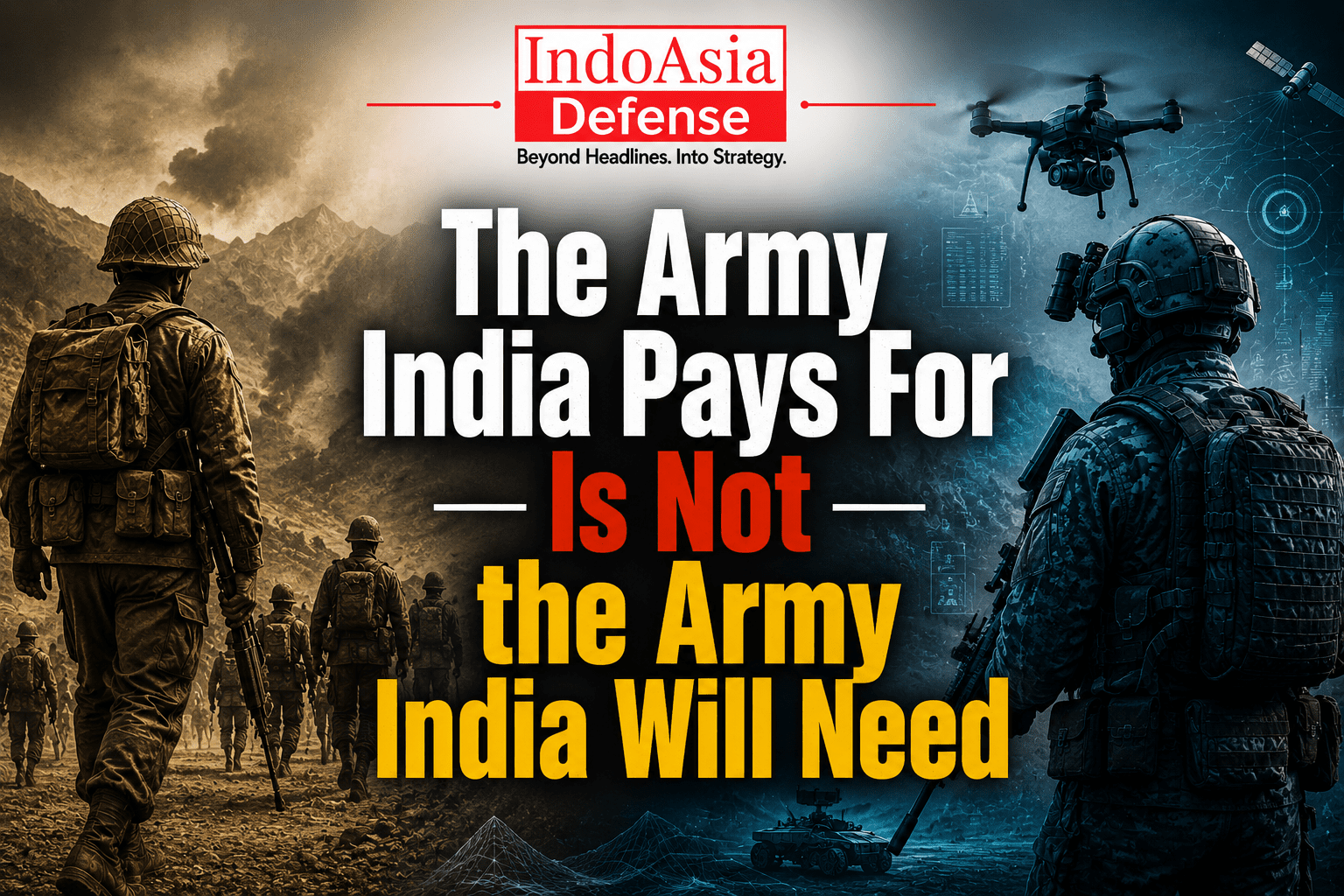
India is trying to finance two distinct military epochs from one fiscal envelope.
The first is a 1.3-million-strong, manpower-heavy, infantry-anchored standing army. Its institutional DNA traces to colonial pattern formations.
It was hardened through five wars between 1947 and 1999. Its operational logic remains continental attrition.
The second is the force the rest of the world is building. Sensor-saturated.
Software-defined. Drone-thickened. AI-augmented. Optimised for shorter kill chains and higher computational tempo.
The first force is sustained by men. The second is sustained by machines. The first needs pensions. The second needs R&D. The Indian military budget services both. Adequately to neither.
The pension bill is the symptom most often mistaken for the disease. Treating it as the central problem produces the wrong reforms.
The real problem is structural. It is the force model that makes the pension bill inevitable, and that the political system has shown no appetite to revisit.
The Arithmetic the Headline Number Hides
Of the ₹6.81 lakh crore defence outlay for 2025-26, roughly ₹1.60 lakh crore goes to pensions.
Approximately ₹2.80 lakh crore covers pay, fuel, rations, maintenance, and the rolling cost of keeping the force in the field. That leaves ₹1.80 lakh crore for capital expenditure.
The figure flatters. Committed liabilities, the staggered payments on Rafale, S-400, P-8I, Apache, Chinook, and the M777 sustainment chain, absorb an estimated 70 to 80 percent of capital outlay.
What remains for new acquisition sits closer to ₹40,000 to ₹50,000 crore. Roughly seven percent of the headline total. Less than what China is estimated to spend on defence R&D in a single year.
The figure is not the most damning part.
The composition is.
Of that residual capital, the overwhelming share funds incremental refresh of legacy categories.
Another tank. Another fighter. Another artillery system.
All configured for an order of battle whose assumptions belong to a previous era. This is replacement, not transformation.
The doctrinal pivot capital should enable, distributed sensors, autonomous platforms, long-range precision fires, integrated multi-domain command, is happening at the margins. Not at the centre.
The visible debate misses this because it operates one layer too high. The right question is not how much India spends. It is what kind of army that spending is structurally compelled to maintain.
Pension Is Structural, Not Welfare
Public debate routinely collapses the pension question into the welfare of the pensioner. This is both ethically lazy and analytically misleading.
Pensioners are not the problem. The state’s commitments to them are non-negotiable, and correctly so. The problem is the force model that makes a pension outlay of this magnitude an arithmetic certainty.
A force structure carrying 1.3 million active personnel and roughly 2.5 million pensioners will generate this fiscal profile. Regardless of which government holds office.
Regardless of which finance minister presents the budget. OROP revisions and pay commission cycles add layers. They do not create the underlying obligation.
That obligation traces to a doctrinal inheritance now seven decades old. A large standing army, capable of simultaneous defensive-offensive operations on two continental fronts, with internal security as a third arc.
This doctrine made sense in the conditions that produced it. The trauma of Partition. The failure of 1962. The inconclusive arithmetic of 1965. The operational triumph of 1971.
Those wars were wars of mass, ground hold, and attrition. ISR was limited. Command cycles ran in hours and days.
Those conditions have collapsed. Ukraine has functioned as the empirical laboratory for what happens when nineteenth-century mass meets twenty-first-century transparency.
Mechanised formations operate as targets in ISR-saturated environments. Concealment is exceptional. Movement is exposure.
A loitering munition under a hundred thousand dollars can disable platforms worth two orders of magnitude more.
In this environment, the 3.8-million uniformed footprint India sustains, active plus pensionable, does not generate the strategic weight it once did. It generates fiscal weight without commensurate operational return.
The pension bill is what that misalignment looks like on a balance sheet.
Agnipath as Fiscal Logic Dressed in Doctrinal Clothing
The Agnipath scheme has been litigated almost entirely on political and social terms. The doctrinal reading has been crowded out. That is unfortunate, because the doctrinal reading is the only one that explains the timing.
Agnipath is, first, a fiscal intervention. By limiting the pension-bearing pipeline to roughly 25 percent of recruits, it bends the long-term curve of pension liability downward.
The benefit accrues over twenty to thirty years. There is no near-term saving.
The state did not announce this in fiscal terms. Doing so would have made the underlying admission too explicit. The existing force model is no longer affordable on present trajectories.
The secondary effect is structural. A four-year rotational service model is, whether intended or not, the first move toward a different force composition. A smaller career professional core.
A larger short-service layer. Variants of this operate in Israel, Singapore, South Korea, and Switzerland, each under its own threat geometry.
The problem is not the move. It is the absence of the larger framework.
Force structure changes of this magnitude are coherent only when training pipelines, equipment philosophy, reserve organisation, and doctrine evolve in parallel.
None of that scaffolding has been built around Agnipath. The reform sits in isolation, carrying significant political cost while delivering uncertain strategic dividend.
A reform driven by fiscal compulsion rather than doctrinal vision tends to produce exactly this outcome. The renovation of one room in a house whose foundations have not been examined.
The Cost Inversion That Makes Mass Expensive
The economic logic of conventional war has inverted.
An armoured division, 250 main battle tanks, supporting elements, roughly 15,000 personnel, represents a sustained investment in the tens of thousands of crores across its life cycle.
A Shahed-136-class loitering munition costs an estimated 20,000 to 50,000 US dollars per unit.
A drone capable of disabling a forty-crore tank costs perhaps thirty lakh rupees. The exchange ratio sits near 1:130.
The arithmetic compounds at scale. A thousand-unit drone strike costs roughly ₹300 crore. The formation it can threaten is worth a hundred times that.
This is not hypothetical. It is what the Black Sea, the Red Sea, and Ukrainian skies have demonstrated on a weekly basis.
The Houthi campaign has added a second dimension. Sub-million-dollar drones and missiles have forced American destroyers to expend interceptors costing ten to twenty times more per engagement.
The kinetic exchange ratio favours the cheaper side.
The economic exchange ratio favours the cheaper side.
Magazine depth becomes the binding constraint, not platform sophistication.
For an Indian system that has historically optimised for platform sophistication over magazine depth, this is the most consequential shift in the operating environment in fifty years.
And it is barely registered in the budget debate.
The Indian drone ecosystem has expanded. iDEX. The Drone Federation. Adani, Tata, Solar, and a widening MSME base.
Annual tactical drone production remains an order of magnitude below Chinese throughput, and two orders below what the United States is targeting under Replicator.
Procurement alone does not solve drone-centric warfare. It requires a redesign of command relationships, training pipelines, magazine philosophy, and most consequentially, manpower distribution.
A drone squadron of fifty operators controlling five hundred unmanned systems is a fundamentally different organisational object than an artillery regiment of five hundred personnel operating eighteen guns.
The pension implications alone are non-trivial.
The mass force the budget is still funding is not the force the next war will reward.
Where the Real Race Is Running: Sea, Air, Space, Spectrum
The continental focus that dominates Indian strategic discussion obscures the domains where the competitive gap is widening fastest.
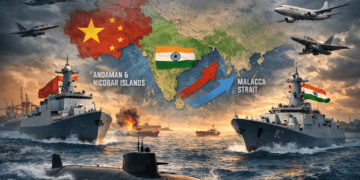
In the Indian Ocean, Chinese naval presence has shifted from episodic anti-piracy deployments in 2008 to a permanent operational pattern.
SSN and SSBN patrols south of the Strait are increasingly routine. Research vessels, almost certainly dual-use, operate near or within India’s EEZ with regularity.
The basing geometry has filled in. Djibouti as a confirmed PLA Support Base. Gwadar in Pakistan. Hambantota’s strategic ambiguity in Sri Lanka. Kyaukpyu in Myanmar.
This is the architecture of a sustainable blue-water posture. Not the optics of one.
The Indian counter-posture suffers compounding shortfalls. The conventional submarine fleet sits well below sanctioned strength. ASW capability has not scaled with the threat.
The third carrier decision has slipped through multiple budget cycles. Project-75I has moved slower than the operational requirement justifies. The SSN programme has political clearance but no clear funding glide path.
Each year of delay is not deferred cost. It is foreclosed capability on a fifteen-year horizon.
The undersea and surface domains are themselves being remade. Autonomous underwater vehicles. Unmanned surface vessels. Distributed maritime operations.
These are now central to American and Chinese naval doctrine. Indian investment in this layer is exploratory, not industrial.
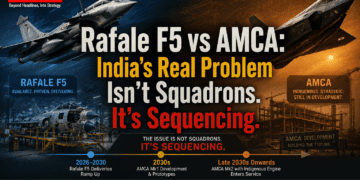
In the air, the most cited number is squadron strength: 31 against a sanctioned 42, with the trajectory still descending. MiG-21 phase-out is essentially complete.
MiG-29 and Mirage-2000 are in late-life sustainment. Jaguar retirement is on the horizon. The MRFA tender has aged through multiple government cycles. AMCA’s most optimistic induction timeline is 2035.
The number is the symptom. The deeper concern is the nature of the air force India will need in 2040, not the one it is struggling to maintain in 2025.
Loyal wingman concepts. AI-enabled air combat. Drone-swarm saturation. Hypersonic strike. Sixth-generation frameworks now visible in concept work.
China’s J-20 is operational at scale. Its sixth-generation work, including the recently surfaced J-36 and J-50 designs, is observable in open-source imagery. India’s AMCA, on the best timeline, arrives in the previous generation’s tail.
The space and electromagnetic domains have received less public attention. They are accordingly less honestly reckoned with.
Satellite-based ISR, navigation, communications, and missile warning are the connective tissue of modern combat. India has assets.
It does not yet have a dedicated, integrated military space architecture comparable to the PLA’s Aerospace Force, which now consolidates space, cyber, and electronic warfare under a single operational arm following the 2024 restructuring.
The Defence Space Agency, established in 2019, is still building. The Defence Cyber Agency is at a similar stage. Neither has reached the operational density that modern multi-domain operations demand.
The determinative inputs across sea, air, space, and spectrum are R&D, technological depth, and industrial scale. India’s defence R&D outlay is estimated at approximately 3 billion dollars annually.
Chinese defence R&D, by credible estimates, sits near 50 billion. The ratio is roughly fifteen-to-one, and widening. No amount of manpower on the LAC closes this gap. It is the wrong currency.
The PLA Lesson Most Indian Analysis Misreads
The PLA comparison usually stops at the topline numbers. 245 billion dollars against 81 billion. This framing is analytically insufficient. The instructive comparison is compositional.
Over the past decade, China reduced its active force from approximately 2.3 million to around 2 million.
The reduction was not cosmetic. It was paired with the consolidation of seven military regions into five theatre commands.
A deliberate compression of ground force share in total manpower. The creation of the PLA Rocket Force as a separate service with strategic mission ownership.
The establishment of the Strategic Support Force, since reorganised into the Aerospace Force, Cyberspace Force, and Information Support Force in 2024.
The redistribution was the point. Fewer soldiers, denser systems. Less infantry, more missiles. Manpower freed by force structure reform was redirected into the layers where future combat is being defined.
This was paired with a sustained R&D commitment, an explicit Military-Civil Fusion framework after 2015, and a defence-industrial integration model that connects state laboratories, universities, and enterprise into a single innovation pipeline.
India’s trajectory has run the opposite way. The force has not shrunk. The pensionable base has expanded.
The R&D share of GDP has remained essentially flat for a decade. Theaterisation, formally underway, is institutionally incomplete and operationally contested.
This is not the product of conscious strategic choice. It is the product of institutional inertia colliding with political risk-aversion.
Multiple committees, Subrahmanyam, Naresh Chandra, Shekatkar, have generated detailed reform blueprints across governments of different political colour.
The implementation record is partial at best. The deeper structural reforms generate friction with service interests, recruitment-dependent regional politics, and the institutional positions of defence PSUs.
The political return on a defence reform whose payoff sits twenty years out is negative within a five-year electoral cycle.
China has been able to absorb the political cost of structural reform because its political system permits top-down restructuring without the friction Indian reform processes encounter.
India’s democratic structure makes such reforms harder, not impossible. The 1991 economic reforms and the 2017 GST are demonstrations that the system can move when leadership accepts the cost.
No comparable political moment has arrived for defence.
The LAC and a Permanent Revenue Drag
The post-2020 deployment posture along the Line of Actual Control has created a structural addition to revenue expenditure. Credible estimates place the additional annual cost at ₹25,000 to ₹35,000 crore.
These are funds that would otherwise have been available for modernisation, now absorbed by the sustainment of forward presence.
The granular economics are worth stating because they are easily abstracted away.
Sustaining an armoured regiment through a Ladakh winter requires moving over 300 tonnes of fuel per week up the supply chain. Cold-weather fuel consumption for a main battle tank runs 30 to 40 percent above baseline.
The annual cost of sustaining a single soldier at 17,000 feet is four to six times the equivalent cost in the plains. A C-17 sortie into Eastern Ladakh is reckoned in crores of operating cost.
This is the geometry of an undeclared form of strategic competition. China, by establishing a forward posture in 2020 that India was compelled to match, imposed a permanent fiscal drag on Indian modernisation.
Beijing’s military force deployment costs are absorbed within a substantially larger and more vertically integrated civilian-military infrastructure.
For India, the same posture is structurally more expensive. And the cost continues for as long as the deployment continues.
There has been disengagement at certain friction points. There has not been, and likely will not be in the foreseeable future, a return to the pre-2020 baseline.
Both sides have institutionalised forward presence as the new normal. The fiscal consequence of that normalisation is now a permanent feature of the Indian defence budget, and a structural compression of modernisation space.
The Internal Inefficiency Most Analysis Avoids
The pension and revenue conversation focuses on the size of the envelope. The internal allocation of that envelope is no less consequential, and significantly less examined.
Headquarters bloat is a recognised but rarely confronted feature of Indian military structure. Senior officer density. Command-level redundancy.
Inter-service duplication. The deployment of uniformed manpower in administrative and ceremonial roles. Together these constitute a non-trivial structural inefficiency.
The Shekatkar Committee in 2016 identified nearly a hundred specific recommendations, many concerning manpower and structure. Partial implementation has occurred. Comprehensive implementation has not.
A meaningful share of logistics, base operations, ordnance management, transport, repair, and medical functions remains performed by uniformed personnel where civilianisation or contracted provision would be operationally adequate and fiscally lighter. This is not a downsizing argument.
It is a role-substitution argument. The political and institutional resistance comes not from operational necessity but from the prerogatives of uniformed organisations defending the scope of their authority.
The CDS architecture, established in 2019, was intended to drive precisely this kind of cross-service rationalisation.
Theaterisation, the most visible expression of that intent, has advanced through 2024-25 but remains institutionally incomplete.
Each of the three services has shaped the design discussions around its own structural interests. Each restructuring decision has had to navigate that contestation.
The CDS office requires sustained, top-level political backing to overcome service-level resistance. That backing has been intermittent rather than continuous.
This is also a civil-military relations question. India’s strong civilian control has historically operated through fiscal authority and policy direction rather than through direct intervention in service structure.
That norm is generally healthy. The cost is slower structural reform, and the persistence of arrangements that have outlived their operational rationale.
The R&D Trap Beneath Everything Else
Atmanirbhar Bharat in defence is an incomplete argument as currently structured. The incompleteness traces directly to underinvestment in R&D.
The chain is mechanical. Low R&D outlay produces limited indigenous technology depth. Limited technology depth produces continued dependence on foreign acquisition.
Continued foreign acquisition consumes capital budget. Capital budget consumption leaves no room for expanded R&D investment. The trap is self-reinforcing.
Breaking it requires moving defence R&D from approximately 0.1 percent of GDP, broadly where it has sat for years, to at least 0.4 percent, a level consistent with what serious defence-industrial states sustain.
That is a three-to-four-fold increase, sustained across multiple budget cycles. Fiscally difficult. Politically possible only if the commitment outlasts any single government’s tenure.
A twenty-year defence R&D plan, consistently funded across political transitions, is what the moment requires. The current political horizon does not produce such instruments easily.
China’s trajectory since the late 1980s has been the opposite.
A consistent strategic R&D vision, embedded into successive Five-Year Plans, formalised after 2015 as Military-Civil Fusion but operative long before.
The connective tissue between state laboratories, universities, and enterprise exists because it was built deliberately over four decades.
India’s equivalent, iDEX, the Strategic Partnership Model, the Defence Industrial Corridors, represents direction without scale.
Without the R&D base to sustain it, indigenous defence production tends toward assembly. Assembly is a mid-tier defence-industrial outcome. It does not deliver strategic autonomy in the categories that matter.
The Partner Question India Is Quietly Inheriting
There is a final dimension that rarely enters the budget conversation. Indian capability assumptions increasingly rest on the assumption of partner enabling.
American ISR. French and Russian platforms with their respective supply chains. Israeli systems for specific niches. The QUAD’s still-emerging architecture of maritime domain awareness.
This is sensible. No medium power builds the full stack independently. But the assumption carries embedded risk that the budget does not price.
Russia’s defence-industrial capacity is now absorbed by its own war.
Spare parts, follow-on orders, and upgrade pathways for the substantial Russian-origin inventory in Indian service, Su-30, T-90, Kilo-class submarines, S-400, are slower and less reliable than they were five years ago.
American partner reliability is increasingly tied to alignment expectations that India has historically resisted.
The QUAD has not yet produced the deep interoperability architecture that would allow Indian planners to assume partner ISR or logistics in a contingency.
The capability portfolio India has built rests on partnerships that were stable when those partnerships were entered. They are less stable now. The budget treats imported capability as a fixed input. It is not.
It is a contingent input, and the contingency is moving in directions that planners have not fully absorbed.
The Political Silence and Its Predictable Logic
The structural diagnosis is not, at this point, hidden. It is openly discussed across the Indian strategic community. The political response has been minimal.
The reason is not analytical confusion. It is the asymmetry between the political cost of reform and its political payoff.
A defence transformation whose operational benefits arrive in fifteen to twenty years offers no electoral return within a five-year cycle. The reform itself generates immediate political cost.
Uniformed services protecting institutional terrain. Regional electoral bases tied to recruitment patterns.
Defence PSU constituencies. Pensioner blocs whose interests must be protected even as the larger system is reconfigured.
The political incentive structure rewards incrementalism and announcement-driven policy over deep structural change.
This pattern is not new. Reform momentum has surfaced briefly after 1962, after 1971, after Kargil, and again after Galwan in 2020.
In each instance, the early energy diffused into partial measures. Theaterisation, Agnipath, the Atmanirbhar push, and the modest increases in capital outlay represent the post-Galwan iteration of this cycle.
They are not insignificant. They are not, individually or collectively, the structural transformation the moment requires.
The fault is not specific to any government. It is a feature of the political economy of Indian defence policymaking.
A system in which the costs of reform are concentrated and immediate, while the benefits are diffuse and deferred.
The Question the Next Decade Will Settle
The conventional debate stays trapped at the wrong level. How much is India spending, and is it enough.
The harder question is what that spending is structurally compelled to fund, and whether the answer is compatible with the operational environment of the 2040s.
The available evidence suggests India is largely funding the maintenance of a 1995-vintage force structure into the 2025 fiscal year.
Marginal upgrades. Incremental acquisitions. Infrastructure improvements. The core force model has not changed.
The combat environment of the 2040s, on present trajectories, will be defined by sensor-network warfare conducted at computational-industrial scale. AI-augmented decision cycles.
Autonomous system saturation. Space-based command and ISR. Electromagnetic dominance contested in microseconds rather than minutes.
In that environment, the strategic weight of 1.3 million uniformed personnel is materially lower than current Indian strategic thinking assumes. Their role remains necessary. It does not remain decisive.
The lesson of 1962 was that a large army is not, by virtue of size, a prepared army.
That lesson applied then to doctrine, intelligence, and political-military communication. It applies now to technology, force structure, and the speed of institutional adaptation.
India is not building the army it will need. It is sustaining the army it has, into a future that will not reward it. The political system is aware of this. It has chosen, consistently and across multiple governments, not to confront it.
The window for confrontation is not permanent. By the time the consequences of inaction become electorally visible, the lead times for correction, fifteen years for an SSN, twelve for a fifth-generation fighter, twenty for a coherent R&D-industrial base, will have foreclosed the easier options.
What is unaffordable to fix in 2025 will be unaffordable to recover in 2040.
The next decade will not settle the question of whether India can fund both armies. It will settle which one it ends up with.

