

















IndoAsia Defense
  • Home
  • Air
    • All
    • Air Defence
    • Drones
    • Fighters
    • ISR & Mobility
    Ghatak UCAV stealth, autonomy, integration

    Inside India’s Ghatak UCAV Program: Stealth, Autonomy, and the Integration Gap

    The F414 engine co-production agreement between Hindustan Aeronautics Limited and GE Aerospace

    India-US F414 Engine Deal Explained: Technology Transfer, Tejas Mk2, and AMCA

    What is the Su-57M1 India deal

    Su-57M1 for India: A Fifth-Generation Shortcut or a Strategic Dependency Trap?

    India indigenous long range surveillance radar with X-band drone detection capability

    450km Eyes, Machine-Speed Decisions: How India’s Indigenous Long Range Surveillance Radar Is Rewriting Air Defence

    Why Software Defined Radios Are the IAF’s Most Consequential Upgrade

    IAF Signs BEL Deal for Software Defined Radios: Rewiring India’s Air Combat Network

    How the Ghatak UCAV Stealth Design Redefines India’s Drone Warfare Doctrine

    Ghatak UCAV: India’s Carbon Composite Stealth Strategy Dissected

    Ballistic Missile Defense system intercepting incoming missile during midcourse phase

    How Ballistic Missile Defense Works: Inside Modern Missile Interception Systems

    Swarm logistics drones delivering military supplies in high-altitude Himalayan terrain with Indian Army presence

    Swarm Logistics Drones in Himalayan Warfare: Can India Close the Supply Gap with China?

    India’s 6th-Gen Fighter Strategy FCAS vs GCAP Explained

    India’s 6th-Gen Fighter Strategy: FCAS vs GCAP Explained

  • Land
    • All
    • Armour & Artillery
    • China Front
    • Future Combat
    • Pakistan Front
    The Indo-Pacific Is Fragmenting, Not Uniting Against China

    Why the Indo-Pacific Will Not Unite Against China

    The India-South Korea defence deal

    The India-South Korea Defence Deal Through China’s Operational Lens

    Railways as War Arteries Can India Match China’s Military Mobility Before the Next Crisis

    Railways as War Arteries: Can India Match China’s Military Mobility Before the Next Crisis?

    China maritime front in Indian Ocean

    What If China Opens a Maritime Front in the Indian Ocean During a LAC Conflict?

    What is Indian military modernization strategy in 2026?

    Indian Military Modernization: Systems, Doctrine, and Capability Architecture (2026-27)

    Tank launching loitering munition in battle

    From Smoke to Strike: India’s Indigenous Loitering Munitions for T-72, T-90, and Arjun Tanks

    How China Mobilizes Forces Along the LAC Speed, Systems, and Strategic Control

    How China Mobilizes Forces Along the LAC: Systems, Speed, and Strategic Signaling

    Ballistic Missile Defense system intercepting incoming missile during midcourse phase

    How Ballistic Missile Defense Works: Inside Modern Missile Interception Systems

    Swarm logistics drones delivering military supplies in high-altitude Himalayan terrain with Indian Army presence

    Swarm Logistics Drones in Himalayan Warfare: Can India Close the Supply Gap with China?

  • Navy
    • All
    • Fleet Expansion
    • Indian Ocean
    • Maritime Security
    • Submarines
    Mogami-class frigate deal overview

    Japan’s Mogami-Class Frigate Offer to India: What the Transfer Terms Reveal About Tokyo’s Indo-Pacific Calculus

    China maritime front in Indian Ocean

    What If China Opens a Maritime Front in the Indian Ocean During a LAC Conflict?

    The Strait of Hormuz Crisis

    India’s Oil Artery Under Threat: Strategic Implications of a Hormuz Crisis

    India’s VL-Shtil Missile Deal with Russia

    India’s VL-Shtil Missile Deal with Russia: Strengthening Naval Air Defense in the Indo-Pacific

    Andaman & Nicobar Command Sleeping Giant of India’s Maritime Strategy

    Andaman & Nicobar Command: Sleeping Giant of India’s Maritime Strategy

    Maritime Surveillance 2.0: Why EO/IR Modernisation Matters for India’s Ocean Security

    Maritime Surveillance 2.0: Why EO/IR Modernisation Matters for India’s Ocean Security

    2030 Will Decide the India ASEAN Maritime Equation

    2030 Will Decide the India ASEAN Maritime Equation

    India Military Transformation Series — Part 3: Maritime Power and the Indian Ocean Imperative

    India Military Transformation Series — Part 3: Maritime Power and the Indian Ocean Imperative

    Indian Navy TEDBF PPP Model: China Factor and 2030–2040 Carrier Strategy

    Indian Navy TEDBF PPP Model: China Factor and 2030–2040 Carrier Strategy

  • Indo-Pacific
    • All
    • 2035 Outlook
    • China Strategy
    • India Strategy
    • Pakistan Outlook
    DRDO-developed Guided Pinaka

    At ₹70 Lakh Per Rocket, DRDO-developed Guided Pinaka May Represent India’s Shift Toward Scalable Precision Warfare

    The Indo-Pacific Is Fragmenting, Not Uniting Against China

    Why the Indo-Pacific Will Not Unite Against China

    Mogami-class frigate deal overview

    Japan’s Mogami-Class Frigate Offer to India: What the Transfer Terms Reveal About Tokyo’s Indo-Pacific Calculus

    The India-South Korea defence deal

    The India-South Korea Defence Deal Through China’s Operational Lens

    Railways as War Arteries Can India Match China’s Military Mobility Before the Next Crisis

    Railways as War Arteries: Can India Match China’s Military Mobility Before the Next Crisis?

    india military integration gap

    Is India Building Military Power Faster Than It Can Integrate It?

    China maritime front in Indian Ocean

    What If China Opens a Maritime Front in the Indian Ocean During a LAC Conflict?

    Can India Fight Beyond 30 Days? Inside India’s War Sustainment Reality

    Can India Fight Beyond 30 Days? Inside India’s War Sustainment Reality

    What is Indian military modernization strategy in 2026?

    Indian Military Modernization: Systems, Doctrine, and Capability Architecture (2026-27)

  • Joint
    • All
    • Integrated Ops
    • Procurement Reform
    • Theater Commands
    India's strategic challenge sustainability first

    India Can Strike in 22 Minutes. Can It Sustain for 22 Weeks?

    Ballistic Missile Defense system intercepting incoming missile during midcourse phase

    How Ballistic Missile Defense Works: Inside Modern Missile Interception Systems

    India defence proposals Rs 2.38 trillion showing S-400 system, strike drones, fighter jets and military architecture shift

    India Defence Proposals Rs 2.38 Trillion: Why This Approval Changes How India Will Fight, Not Just What It Buys

    DAP 2026 India’s Quiet Revolution in Defence Procurement

    DAP 2026: India’s Quiet Revolution in Defence Procurement

    Integrated Battle Groups vs China’s Western Theater Command

    Integrated Battle Groups vs China’s Western Theater Command: Can Doctrine Survive the Himalayan Reality?

    Andaman & Nicobar Command Sleeping Giant of India’s Maritime Strategy

    Andaman & Nicobar Command: Sleeping Giant of India’s Maritime Strategy

    India Military Transformation Series — Part 2: The Theatre Command Reckoning

    India Military Transformation Series — Part 2: The Theatre Command Reckoning

    India AI C4ISR modernization

    India Military Transformation Series — Part 1: India AI C4ISR Modernization

    India’s Two-Front Theatre Command: Preparing for Simultaneous Conflict

    India’s Two-Front Theatre Command: Preparing for Simultaneous Conflict

  • Tech
    • All
    • AI & Autonomous Systems
    • Cyber
    • Electronic Warfare
    • Space
    Why Software Defined Radios Are the IAF’s Most Consequential Upgrade

    IAF Signs BEL Deal for Software Defined Radios: Rewiring India’s Air Combat Network

    Source Code or ICD India’s Source Code Negotiation Explained

    Source Code or ICD: India’s Source Code Negotiation Explained

    Supply Chain Weaponization

    Supply Chain Weaponization: Strategic Autonomy Meets Semiconductor Reality

    AI-driven battlefield in India's military

    The Algorithm of Borders: What India’s Military AI Push Actually Looks Like on the Ground

    India AI C4ISR modernization

    India Military Transformation Series — Part 1: India AI C4ISR Modernization

    PRAHAR Explained India Counter Terror Policy Prahaar

    PRAHAAR Explained: Why ‘PRAHAAR’ India’s National Counter-terrorism Doctrine, Signals the End of Traditional Warfare

    The Weapons Making the AMCA Unbeatable

    The Weapons Making the AMCA Unbeatable

    India’s Aerospace Ecosystem After Rafale: The 2026–2030 Industrial Test

    India’s Aerospace Ecosystem After Rafale: The 2026–2030 Industrial Test

    PLA’s Cyber Warfare Units and the Question of Indian Critical Infrastructure Resilience

    PLA’s Cyber Warfare Units and the Question of Indian Critical Infrastructure Resilience

  • Industry
    • All
    • Budget
    • Exports
    • Make in India
    • Supply Chains
    India’s Defence MSME Blind Spot Could Become a Wartime Liability

    India’s Defence MSME Blind Spot Could Become a Wartime Liability

    India's strategic challenge sustainability first

    India Can Strike in 22 Minutes. Can It Sustain for 22 Weeks?

    India-UAE defence pact and Gulf strategy

    India-UAE Defence Pact: Why Abu Dhabi Is Becoming India’s Western Strategic Depth

    Ghatak UCAV stealth, autonomy, integration

    Inside India’s Ghatak UCAV Program: Stealth, Autonomy, and the Integration Gap

    The India-South Korea defence deal

    The India-South Korea Defence Deal Through China’s Operational Lens

    The F414 engine co-production agreement between Hindustan Aeronautics Limited and GE Aerospace

    India-US F414 Engine Deal Explained: Technology Transfer, Tejas Mk2, and AMCA

    Why Software Defined Radios Are the IAF’s Most Consequential Upgrade

    IAF Signs BEL Deal for Software Defined Radios: Rewiring India’s Air Combat Network

    How the Ghatak UCAV Stealth Design Redefines India’s Drone Warfare Doctrine

    Ghatak UCAV: India’s Carbon Composite Stealth Strategy Dissected

    Swarm logistics drones delivering military supplies in high-altitude Himalayan terrain with Indian Army presence

    Swarm Logistics Drones in Himalayan Warfare: Can India Close the Supply Gap with China?

  • Global
    • All
    • China-Pak
    • Emerging Tech
    • Middle Eeast
    • Regional Trends
    • US-India
    • US-Israel
    India-UAE defence pact and Gulf strategy

    India-UAE Defence Pact: Why Abu Dhabi Is Becoming India’s Western Strategic Depth

    The Indo-Pacific Is Fragmenting, Not Uniting Against China

    Why the Indo-Pacific Will Not Unite Against China

    Ghatak UCAV stealth, autonomy, integration

    Inside India’s Ghatak UCAV Program: Stealth, Autonomy, and the Integration Gap

    The F414 engine co-production agreement between Hindustan Aeronautics Limited and GE Aerospace

    India-US F414 Engine Deal Explained: Technology Transfer, Tejas Mk2, and AMCA

    india military integration gap

    Is India Building Military Power Faster Than It Can Integrate It?

    India indigenous long range surveillance radar with X-band drone detection capability

    450km Eyes, Machine-Speed Decisions: How India’s Indigenous Long Range Surveillance Radar Is Rewriting Air Defence

    What is Indian military modernization strategy in 2026?

    Indian Military Modernization: Systems, Doctrine, and Capability Architecture (2026-27)

    India defence proposals Rs 2.38 trillion showing S-400 system, strike drones, fighter jets and military architecture shift

    India Defence Proposals Rs 2.38 Trillion: Why This Approval Changes How India Will Fight, Not Just What It Buys

    India’s 6th-Gen Fighter Strategy FCAS vs GCAP Explained

    India’s 6th-Gen Fighter Strategy: FCAS vs GCAP Explained

  • Resources
    • India Military Capability Index
    • India vs China Military Balance
    • China Western Theater Command Guide
    • Pakistan Military Tracker 2026-27
    • India’s Military Doctrine Library
    • India vs China vs Pakistan Missile Arsenal Comparison
    • India’s Missile List
    • India Missile Range Map
    • Indo-Pacific Military Power Map
    • Indo-Pacific Defense Timeline
    • Global Military Balance Dashboard
    • Global Weapons Systems Database
    • Global Missile Systems Database
  • What If
    • China India Naval Conflict
No Result
View All Result
  • Home
  • Air
    • All
    • Air Defence
    • Drones
    • Fighters
    • ISR & Mobility
    Ghatak UCAV stealth, autonomy, integration

    Inside India’s Ghatak UCAV Program: Stealth, Autonomy, and the Integration Gap

    The F414 engine co-production agreement between Hindustan Aeronautics Limited and GE Aerospace

    India-US F414 Engine Deal Explained: Technology Transfer, Tejas Mk2, and AMCA

    What is the Su-57M1 India deal

    Su-57M1 for India: A Fifth-Generation Shortcut or a Strategic Dependency Trap?

    India indigenous long range surveillance radar with X-band drone detection capability

    450km Eyes, Machine-Speed Decisions: How India’s Indigenous Long Range Surveillance Radar Is Rewriting Air Defence

    Why Software Defined Radios Are the IAF’s Most Consequential Upgrade

    IAF Signs BEL Deal for Software Defined Radios: Rewiring India’s Air Combat Network

    How the Ghatak UCAV Stealth Design Redefines India’s Drone Warfare Doctrine

    Ghatak UCAV: India’s Carbon Composite Stealth Strategy Dissected

    Ballistic Missile Defense system intercepting incoming missile during midcourse phase

    How Ballistic Missile Defense Works: Inside Modern Missile Interception Systems

    Swarm logistics drones delivering military supplies in high-altitude Himalayan terrain with Indian Army presence

    Swarm Logistics Drones in Himalayan Warfare: Can India Close the Supply Gap with China?

    India’s 6th-Gen Fighter Strategy FCAS vs GCAP Explained

    India’s 6th-Gen Fighter Strategy: FCAS vs GCAP Explained

  • Land
    • All
    • Armour & Artillery
    • China Front
    • Future Combat
    • Pakistan Front
    The Indo-Pacific Is Fragmenting, Not Uniting Against China

    Why the Indo-Pacific Will Not Unite Against China

    The India-South Korea defence deal

    The India-South Korea Defence Deal Through China’s Operational Lens

    Railways as War Arteries Can India Match China’s Military Mobility Before the Next Crisis

    Railways as War Arteries: Can India Match China’s Military Mobility Before the Next Crisis?

    China maritime front in Indian Ocean

    What If China Opens a Maritime Front in the Indian Ocean During a LAC Conflict?

    What is Indian military modernization strategy in 2026?

    Indian Military Modernization: Systems, Doctrine, and Capability Architecture (2026-27)

    Tank launching loitering munition in battle

    From Smoke to Strike: India’s Indigenous Loitering Munitions for T-72, T-90, and Arjun Tanks

    How China Mobilizes Forces Along the LAC Speed, Systems, and Strategic Control

    How China Mobilizes Forces Along the LAC: Systems, Speed, and Strategic Signaling

    Ballistic Missile Defense system intercepting incoming missile during midcourse phase

    How Ballistic Missile Defense Works: Inside Modern Missile Interception Systems

    Swarm logistics drones delivering military supplies in high-altitude Himalayan terrain with Indian Army presence

    Swarm Logistics Drones in Himalayan Warfare: Can India Close the Supply Gap with China?

  • Navy
    • All
    • Fleet Expansion
    • Indian Ocean
    • Maritime Security
    • Submarines
    Mogami-class frigate deal overview

    Japan’s Mogami-Class Frigate Offer to India: What the Transfer Terms Reveal About Tokyo’s Indo-Pacific Calculus

    China maritime front in Indian Ocean

    What If China Opens a Maritime Front in the Indian Ocean During a LAC Conflict?

    The Strait of Hormuz Crisis

    India’s Oil Artery Under Threat: Strategic Implications of a Hormuz Crisis

    India’s VL-Shtil Missile Deal with Russia

    India’s VL-Shtil Missile Deal with Russia: Strengthening Naval Air Defense in the Indo-Pacific

    Andaman & Nicobar Command Sleeping Giant of India’s Maritime Strategy

    Andaman & Nicobar Command: Sleeping Giant of India’s Maritime Strategy

    Maritime Surveillance 2.0: Why EO/IR Modernisation Matters for India’s Ocean Security

    Maritime Surveillance 2.0: Why EO/IR Modernisation Matters for India’s Ocean Security

    2030 Will Decide the India ASEAN Maritime Equation

    2030 Will Decide the India ASEAN Maritime Equation

    India Military Transformation Series — Part 3: Maritime Power and the Indian Ocean Imperative

    India Military Transformation Series — Part 3: Maritime Power and the Indian Ocean Imperative

    Indian Navy TEDBF PPP Model: China Factor and 2030–2040 Carrier Strategy

    Indian Navy TEDBF PPP Model: China Factor and 2030–2040 Carrier Strategy

  • Indo-Pacific
    • All
    • 2035 Outlook
    • China Strategy
    • India Strategy
    • Pakistan Outlook
    DRDO-developed Guided Pinaka

    At ₹70 Lakh Per Rocket, DRDO-developed Guided Pinaka May Represent India’s Shift Toward Scalable Precision Warfare

    The Indo-Pacific Is Fragmenting, Not Uniting Against China

    Why the Indo-Pacific Will Not Unite Against China

    Mogami-class frigate deal overview

    Japan’s Mogami-Class Frigate Offer to India: What the Transfer Terms Reveal About Tokyo’s Indo-Pacific Calculus

    The India-South Korea defence deal

    The India-South Korea Defence Deal Through China’s Operational Lens

    Railways as War Arteries Can India Match China’s Military Mobility Before the Next Crisis

    Railways as War Arteries: Can India Match China’s Military Mobility Before the Next Crisis?

    india military integration gap

    Is India Building Military Power Faster Than It Can Integrate It?

    China maritime front in Indian Ocean

    What If China Opens a Maritime Front in the Indian Ocean During a LAC Conflict?

    Can India Fight Beyond 30 Days? Inside India’s War Sustainment Reality

    Can India Fight Beyond 30 Days? Inside India’s War Sustainment Reality

    What is Indian military modernization strategy in 2026?

    Indian Military Modernization: Systems, Doctrine, and Capability Architecture (2026-27)

  • Joint
    • All
    • Integrated Ops
    • Procurement Reform
    • Theater Commands
    India's strategic challenge sustainability first

    India Can Strike in 22 Minutes. Can It Sustain for 22 Weeks?

    Ballistic Missile Defense system intercepting incoming missile during midcourse phase

    How Ballistic Missile Defense Works: Inside Modern Missile Interception Systems

    India defence proposals Rs 2.38 trillion showing S-400 system, strike drones, fighter jets and military architecture shift

    India Defence Proposals Rs 2.38 Trillion: Why This Approval Changes How India Will Fight, Not Just What It Buys

    DAP 2026 India’s Quiet Revolution in Defence Procurement

    DAP 2026: India’s Quiet Revolution in Defence Procurement

    Integrated Battle Groups vs China’s Western Theater Command

    Integrated Battle Groups vs China’s Western Theater Command: Can Doctrine Survive the Himalayan Reality?

    Andaman & Nicobar Command Sleeping Giant of India’s Maritime Strategy

    Andaman & Nicobar Command: Sleeping Giant of India’s Maritime Strategy

    India Military Transformation Series — Part 2: The Theatre Command Reckoning

    India Military Transformation Series — Part 2: The Theatre Command Reckoning

    India AI C4ISR modernization

    India Military Transformation Series — Part 1: India AI C4ISR Modernization

    India’s Two-Front Theatre Command: Preparing for Simultaneous Conflict

    India’s Two-Front Theatre Command: Preparing for Simultaneous Conflict

  • Tech
    • All
    • AI & Autonomous Systems
    • Cyber
    • Electronic Warfare
    • Space
    Why Software Defined Radios Are the IAF’s Most Consequential Upgrade

    IAF Signs BEL Deal for Software Defined Radios: Rewiring India’s Air Combat Network

    Source Code or ICD India’s Source Code Negotiation Explained

    Source Code or ICD: India’s Source Code Negotiation Explained

    Supply Chain Weaponization

    Supply Chain Weaponization: Strategic Autonomy Meets Semiconductor Reality

    AI-driven battlefield in India's military

    The Algorithm of Borders: What India’s Military AI Push Actually Looks Like on the Ground

    India AI C4ISR modernization

    India Military Transformation Series — Part 1: India AI C4ISR Modernization

    PRAHAR Explained India Counter Terror Policy Prahaar

    PRAHAAR Explained: Why ‘PRAHAAR’ India’s National Counter-terrorism Doctrine, Signals the End of Traditional Warfare

    The Weapons Making the AMCA Unbeatable

    The Weapons Making the AMCA Unbeatable

    India’s Aerospace Ecosystem After Rafale: The 2026–2030 Industrial Test

    India’s Aerospace Ecosystem After Rafale: The 2026–2030 Industrial Test

    PLA’s Cyber Warfare Units and the Question of Indian Critical Infrastructure Resilience

    PLA’s Cyber Warfare Units and the Question of Indian Critical Infrastructure Resilience

  • Industry
    • All
    • Budget
    • Exports
    • Make in India
    • Supply Chains
    India’s Defence MSME Blind Spot Could Become a Wartime Liability

    India’s Defence MSME Blind Spot Could Become a Wartime Liability

    India's strategic challenge sustainability first

    India Can Strike in 22 Minutes. Can It Sustain for 22 Weeks?

    India-UAE defence pact and Gulf strategy

    India-UAE Defence Pact: Why Abu Dhabi Is Becoming India’s Western Strategic Depth

    Ghatak UCAV stealth, autonomy, integration

    Inside India’s Ghatak UCAV Program: Stealth, Autonomy, and the Integration Gap

    The India-South Korea defence deal

    The India-South Korea Defence Deal Through China’s Operational Lens

    The F414 engine co-production agreement between Hindustan Aeronautics Limited and GE Aerospace

    India-US F414 Engine Deal Explained: Technology Transfer, Tejas Mk2, and AMCA

    Why Software Defined Radios Are the IAF’s Most Consequential Upgrade

    IAF Signs BEL Deal for Software Defined Radios: Rewiring India’s Air Combat Network

    How the Ghatak UCAV Stealth Design Redefines India’s Drone Warfare Doctrine

    Ghatak UCAV: India’s Carbon Composite Stealth Strategy Dissected

    Swarm logistics drones delivering military supplies in high-altitude Himalayan terrain with Indian Army presence

    Swarm Logistics Drones in Himalayan Warfare: Can India Close the Supply Gap with China?

  • Global
    • All
    • China-Pak
    • Emerging Tech
    • Middle Eeast
    • Regional Trends
    • US-India
    • US-Israel
    India-UAE defence pact and Gulf strategy

    India-UAE Defence Pact: Why Abu Dhabi Is Becoming India’s Western Strategic Depth

    The Indo-Pacific Is Fragmenting, Not Uniting Against China

    Why the Indo-Pacific Will Not Unite Against China

    Ghatak UCAV stealth, autonomy, integration

    Inside India’s Ghatak UCAV Program: Stealth, Autonomy, and the Integration Gap

    The F414 engine co-production agreement between Hindustan Aeronautics Limited and GE Aerospace

    India-US F414 Engine Deal Explained: Technology Transfer, Tejas Mk2, and AMCA

    india military integration gap

    Is India Building Military Power Faster Than It Can Integrate It?

    India indigenous long range surveillance radar with X-band drone detection capability

    450km Eyes, Machine-Speed Decisions: How India’s Indigenous Long Range Surveillance Radar Is Rewriting Air Defence

    What is Indian military modernization strategy in 2026?

    Indian Military Modernization: Systems, Doctrine, and Capability Architecture (2026-27)

    India defence proposals Rs 2.38 trillion showing S-400 system, strike drones, fighter jets and military architecture shift

    India Defence Proposals Rs 2.38 Trillion: Why This Approval Changes How India Will Fight, Not Just What It Buys

    India’s 6th-Gen Fighter Strategy FCAS vs GCAP Explained

    India’s 6th-Gen Fighter Strategy: FCAS vs GCAP Explained

  • Resources
    • India Military Capability Index
    • India vs China Military Balance
    • China Western Theater Command Guide
    • Pakistan Military Tracker 2026-27
    • India’s Military Doctrine Library
    • India vs China vs Pakistan Missile Arsenal Comparison
    • India’s Missile List
    • India Missile Range Map
    • Indo-Pacific Military Power Map
    • Indo-Pacific Defense Timeline
    • Global Military Balance Dashboard
    • Global Weapons Systems Database
    • Global Missile Systems Database
  • What If
    • China India Naval Conflict
No Result
View All Result
IndoAsia Defense
No Result
View All Result
Home Land Armour & Artillery

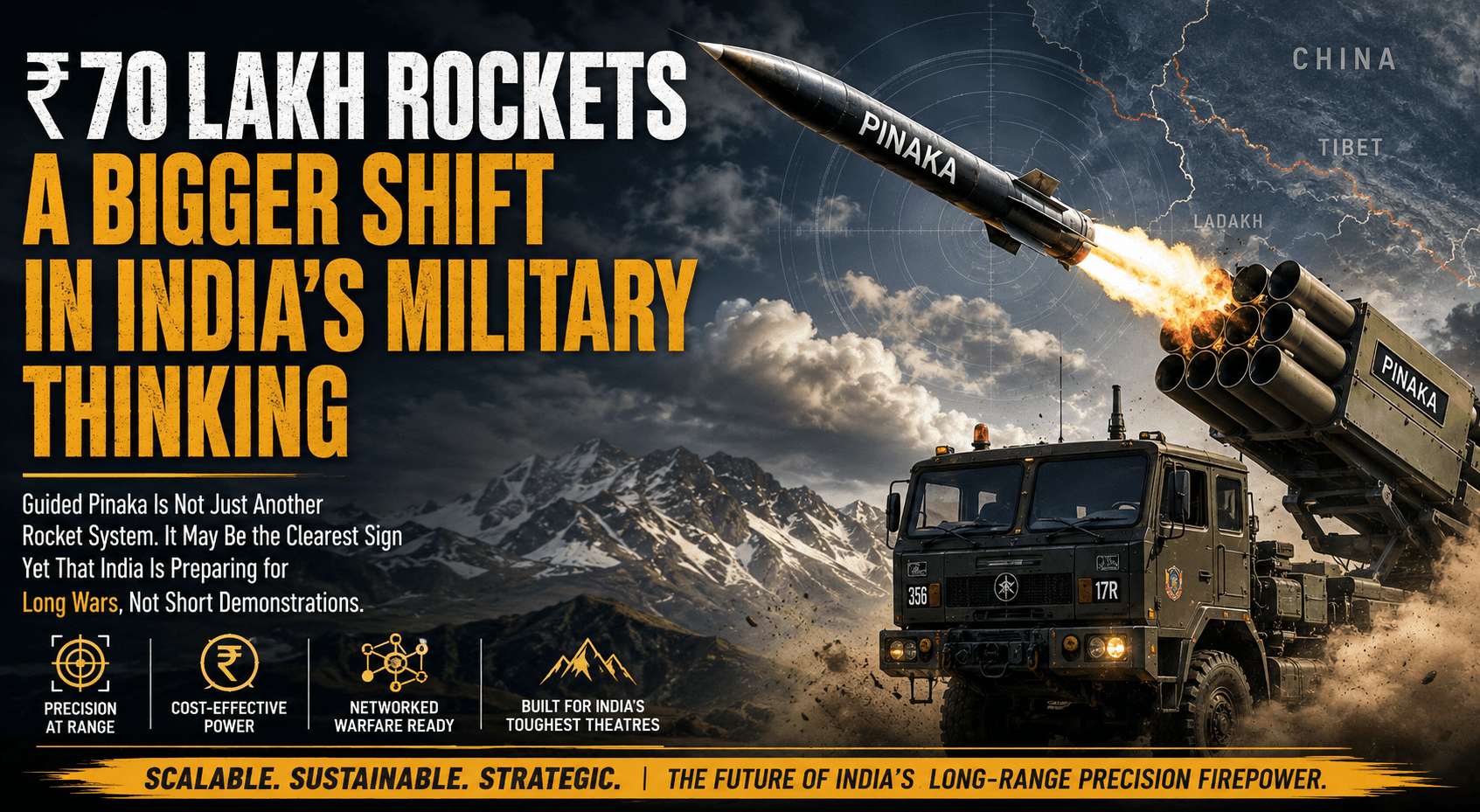
At ₹70 Lakh Per Rocket, DRDO-developed Guided Pinaka May Represent India’s Shift Toward Scalable Precision Warfare

Guided Pinaka Is Not Just Another Rocket System. It May Be the Clearest Sign Yet That India Is Preparing for Long Wars, Not Short Demonstrations.

IndoAsia Defense by IndoAsia Defense
May 10, 2026
in Indo-Pacific
0
DRDO-developed Guided Pinaka

Why Guided Pinaka Could Become India’s Most Important Battlefield Weapon

0
SHARES
11
VIEWS
Share on LinkedinShare on FacebookShare on Twitter

For decades, India’s military modernization story revolved around platforms. Fighter aircraft symbolized technological power. Aircraft carriers projected geopolitical ambition.

Cruise missiles embodied deterrence. Much of India’s defence discourse became centered around high-visibility acquisitions carrying political symbolism alongside operational utility.

But modern warfare is steadily exposing a harsher reality: wars are rarely sustained by prestige systems alone.

They are sustained by ammunition depth, industrial production capacity, battlefield networking, logistics resilience, and the ability to continue generating combat effects long after the opening phase of a conflict has already exhausted initial stockpiles.

This is where the Guided Pinaka rocket system becomes strategically important.

Its significance lies not merely in range or accuracy. The deeper story is that India may finally be restructuring part of its military modernization around scalable precision warfare rather than selective precision capability.

That distinction matters enormously in the kind of conflicts India is most likely to face over the next two decades.

The Ghost of Bofors Still Hangs Over Indian Artillery

To understand why Guided Pinaka rocket matters, it is necessary to understand the historical failure it is emerging from.

India’s artillery modernization trajectory was effectively frozen for decades after the 1986 Bofors scandal. What began as a corruption controversy gradually evolved into institutional paralysis.

Political caution around artillery procurement became so severe that India went nearly four decades without major large-scale howitzer acquisitions.

The consequences became painfully visible during the Kargil War in 1999.

Indian artillery ultimately performed decisively during the conflict, particularly the FH-77B Bofors guns themselves, but Kargil also exposed how uneven and outdated much of India’s artillery structure had become.

The war triggered the Field Artillery Rationalisation Plan (FARP), an ambitious roadmap intended to overhaul the Army’s artillery inventory through thousands of modern guns, rocket systems, and supporting infrastructure.

But implementation repeatedly slowed under bureaucratic caution, import dependency, shifting procurement priorities, and industrial limitations.

This historical context matters because Guided Pinaka rocket represents something structurally different from many previous Indian artillery programs.

It is not merely a procurement project.

It is an attempt to build an indigenous precision-fire ecosystem capable of wartime scaling, domestic replenishment, and sustained battlefield usage without excessive foreign dependency. That is a much larger strategic shift than the rocket itself.

India’s Old Artillery Doctrine Is Colliding With a New Battlefield Reality

Traditional artillery doctrine inherited a basic industrial-era assumption: if accuracy remains limited, compensate through massed firepower.

Rocket artillery systems across the world were therefore optimized for saturation effects rather than precision targeting. Large barrages were intended to suppress broad areas, overwhelm troop concentrations, and create battlefield disruption through sheer volume.

That logic worked under older battlefield conditions where surveillance coverage remained weak, targeting cycles were slower, and battlefield transparency was limited.

Modern combat environments are dismantling those assumptions rapidly.

Today’s battlefield is increasingly sensor-saturated. Drones monitor artillery movement continuously. Counter-battery radars identify firing signatures within seconds. Satellites track logistical patterns across large distances. Electronic intelligence systems compress detection timelines dramatically.

Under these conditions, unguided artillery faces a structural efficiency problem. Massive ammunition expenditure no longer guarantees battlefield effectiveness. Instead, it creates logistical strain, exposes launcher positions, and accelerates depletion cycles.

Precision therefore becomes essential. But globally, precision systems created another problem: cost.

Most advanced long-range precision munitions remain expensive enough that militaries cannot comfortably employ them at sustained operational tempo during prolonged conflicts. Guided Pinaka rocket appears designed specifically to bridge that gap.

Rather than choosing between mass fires and precision fires, India is attempting to combine both into a scalable battlefield architecture.

That is not merely a technological transition. It is a doctrinal one.

The Himalayas Are Quietly Becoming a Rocket-Artillery Competition

Much of the India-China military discussion still revolves around fighters, roads, airbases, and naval expansion. Those factors remain important.

But the emerging military competition along the Himalayan frontier increasingly revolves around something less visible: which side can sustain accurate long-range battlefield pressure more efficiently over time.

Mountain warfare radically magnifies the importance of logistics.

A single road can sustain an entire deployment sector. One tunnel disruption can delay reinforcement cycles for days. Fuel depots, ammunition nodes, bridge crossings, and mountain logistics hubs become disproportionately important because geography limits redundancy.

This creates ideal conditions for operational-depth precision fires.

China recognized this years ago. The People’s Liberation Army Rocket Force and PLA Ground Force have steadily expanded long-range rocket artillery deployment across the Western Theater Command. Systems like the PHL-191 have significantly altered the battlefield geometry along the Himalayan frontier.

The PHL-191 is not simply a conventional rocket launcher. It represents a highly networked long-range precision-fire platform capable of deploying guided rockets and tactical ballistic missiles at operational depth. Open-source reporting suggests the system can employ rockets reaching roughly 350 km, while some variants reportedly extend beyond that threshold using Fire Dragon-class guided munitions.

More importantly, these systems are associated with high-altitude deployments connected to Tibet and Xinjiang military formations.

That matters because China’s rocket-force architecture increasingly allows the PLA to threaten logistics corridors, forward airfields, ammunition depots, operational headquarters, and reinforcement infrastructure far behind the immediate Line of Actual Control.

India’s own trajectory increasingly reflects recognition of this challenge.

Guided Pinaka rocket allows the Indian Army to generate reciprocal pressure against operational-depth targets without depending exclusively on expensive strategic missile inventories.

The real strategic competition therefore is not merely about who possesses longer-range missiles. It is about which military can sustain denser precision-fire networks over longer durations without exhausting industrial or financial capacity.

That is where Guided Pinaka rocket becomes strategically important.

Even Ten Guided Pinaka Rcokect Regiments May Still Leave India Short

Public discussions often present expanding Guided Pinaka Rocket induction as evidence of growing artillery strength. But force-structure arithmetic becomes harsher when viewed through India’s two-front contingency requirements.

The challenge is not simply acquiring regiments. The challenge is sustaining operational density simultaneously across the northern and western theatres.

Even if India reaches ten Guided Pinaka Rocket regiments by 2027, that number may still prove insufficient once broader operational realities are considered. Northern theatre deployment requirements alone could consume significant rocket-force concentration because of the geography involved.

Long-distance sustainment, dispersed deployment patterns, maintenance cycles, reserve force obligations, and launcher survivability requirements dilute usable density rapidly.

This becomes even more complicated if simultaneous escalation occurs with Pakistan.

India’s challenge therefore is not simply induction speed. It is precision-fire mass.

China’s long-range rocket-force buildup already reflects this logic. Beijing is building battlefield depth through quantity, redundancy, and layered fires. India is still catching up to that architecture.

Guided Pinaka Rocket helps narrow the gap. But it does not eliminate it.

The Most Important Part of Guided Pinaka May Not Be the Rocket at All

The future battlefield increasingly revolves around sensor-to-shooter compression.

The real value of systems like Guided Pinaka Rocket will emerge not from rockets alone, but from integration between drones, battlefield radars, AI-assisted targeting systems, encrypted communications networks, loitering munitions, and real-time fire correction cycles.

This is where long-range precision warfare is heading globally.

The combination of relatively affordable guided rockets with persistent ISR and UAV-assisted targeting could fundamentally alter the economics of battlefield lethality. A guided rocket becomes dramatically more dangerous when paired with continuous surveillance and real-time target confirmation.

India appears increasingly aware of this transition. But this evolution also introduces survivability challenges that are often underestimated in public discussions.

Modern rocket artillery systems are highly detectable. Launch signatures reveal firing positions. Drones track relocation patterns. Satellite surveillance reduces concealment windows. Counter-battery timelines are shrinking rapidly.

In a future conflict against China, launcher survivability may become nearly as important as strike range itself.

This means India’s rocket-force doctrine cannot rely on firepower alone. It will require electronic warfare protection, rapid shoot-and-scoot mobility, distributed firing patterns, decoy deployment, hardened logistics support, and integrated air-defence coverage.

Without these layers, precision rocket systems risk becoming expensive targets inside highly networked battlefields.

The Escalation Ladder Is Becoming More Complicated

Another major strategic question remains insufficiently discussed: at what point does long-range rocket artillery begin overlapping with strategic strike signaling?

This question becomes increasingly relevant as the Pinaka roadmap expands toward 300 km and potentially 450 km variants.

At shorter ranges, systems like Guided Pinaka Rocket fit relatively comfortably inside the category of operational battlefield fires. But longer-range variants begin entering a more ambiguous escalation space.

A 450 km rocket-force capability targeting operational infrastructure deep inside Tibet may still remain technically conventional. Yet from an adversary’s perspective, distinguishing between operational and strategic signaling becomes far more difficult once long-range precision salvos begin targeting rear-echelon infrastructure at scale.

This becomes even more important because India is simultaneously moving toward an Integrated Rocket Force structure combining Pinaka, Pralay, Nirbhay, and BrahMos under a broader long-range fires architecture.

The issue is not that Guided Pinaka Rocket itself is destabilizing.

The issue is that the future ecosystem surrounding it may gradually blur the line between tactical fires, operational strike systems, and strategic signaling.

That ambiguity will likely become a far more important part of India-China deterrence dynamics over the next decade.

India May Finally Be Learning the Economics of Modern War

For years, India’s defence modernization often emphasized acquisition symbolism over combat sustainability.

Systems were frequently evaluated through prestige value rather than through wartime endurance logic.

But modern wars increasingly reward something different: scalable production, ammunition sustainability, operational redundancy, affordable precision, industrial resilience, and networked battlefield integration.

Guided Pinaka rocket reflects that broader shift in Indian strategic thinking. Its importance lies not in being India’s most sophisticated weapon system.

It lies in representing one of the first major Indian attempts to build scalable precision warfare around the realities of prolonged conflict.

That may ultimately become far more consequential than any individual specification associated with the rocket itself.

Because future wars in the Indo-Pacific are unlikely to reward militaries that merely possess advanced systems.

They are more likely to reward militaries capable of sustaining precision combat effects longer, cheaper, and at greater operational scale than their adversaries.

FAQs

What is the Guided Pinaka rocket system?

Guided Pinaka is an advanced version of India’s indigenous Pinaka multi-barrel rocket launcher (MBRL) system developed by the Defence Research and Development Organisation (DRDO). Unlike earlier unguided variants designed mainly for area saturation, the guided version uses navigation and control systems to deliver much higher strike accuracy against battlefield targets at long range.

What is the range of Guided Pinaka rockets?

The currently known guided variants are reported to have ranges of around 75 km, while the newer Long-Range Guided Rocket (LRGR) variants are expected to extend that reach to roughly 120 km. DRDO is also reportedly working on future variants with much longer ranges.

Why is Guided Pinaka considered important for India?

Guided Pinaka is important because it gives India relatively affordable long-range precision firepower that can be used at scale during prolonged conflicts. It helps bridge the gap between conventional artillery and expensive strategic missile systems like BrahMos.

How much does a Guided Pinaka rocket cost?

Open-source estimates suggest a Guided Pinaka rocket costs around ₹70 lakh per round. This makes it significantly cheaper than many strategic missile systems while still offering precision-strike capability.

How is Guided Pinaka different from BrahMos?

BrahMos is a supersonic cruise missile designed primarily for high-value strategic targets such as warships, hardened command centers, and critical infrastructure. Guided Pinaka operates in a different battlefield category. It is intended for operational-depth precision fires against targets like logistics hubs, artillery formations, radar systems, and troop concentrations at a much lower per-strike cost.

Can Guided Pinaka compete with HIMARS?

Guided Pinaka and the American HIMARS system occupy similar operational categories in terms of long-range precision rocket artillery. However, they differ in doctrine, ecosystem, cost structure, and battlefield integration. Guided Pinaka’s biggest advantage is its lower estimated cost and domestic producibility for India’s wartime requirements.

Why does Guided Pinaka matter in the India-China military balance?

Mountain warfare in the Himalayas makes logistics infrastructure extremely important. Roads, bridges, fuel depots, and supply hubs become vulnerable chokepoints. Guided Pinaka allows India to target operational-depth logistics and support infrastructure without relying entirely on expensive strategic missiles.

What is China’s PHL-191 rocket system?

The PHL-191 is one of China’s advanced long-range rocket artillery systems associated with the PLA’s Western Theater Command. It is capable of deploying guided rockets and tactical ballistic missiles over long distances and forms part of China’s growing precision-fire architecture near the Himalayan frontier.

Why is affordable precision firepower becoming important in modern warfare?

Recent conflicts, especially the Russia-Ukraine war, demonstrated that ammunition expenditure rates in prolonged warfare are extremely high. Militaries increasingly require precision weapons that are accurate enough for modern battlefields but affordable enough to sustain over long conflicts. This is the strategic space systems like Guided Pinaka are designed to fill.

What is India’s Integrated Rocket Force concept?

India is gradually moving toward a more integrated long-range fires structure that may combine systems such as Pinaka, Pralay, BrahMos, and Nirbhay under a broader operational framework. The goal is to improve coordination between different strike systems and create layered conventional deterrence.

Can Guided Pinaka become a major Indian defence export?

Potentially yes. Countries looking for relatively affordable long-range precision artillery systems may find Guided Pinaka attractive because of its lower acquisition cost, indigenous production base, and operational flexibility. Armenia’s procurement of Pinaka systems is already being viewed as an important proof-of-concept moment for India’s defence exports.

Is Guided Pinaka enough to close the artillery gap with China?

No single system can close the gap alone. China already possesses extensive rocket-force infrastructure, larger inventories, and highly networked battlefield ISR capabilities. Guided Pinaka helps India narrow the precision-fire gap, but long-term competition will also depend on production scale, drone integration, survivability, battlefield networking, and operational doctrine.

Tags: In Focus
Previous Post

Why the Indo-Pacific Will Not Unite Against China

Next Post

India-UAE Defence Pact: Why Abu Dhabi Is Becoming India’s Western Strategic Depth

IndoAsia Defense

IndoAsia Defense

IndoAsia Defense Team is a specialist research and analysis group focused on India’s military modernization and Indo-Pacific strategic dynamics. The platform delivers structured, data-driven insights on doctrine, force posture, defense technology, and regional power balance.

Next Post
India-UAE defence pact and Gulf strategy

India-UAE Defence Pact: Why Abu Dhabi Is Becoming India’s Western Strategic Depth

Leave a Reply Cancel reply

Login with your Social ID

Your email address will not be published. Required fields are marked *

Category

  • Air
  • Global
  • Indo-Pacific
  • Industry
  • Joint
  • Land
  • Navy
  • Tech

Defence Capabilities

  • Air Defence
  • Drones
  • Fighters
  • ISR & Mobility
  • China Military
  • Emerging Tech
  • Regional Trends
  • U.S. Posture

Strategy

  • 2035 Outlook
  • China Strategy
  • India Strategy
  • Pakistan Outlook
  • Budget
  • Exports
  • Make in India
  • Supply Chains

Operations

  • Integrated Ops
  • Procurement Reform
  • Theater Commands
  • Armour & Artillery
  • China Front
  • Future Combat
  • Pakistan Front
  • Fleet Expansion

Resources

  • India vs China Military Balance
  • Indo-Pacific Military Power Map
  • Global Military Balance Dashboard
  • Global Weapons Systems Database
  • Global Missile Systems Database
  • Indo-Pacific Defense Timeline
  • India Military Capability Index
  • About
  • Contact
  • Privacy & Policy
  • Editorial Policy
  • Cookie Policy
  • Disclaimer
  • Terms And Conditions
Facebook Linkedin X-twitter
© 2026 IndoAsia Defense. All Rights Reserved.
No Result
View All Result
  • Home
  • Air
    • Air Defence
    • Drones
    • Fighters
    • ISR & Mobility
  • Land
    • Armour & Artillery
    • China Front
    • Future Combat
    • Pakistan Front
  • Navy
    • Fleet Expansion
    • Indian Ocean
    • Maritime Security
    • Submarines
  • Indo-Pacific
    • 2035 Outlook
    • China Strategy
    • India Strategy
    • Pakistan Outlook
  • Joint
    • Integrated Ops
    • Procurement Reform
    • Theater Commands
  • Tech
    • AI & Autonomous Systems
    • Cyber
    • Electronic Warfare
    • Space
  • Industry
    • Budget
    • Exports
    • Make in India
    • Supply Chains
  • Global
    • China-Pak
    • Emerging Tech
    • Regional Trends
    • US-India