




IndoAsia Defense
  • Home
  • Air
    • All
    • Air Defence
    • Drones
    • Fighters
    • ISR & Mobility
    Ghatak UCAV stealth, autonomy, integration

    Inside India’s Ghatak UCAV Program: Stealth, Autonomy, and the Integration Gap

    The F414 engine co-production agreement between Hindustan Aeronautics Limited and GE Aerospace

    India-US F414 Engine Deal Explained: Technology Transfer, Tejas Mk2, and AMCA

    What is the Su-57M1 India deal

    Su-57M1 for India: A Fifth-Generation Shortcut or a Strategic Dependency Trap?

    India indigenous long range surveillance radar with X-band drone detection capability

    450km Eyes, Machine-Speed Decisions: How India’s Indigenous Long Range Surveillance Radar Is Rewriting Air Defence

    Why Software Defined Radios Are the IAF’s Most Consequential Upgrade

    IAF Signs BEL Deal for Software Defined Radios: Rewiring India’s Air Combat Network

    How the Ghatak UCAV Stealth Design Redefines India’s Drone Warfare Doctrine

    Ghatak UCAV: India’s Carbon Composite Stealth Strategy Dissected

    Ballistic Missile Defense system intercepting incoming missile during midcourse phase

    How Ballistic Missile Defense Works: Inside Modern Missile Interception Systems

    Swarm logistics drones delivering military supplies in high-altitude Himalayan terrain with Indian Army presence

    Swarm Logistics Drones in Himalayan Warfare: Can India Close the Supply Gap with China?

    India’s 6th-Gen Fighter Strategy FCAS vs GCAP Explained

    India’s 6th-Gen Fighter Strategy: FCAS vs GCAP Explained

  • Land
    • All
    • Armour & Artillery
    • China Front
    • Future Combat
    • Pakistan Front
    The Indo-Pacific Is Fragmenting, Not Uniting Against China

    Why the Indo-Pacific Will Not Unite Against China

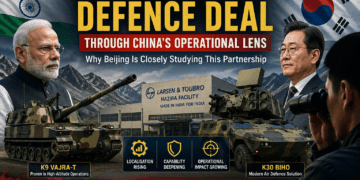
    The India-South Korea defence deal

    The India-South Korea Defence Deal Through China’s Operational Lens

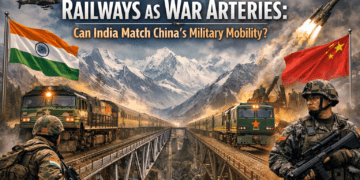
    Railways as War Arteries Can India Match China’s Military Mobility Before the Next Crisis

    Railways as War Arteries: Can India Match China’s Military Mobility Before the Next Crisis?

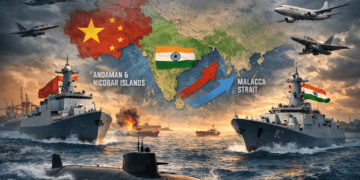
    China maritime front in Indian Ocean

    What If China Opens a Maritime Front in the Indian Ocean During a LAC Conflict?

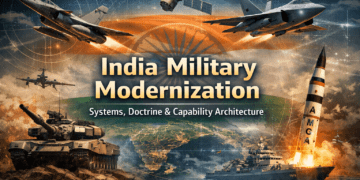
    What is Indian military modernization strategy in 2026?

    Indian Military Modernization: Systems, Doctrine, and Capability Architecture (2026-27)

    Tank launching loitering munition in battle

    From Smoke to Strike: India’s Indigenous Loitering Munitions for T-72, T-90, and Arjun Tanks

    How China Mobilizes Forces Along the LAC Speed, Systems, and Strategic Control

    How China Mobilizes Forces Along the LAC: Systems, Speed, and Strategic Signaling

    Ballistic Missile Defense system intercepting incoming missile during midcourse phase

    How Ballistic Missile Defense Works: Inside Modern Missile Interception Systems

    Swarm logistics drones delivering military supplies in high-altitude Himalayan terrain with Indian Army presence

    Swarm Logistics Drones in Himalayan Warfare: Can India Close the Supply Gap with China?

  • Navy
    • All
    • Fleet Expansion
    • Indian Ocean
    • Maritime Security
    • Submarines
    Mogami-class frigate deal overview

    Japan’s Mogami-Class Frigate Offer to India: What the Transfer Terms Reveal About Tokyo’s Indo-Pacific Calculus

    China maritime front in Indian Ocean

    What If China Opens a Maritime Front in the Indian Ocean During a LAC Conflict?

    The Strait of Hormuz Crisis

    India’s Oil Artery Under Threat: Strategic Implications of a Hormuz Crisis

    India’s VL-Shtil Missile Deal with Russia

    India’s VL-Shtil Missile Deal with Russia: Strengthening Naval Air Defense in the Indo-Pacific

    Andaman & Nicobar Command Sleeping Giant of India’s Maritime Strategy

    Andaman & Nicobar Command: Sleeping Giant of India’s Maritime Strategy

    Maritime Surveillance 2.0: Why EO/IR Modernisation Matters for India’s Ocean Security

    Maritime Surveillance 2.0: Why EO/IR Modernisation Matters for India’s Ocean Security

    2030 Will Decide the India ASEAN Maritime Equation

    2030 Will Decide the India ASEAN Maritime Equation

    India Military Transformation Series — Part 3: Maritime Power and the Indian Ocean Imperative

    India Military Transformation Series — Part 3: Maritime Power and the Indian Ocean Imperative

    Indian Navy TEDBF PPP Model: China Factor and 2030–2040 Carrier Strategy

    Indian Navy TEDBF PPP Model: China Factor and 2030–2040 Carrier Strategy

  • Indo-Pacific
    • All
    • 2035 Outlook
    • China Strategy
    • India Strategy
    • Pakistan Outlook
    DRDO-developed Guided Pinaka

    At ₹70 Lakh Per Rocket, DRDO-developed Guided Pinaka May Represent India’s Shift Toward Scalable Precision Warfare

    The Indo-Pacific Is Fragmenting, Not Uniting Against China

    Why the Indo-Pacific Will Not Unite Against China

    Mogami-class frigate deal overview

    Japan’s Mogami-Class Frigate Offer to India: What the Transfer Terms Reveal About Tokyo’s Indo-Pacific Calculus

    The India-South Korea defence deal

    The India-South Korea Defence Deal Through China’s Operational Lens

    Railways as War Arteries Can India Match China’s Military Mobility Before the Next Crisis

    Railways as War Arteries: Can India Match China’s Military Mobility Before the Next Crisis?

    india military integration gap

    Is India Building Military Power Faster Than It Can Integrate It?

    China maritime front in Indian Ocean

    What If China Opens a Maritime Front in the Indian Ocean During a LAC Conflict?

    Can India Fight Beyond 30 Days? Inside India’s War Sustainment Reality

    Can India Fight Beyond 30 Days? Inside India’s War Sustainment Reality

    What is Indian military modernization strategy in 2026?

    Indian Military Modernization: Systems, Doctrine, and Capability Architecture (2026-27)

  • Joint
    • All
    • Integrated Ops
    • Procurement Reform
    • Theater Commands
    India's strategic challenge sustainability first

    India Can Strike in 22 Minutes. Can It Sustain for 22 Weeks?

    Ballistic Missile Defense system intercepting incoming missile during midcourse phase

    How Ballistic Missile Defense Works: Inside Modern Missile Interception Systems

    India defence proposals Rs 2.38 trillion showing S-400 system, strike drones, fighter jets and military architecture shift

    India Defence Proposals Rs 2.38 Trillion: Why This Approval Changes How India Will Fight, Not Just What It Buys

    DAP 2026 India’s Quiet Revolution in Defence Procurement

    DAP 2026: India’s Quiet Revolution in Defence Procurement

    Integrated Battle Groups vs China’s Western Theater Command

    Integrated Battle Groups vs China’s Western Theater Command: Can Doctrine Survive the Himalayan Reality?

    Andaman & Nicobar Command Sleeping Giant of India’s Maritime Strategy

    Andaman & Nicobar Command: Sleeping Giant of India’s Maritime Strategy

    India Military Transformation Series — Part 2: The Theatre Command Reckoning

    India Military Transformation Series — Part 2: The Theatre Command Reckoning

    India AI C4ISR modernization

    India Military Transformation Series — Part 1: India AI C4ISR Modernization

    India’s Two-Front Theatre Command: Preparing for Simultaneous Conflict

    India’s Two-Front Theatre Command: Preparing for Simultaneous Conflict

  • Tech
    • All
    • AI & Autonomous Systems
    • Cyber
    • Electronic Warfare
    • Space
    Why Software Defined Radios Are the IAF’s Most Consequential Upgrade

    IAF Signs BEL Deal for Software Defined Radios: Rewiring India’s Air Combat Network

    Source Code or ICD India’s Source Code Negotiation Explained

    Source Code or ICD: India’s Source Code Negotiation Explained

    Supply Chain Weaponization

    Supply Chain Weaponization: Strategic Autonomy Meets Semiconductor Reality

    AI-driven battlefield in India's military

    The Algorithm of Borders: What India’s Military AI Push Actually Looks Like on the Ground

    India AI C4ISR modernization

    India Military Transformation Series — Part 1: India AI C4ISR Modernization

    PRAHAR Explained India Counter Terror Policy Prahaar

    PRAHAAR Explained: Why ‘PRAHAAR’ India’s National Counter-terrorism Doctrine, Signals the End of Traditional Warfare

    The Weapons Making the AMCA Unbeatable

    The Weapons Making the AMCA Unbeatable

    India’s Aerospace Ecosystem After Rafale: The 2026–2030 Industrial Test

    India’s Aerospace Ecosystem After Rafale: The 2026–2030 Industrial Test

    PLA’s Cyber Warfare Units and the Question of Indian Critical Infrastructure Resilience

    PLA’s Cyber Warfare Units and the Question of Indian Critical Infrastructure Resilience

  • Industry
    • All
    • Budget
    • Exports
    • Make in India
    • Supply Chains
    India’s Defence MSME Blind Spot Could Become a Wartime Liability

    India’s Defence MSME Blind Spot Could Become a Wartime Liability

    India's strategic challenge sustainability first

    India Can Strike in 22 Minutes. Can It Sustain for 22 Weeks?

    India-UAE defence pact and Gulf strategy

    India-UAE Defence Pact: Why Abu Dhabi Is Becoming India’s Western Strategic Depth

    Ghatak UCAV stealth, autonomy, integration

    Inside India’s Ghatak UCAV Program: Stealth, Autonomy, and the Integration Gap

    The India-South Korea defence deal

    The India-South Korea Defence Deal Through China’s Operational Lens

    The F414 engine co-production agreement between Hindustan Aeronautics Limited and GE Aerospace

    India-US F414 Engine Deal Explained: Technology Transfer, Tejas Mk2, and AMCA

    Why Software Defined Radios Are the IAF’s Most Consequential Upgrade

    IAF Signs BEL Deal for Software Defined Radios: Rewiring India’s Air Combat Network

    How the Ghatak UCAV Stealth Design Redefines India’s Drone Warfare Doctrine

    Ghatak UCAV: India’s Carbon Composite Stealth Strategy Dissected

    Swarm logistics drones delivering military supplies in high-altitude Himalayan terrain with Indian Army presence

    Swarm Logistics Drones in Himalayan Warfare: Can India Close the Supply Gap with China?

  • Global
    • All
    • China-Pak
    • Emerging Tech
    • Middle Eeast
    • Regional Trends
    • US-India
    • US-Israel
    India-UAE defence pact and Gulf strategy

    India-UAE Defence Pact: Why Abu Dhabi Is Becoming India’s Western Strategic Depth

    The Indo-Pacific Is Fragmenting, Not Uniting Against China

    Why the Indo-Pacific Will Not Unite Against China

    Ghatak UCAV stealth, autonomy, integration

    Inside India’s Ghatak UCAV Program: Stealth, Autonomy, and the Integration Gap

    The F414 engine co-production agreement between Hindustan Aeronautics Limited and GE Aerospace

    India-US F414 Engine Deal Explained: Technology Transfer, Tejas Mk2, and AMCA

    india military integration gap

    Is India Building Military Power Faster Than It Can Integrate It?

    India indigenous long range surveillance radar with X-band drone detection capability

    450km Eyes, Machine-Speed Decisions: How India’s Indigenous Long Range Surveillance Radar Is Rewriting Air Defence

    What is Indian military modernization strategy in 2026?

    Indian Military Modernization: Systems, Doctrine, and Capability Architecture (2026-27)

    India defence proposals Rs 2.38 trillion showing S-400 system, strike drones, fighter jets and military architecture shift

    India Defence Proposals Rs 2.38 Trillion: Why This Approval Changes How India Will Fight, Not Just What It Buys

    India’s 6th-Gen Fighter Strategy FCAS vs GCAP Explained

    India’s 6th-Gen Fighter Strategy: FCAS vs GCAP Explained

  • Resources
    • India Military Capability Index
    • India vs China Military Balance
    • China Western Theater Command Guide
    • Pakistan Military Tracker 2026-27
    • India’s Military Doctrine Library
    • India vs China vs Pakistan Missile Arsenal Comparison
    • India’s Missile List
    • India Missile Range Map
    • Indo-Pacific Military Power Map
    • Indo-Pacific Defense Timeline
    • Global Military Balance Dashboard
    • Global Weapons Systems Database
    • Global Missile Systems Database
  • What If
    • China India Naval Conflict
No Result
View All Result
  • Home
  • Air
    • All
    • Air Defence
    • Drones
    • Fighters
    • ISR & Mobility
    Ghatak UCAV stealth, autonomy, integration

    Inside India’s Ghatak UCAV Program: Stealth, Autonomy, and the Integration Gap

    The F414 engine co-production agreement between Hindustan Aeronautics Limited and GE Aerospace

    India-US F414 Engine Deal Explained: Technology Transfer, Tejas Mk2, and AMCA

    What is the Su-57M1 India deal

    Su-57M1 for India: A Fifth-Generation Shortcut or a Strategic Dependency Trap?

    India indigenous long range surveillance radar with X-band drone detection capability

    450km Eyes, Machine-Speed Decisions: How India’s Indigenous Long Range Surveillance Radar Is Rewriting Air Defence

    Why Software Defined Radios Are the IAF’s Most Consequential Upgrade

    IAF Signs BEL Deal for Software Defined Radios: Rewiring India’s Air Combat Network

    How the Ghatak UCAV Stealth Design Redefines India’s Drone Warfare Doctrine

    Ghatak UCAV: India’s Carbon Composite Stealth Strategy Dissected

    Ballistic Missile Defense system intercepting incoming missile during midcourse phase

    How Ballistic Missile Defense Works: Inside Modern Missile Interception Systems

    Swarm logistics drones delivering military supplies in high-altitude Himalayan terrain with Indian Army presence

    Swarm Logistics Drones in Himalayan Warfare: Can India Close the Supply Gap with China?

    India’s 6th-Gen Fighter Strategy FCAS vs GCAP Explained

    India’s 6th-Gen Fighter Strategy: FCAS vs GCAP Explained

  • Land
    • All
    • Armour & Artillery
    • China Front
    • Future Combat
    • Pakistan Front
    The Indo-Pacific Is Fragmenting, Not Uniting Against China

    Why the Indo-Pacific Will Not Unite Against China

    The India-South Korea defence deal

    The India-South Korea Defence Deal Through China’s Operational Lens

    Railways as War Arteries Can India Match China’s Military Mobility Before the Next Crisis

    Railways as War Arteries: Can India Match China’s Military Mobility Before the Next Crisis?

    China maritime front in Indian Ocean

    What If China Opens a Maritime Front in the Indian Ocean During a LAC Conflict?

    What is Indian military modernization strategy in 2026?

    Indian Military Modernization: Systems, Doctrine, and Capability Architecture (2026-27)

    Tank launching loitering munition in battle

    From Smoke to Strike: India’s Indigenous Loitering Munitions for T-72, T-90, and Arjun Tanks

    How China Mobilizes Forces Along the LAC Speed, Systems, and Strategic Control

    How China Mobilizes Forces Along the LAC: Systems, Speed, and Strategic Signaling

    Ballistic Missile Defense system intercepting incoming missile during midcourse phase

    How Ballistic Missile Defense Works: Inside Modern Missile Interception Systems

    Swarm logistics drones delivering military supplies in high-altitude Himalayan terrain with Indian Army presence

    Swarm Logistics Drones in Himalayan Warfare: Can India Close the Supply Gap with China?

  • Navy
    • All
    • Fleet Expansion
    • Indian Ocean
    • Maritime Security
    • Submarines
    Mogami-class frigate deal overview

    Japan’s Mogami-Class Frigate Offer to India: What the Transfer Terms Reveal About Tokyo’s Indo-Pacific Calculus

    China maritime front in Indian Ocean

    What If China Opens a Maritime Front in the Indian Ocean During a LAC Conflict?

    The Strait of Hormuz Crisis

    India’s Oil Artery Under Threat: Strategic Implications of a Hormuz Crisis

    India’s VL-Shtil Missile Deal with Russia

    India’s VL-Shtil Missile Deal with Russia: Strengthening Naval Air Defense in the Indo-Pacific

    Andaman & Nicobar Command Sleeping Giant of India’s Maritime Strategy

    Andaman & Nicobar Command: Sleeping Giant of India’s Maritime Strategy

    Maritime Surveillance 2.0: Why EO/IR Modernisation Matters for India’s Ocean Security

    Maritime Surveillance 2.0: Why EO/IR Modernisation Matters for India’s Ocean Security

    2030 Will Decide the India ASEAN Maritime Equation

    2030 Will Decide the India ASEAN Maritime Equation

    India Military Transformation Series — Part 3: Maritime Power and the Indian Ocean Imperative

    India Military Transformation Series — Part 3: Maritime Power and the Indian Ocean Imperative

    Indian Navy TEDBF PPP Model: China Factor and 2030–2040 Carrier Strategy

    Indian Navy TEDBF PPP Model: China Factor and 2030–2040 Carrier Strategy

  • Indo-Pacific
    • All
    • 2035 Outlook
    • China Strategy
    • India Strategy
    • Pakistan Outlook
    DRDO-developed Guided Pinaka

    At ₹70 Lakh Per Rocket, DRDO-developed Guided Pinaka May Represent India’s Shift Toward Scalable Precision Warfare

    The Indo-Pacific Is Fragmenting, Not Uniting Against China

    Why the Indo-Pacific Will Not Unite Against China

    Mogami-class frigate deal overview

    Japan’s Mogami-Class Frigate Offer to India: What the Transfer Terms Reveal About Tokyo’s Indo-Pacific Calculus

    The India-South Korea defence deal

    The India-South Korea Defence Deal Through China’s Operational Lens

    Railways as War Arteries Can India Match China’s Military Mobility Before the Next Crisis

    Railways as War Arteries: Can India Match China’s Military Mobility Before the Next Crisis?

    india military integration gap

    Is India Building Military Power Faster Than It Can Integrate It?

    China maritime front in Indian Ocean

    What If China Opens a Maritime Front in the Indian Ocean During a LAC Conflict?

    Can India Fight Beyond 30 Days? Inside India’s War Sustainment Reality

    Can India Fight Beyond 30 Days? Inside India’s War Sustainment Reality

    What is Indian military modernization strategy in 2026?

    Indian Military Modernization: Systems, Doctrine, and Capability Architecture (2026-27)

  • Joint
    • All
    • Integrated Ops
    • Procurement Reform
    • Theater Commands
    India's strategic challenge sustainability first

    India Can Strike in 22 Minutes. Can It Sustain for 22 Weeks?

    Ballistic Missile Defense system intercepting incoming missile during midcourse phase

    How Ballistic Missile Defense Works: Inside Modern Missile Interception Systems

    India defence proposals Rs 2.38 trillion showing S-400 system, strike drones, fighter jets and military architecture shift

    India Defence Proposals Rs 2.38 Trillion: Why This Approval Changes How India Will Fight, Not Just What It Buys

    DAP 2026 India’s Quiet Revolution in Defence Procurement

    DAP 2026: India’s Quiet Revolution in Defence Procurement

    Integrated Battle Groups vs China’s Western Theater Command

    Integrated Battle Groups vs China’s Western Theater Command: Can Doctrine Survive the Himalayan Reality?

    Andaman & Nicobar Command Sleeping Giant of India’s Maritime Strategy

    Andaman & Nicobar Command: Sleeping Giant of India’s Maritime Strategy

    India Military Transformation Series — Part 2: The Theatre Command Reckoning

    India Military Transformation Series — Part 2: The Theatre Command Reckoning

    India AI C4ISR modernization

    India Military Transformation Series — Part 1: India AI C4ISR Modernization

    India’s Two-Front Theatre Command: Preparing for Simultaneous Conflict

    India’s Two-Front Theatre Command: Preparing for Simultaneous Conflict

  • Tech
    • All
    • AI & Autonomous Systems
    • Cyber
    • Electronic Warfare
    • Space
    Why Software Defined Radios Are the IAF’s Most Consequential Upgrade

    IAF Signs BEL Deal for Software Defined Radios: Rewiring India’s Air Combat Network

    Source Code or ICD India’s Source Code Negotiation Explained

    Source Code or ICD: India’s Source Code Negotiation Explained

    Supply Chain Weaponization

    Supply Chain Weaponization: Strategic Autonomy Meets Semiconductor Reality

    AI-driven battlefield in India's military

    The Algorithm of Borders: What India’s Military AI Push Actually Looks Like on the Ground

    India AI C4ISR modernization

    India Military Transformation Series — Part 1: India AI C4ISR Modernization

    PRAHAR Explained India Counter Terror Policy Prahaar

    PRAHAAR Explained: Why ‘PRAHAAR’ India’s National Counter-terrorism Doctrine, Signals the End of Traditional Warfare

    The Weapons Making the AMCA Unbeatable

    The Weapons Making the AMCA Unbeatable

    India’s Aerospace Ecosystem After Rafale: The 2026–2030 Industrial Test

    India’s Aerospace Ecosystem After Rafale: The 2026–2030 Industrial Test

    PLA’s Cyber Warfare Units and the Question of Indian Critical Infrastructure Resilience

    PLA’s Cyber Warfare Units and the Question of Indian Critical Infrastructure Resilience

  • Industry
    • All
    • Budget
    • Exports
    • Make in India
    • Supply Chains
    India’s Defence MSME Blind Spot Could Become a Wartime Liability

    India’s Defence MSME Blind Spot Could Become a Wartime Liability

    India's strategic challenge sustainability first

    India Can Strike in 22 Minutes. Can It Sustain for 22 Weeks?

    India-UAE defence pact and Gulf strategy

    India-UAE Defence Pact: Why Abu Dhabi Is Becoming India’s Western Strategic Depth

    Ghatak UCAV stealth, autonomy, integration

    Inside India’s Ghatak UCAV Program: Stealth, Autonomy, and the Integration Gap

    The India-South Korea defence deal

    The India-South Korea Defence Deal Through China’s Operational Lens

    The F414 engine co-production agreement between Hindustan Aeronautics Limited and GE Aerospace

    India-US F414 Engine Deal Explained: Technology Transfer, Tejas Mk2, and AMCA

    Why Software Defined Radios Are the IAF’s Most Consequential Upgrade

    IAF Signs BEL Deal for Software Defined Radios: Rewiring India’s Air Combat Network

    How the Ghatak UCAV Stealth Design Redefines India’s Drone Warfare Doctrine

    Ghatak UCAV: India’s Carbon Composite Stealth Strategy Dissected

    Swarm logistics drones delivering military supplies in high-altitude Himalayan terrain with Indian Army presence

    Swarm Logistics Drones in Himalayan Warfare: Can India Close the Supply Gap with China?

  • Global
    • All
    • China-Pak
    • Emerging Tech
    • Middle Eeast
    • Regional Trends
    • US-India
    • US-Israel
    India-UAE defence pact and Gulf strategy

    India-UAE Defence Pact: Why Abu Dhabi Is Becoming India’s Western Strategic Depth

    The Indo-Pacific Is Fragmenting, Not Uniting Against China

    Why the Indo-Pacific Will Not Unite Against China

    Ghatak UCAV stealth, autonomy, integration

    Inside India’s Ghatak UCAV Program: Stealth, Autonomy, and the Integration Gap

    The F414 engine co-production agreement between Hindustan Aeronautics Limited and GE Aerospace

    India-US F414 Engine Deal Explained: Technology Transfer, Tejas Mk2, and AMCA

    india military integration gap

    Is India Building Military Power Faster Than It Can Integrate It?

    India indigenous long range surveillance radar with X-band drone detection capability

    450km Eyes, Machine-Speed Decisions: How India’s Indigenous Long Range Surveillance Radar Is Rewriting Air Defence

    What is Indian military modernization strategy in 2026?

    Indian Military Modernization: Systems, Doctrine, and Capability Architecture (2026-27)

    India defence proposals Rs 2.38 trillion showing S-400 system, strike drones, fighter jets and military architecture shift

    India Defence Proposals Rs 2.38 Trillion: Why This Approval Changes How India Will Fight, Not Just What It Buys

    India’s 6th-Gen Fighter Strategy FCAS vs GCAP Explained

    India’s 6th-Gen Fighter Strategy: FCAS vs GCAP Explained

  • Resources
    • India Military Capability Index
    • India vs China Military Balance
    • China Western Theater Command Guide
    • Pakistan Military Tracker 2026-27
    • India’s Military Doctrine Library
    • India vs China vs Pakistan Missile Arsenal Comparison
    • India’s Missile List
    • India Missile Range Map
    • Indo-Pacific Military Power Map
    • Indo-Pacific Defense Timeline
    • Global Military Balance Dashboard
    • Global Weapons Systems Database
    • Global Missile Systems Database
  • What If
    • China India Naval Conflict
No Result
View All Result
IndoAsia Defense
No Result
View All Result
Home Global Middle Eeast

India-UAE Defence Pact: Why Abu Dhabi Is Becoming India’s Western Strategic Depth

India’s latest agreements with the UAE go far beyond diplomacy. From strategic oil reserves and LNG supply to maritime infrastructure and defence cooperation, New Delhi is quietly building a new western strategic depth architecture in the Gulf.

IndoAsia Defense by IndoAsia Defense
May 15, 2026
in Middle Eeast, Regional Trends, Supply Chains
0
India-UAE defence pact and Gulf strategy

India-UAE Defence Pact Reveals India’s New Gulf Strategy

0
SHARES
12
VIEWS
Share on LinkedinShare on FacebookShare on Twitter

India’s Gulf Policy Is No Longer Just About Oil

India’s most exposed strategic frontier is not only the Himalayan border. It also runs through the Arabian Sea, the Strait of Hormuz, the Gulf shipping lanes and the energy corridors that keep India’s economy and military machine functioning.

That is why the latest India-UAE defence and energy agreements deserve more attention than a routine diplomatic readout. Prime Minister Narendra Modi’s May 15, 2026 visit to Abu Dhabi produced agreements covering a strategic defence partnership, petroleum reserves, LPG cooperation, maritime infrastructure and UAE investment commitments worth $5 billion in India.

The official outcome list also includes a strategic petroleum reserve arrangement with ADNOC, potential crude storage of up to 30 million barrels in India, and a ship repair cluster at Vadinar in Gujarat.

The headline is defence cooperation. The deeper story is strategic geography.

India is trying to turn the UAE into a western strategic depth partner: a state that can support India’s energy security, maritime resilience, defence-industrial expansion, logistics posture and Gulf diplomacy without forcing New Delhi into a formal alliance structure.

That distinction matters. India does not want alliance obligations in West Asia. But it does want access, stability, capital, energy redundancy and maritime infrastructure. The UAE offers all five.

The Defence Pact Is Really About Systems Integration

The India-UAE strategic defence partnership framework covers defence-industrial collaboration, innovation, advanced technology, training, exercises, education, doctrine, special operations, interoperability, maritime security, cyber defence, secure communications and information exchange.

This is not a narrow military agreement. It is a systems-integration framework.

For India, the value lies in building a Gulf-facing security architecture that can support maritime operations, intelligence coordination, defence production and crisis management.

For the UAE, the value lies in diversifying security partnerships beyond traditional Western suppliers while accessing India’s scale, military experience and manufacturing base.

The defence-industrial portion is especially important. India is no longer satisfied with being a buyer in global defence markets. The UAE, through its own defence technology ecosystem, is also trying to move beyond procurement dependence.

That creates a natural convergence in drones, missiles, naval systems, small arms, secure communications, cyber defence and unmanned platforms.

The strategic question is whether this framework produces real factories, exportable systems and operationally relevant technology, or whether it remains another high-level defence document. For IndoAsia Defense, that is the central test.

Why Vadinar Matters More Than It Looks

The MoU between Cochin Shipyard Limited and Drydocks World for a ship repair cluster at Vadinar may be one of the most strategically underrated outcomes of the visit. The official outcome list describes cooperation for setting up a ship repair cluster at Vadinar, including offshore fabrication, under India’s Maritime Development Fund Scheme.

This is not just commercial shipping infrastructure.

Ship repair capacity is a form of maritime endurance. A navy that cannot maintain, repair and rapidly return platforms to service cannot sustain presence in contested waters. A merchant fleet without reliable repair hubs faces higher operational risk during conflict, sanctions, chokepoint disruption or regional instability.

Vadinar sits on India’s western seaboard, facing the Arabian Sea. That geography makes it relevant to Gulf energy routes, Indian naval posture, commercial shipping, offshore infrastructure and crisis logistics.

China understood the strategic value of port-linked infrastructure long before India fully internalised it. Across the Indian Ocean, Beijing’s maritime footprint has been built not only through naval deployments, but through ports, logistics nodes, repair ecosystems, industrial corridors and financing relationships.

India’s answer does not need to copy China’s model. But it does need its own maritime resilience network. Vadinar could become part of that network.

Strategic Oil Reserves Are Wartime Infrastructure

The petroleum reserve agreement with ADNOC is being discussed mainly as an energy security arrangement. That is accurate, but incomplete.

Strategic oil reserves are wartime infrastructure.

The official outcome list refers to potential ADNOC crude storage in India’s strategic petroleum reserves of up to 30 million barrels, including participation in Visakhapatnam and development of reserve facilities in Chandikhol, Odisha. Reuters also reported that the agreements aim to expand India’s strategic petroleum reserves and crude storage capacity with ADNOC involvement.

This matters because India’s military capability depends on uninterrupted energy flows. Fighter sorties, naval deployments, logistics convoys, industrial production, ammunition movement and civilian economic stability all rely on fuel availability.

In peacetime, energy disruption is an economic problem. In wartime, it becomes a strategic vulnerability.

India’s adversaries do not need to defeat Indian forces directly to impose pressure. They can exploit chokepoints, insurance costs, shipping delays, crude price spikes and supply uncertainty. A serious conflict around the Strait of Hormuz would immediately test India’s economic and military resilience.

That is why the UAE partnership has strategic value. It creates a physical reserve architecture on Indian soil, backed by a trusted Gulf supplier. It does not eliminate vulnerability. But it gives India more room to absorb shocks.

LPG and LNG Give the Pact a Household-to-Strategy Link

The energy layer is broader than crude reserves.

India and the UAE also moved on LPG cooperation during the May 2026 visit. Reuters reported plans to expand LPG supply and trading with Indian Oil Corporation.

Earlier, in January 2026, ADNOC Gas signed a 10-year LNG sales agreement with Hindustan Petroleum Corporation Limited, valued at up to $3 billion, under which ADNOC Gas will supply 0.5 million metric tonnes of LNG annually to HPCL.

This gives the India-UAE relationship a layered energy structure.

Crude reserves support strategic buffering. LPG supports household and consumer energy stability. LNG supports industrial and gas-sector requirements. Together, these arrangements reduce India’s exposure to short-term volatility in a region where conflict can quickly convert into price pressure.

For India, energy security is not only about import volume. It is about predictability under stress.

A country of India’s size cannot run its strategic planning on spot-market panic. Long-term energy arrangements with the UAE help create a degree of insulation against sudden shocks, even if they cannot fully protect India from global price surges.

The $5 Billion Investment Is Part of Strategic Statecraft

The UAE’s $5 billion investment commitment into India should not be read as a separate economic headline. It belongs inside the same strategic frame.

Reports state that the UAE announced $5 billion in investments in India alongside the defence, energy and infrastructure agreements. The broader bilateral ambition is to deepen economic integration and move toward a $200 billion trade target, building on the existing India-UAE economic partnership.

Reuters reported in January 2026 that both sides had committed to doubling bilateral trade to $200 billion within six years.

Capital is now part of strategic alignment.

The UAE has money, logistics networks, sovereign investment capacity and a strong appetite for infrastructure-linked influence. India has scale, market depth, infrastructure demand and strategic geography. The result is a partnership where investment is not merely financial.

It can shape ports, logistics corridors, industrial zones, energy storage, banking access and connectivity frameworks.

This is the new grammar of strategic autonomy.

India is not joining a bloc. It is building interdependence with multiple poles. The UAE is useful because it brings capital without the political conditionality usually associated with Western security partners, and without the strategic suspicion attached to Chinese infrastructure finance.

The Pakistan-Saudi Angle Changes the Western Theatre

The India-UAE pact also sits inside a shifting West Asian security environment.

Reuters noted that the agreements came amid growing Saudi-Pakistani defence relations and Pakistan’s diplomatic role during the Iran conflict. The user-provided reporting brief also highlights the Pakistan-Saudi security pact, regional oil shock and India’s strategic autonomy doctrine as part of the relevant context.

India cannot ignore this.

For decades, Pakistan relied on military, religious and financial linkages with parts of the Gulf. India, meanwhile, built its Gulf relationships through labour, remittances, energy and trade. That equation has changed. India is now too large an economic and strategic actor for Gulf capitals to treat it as secondary to Pakistan.

The UAE partnership reflects this shift.

It does not mean Abu Dhabi will choose India over Pakistan in every regional context. Gulf states do not operate in such binary terms. But it does mean India is embedding itself into the region’s strategic calculations in ways that reduce Pakistan’s older diplomatic advantage.

The more India becomes important to Gulf energy markets, infrastructure flows, technology partnerships and defence-industrial cooperation, the harder it becomes for any Gulf actor to ignore Indian interests during a crisis.

This Is Also About China, Even When China Is Not Mentioned

China is not the headline actor in the India-UAE pact, but it is part of the strategic background.

Beijing’s influence in the Gulf is built through energy demand, infrastructure finance, technology exports, port relationships and diplomatic positioning. It has also expanded its maritime footprint across the Indian Ocean, from the western Pacific to the Arabian Sea.

India cannot match China dollar-for-dollar in infrastructure diplomacy. Nor can it rely only on naval deployments to counter Chinese influence. It needs trusted regional partnerships that create strategic friction against Chinese overreach.

The UAE matters here because it is a Gulf logistics, finance and technology hub. If India deepens defence-industrial, maritime and energy integration with Abu Dhabi, it strengthens its own position in a region where China wants long-term access.

The India-UAE framework therefore serves two purposes. It stabilises India’s western flank and complicates China’s ability to dominate the Gulf-Indian Ocean interface.

The Real Question Is Execution

The India-UAE defence pact will be judged by what follows.

Three implementation tracks matter most.

First, defence industry. Joint manufacturing must move beyond intent. If drones, missiles, naval systems, small arms or secure communications platforms become real production lines, the partnership gains strategic weight. If not, the agreement will remain diplomatic theatre.

Second, maritime infrastructure. Vadinar must become a functional repair and offshore fabrication ecosystem, not merely a signed MoU. India needs western-coast maritime capacity that can support naval endurance, merchant shipping resilience and offshore energy infrastructure.

Third, strategic reserves. The ADNOC-linked reserve plan must translate into meaningful stored volumes, operational rules and crisis-use mechanisms. Storage capacity is valuable only if it can be accessed quickly during disruption.

These are not administrative details. They decide whether the pact becomes strategic architecture or summit symbolism.

India Is Building a Gulf Strategy Without Calling It One

The most important conclusion from the India-UAE agreements is that India is quietly building a Gulf strategy without formally naming it as such.

This strategy has five elements.

  1. Energy reserves to absorb shocks.
  2. Defence cooperation to build operational familiarity.
  3. Industrial collaboration to reduce procurement dependence.
  4. Maritime infrastructure to sustain western-seaboard operations.
  5. Investment flows to bind the relationship beyond hydrocarbons.

Put together, these elements point to a new Indian approach: strategic autonomy through infrastructure-backed partnerships.

India does not want to be pulled into West Asian wars. But it cannot remain a passive observer when West Asian instability can affect Indian fuel prices, shipping flows, diaspora security, naval operations and inflation.

The UAE pact is India’s attempt to square that circle.

It gives New Delhi more depth without formal entanglement. It gives Abu Dhabi a major Asian partner without abandoning its multi-vector foreign policy. It gives both sides a practical framework for security cooperation without treaty obligations.

The unresolved question is whether India can move fast enough.

China is already embedded across global ports, energy systems and logistics corridors. Pakistan is seeking renewed relevance through Gulf security linkages. The United States remains the dominant external military power in West Asia. Iran-linked instability continues to threaten energy routes.

India’s advantage is not speed. It is scale, geography, trust and strategic patience.

The India-UAE pact will matter if New Delhi converts those advantages into durable infrastructure, real industrial cooperation and usable crisis resilience.

If that happens, May 15, 2026 may be remembered not simply as the day India and the UAE signed another set of agreements, but as the moment India began turning the Gulf from an energy dependency into a western strategic depth architecture.

Tags: Editor’s Pick
Previous Post

At ₹70 Lakh Per Rocket, DRDO-developed Guided Pinaka May Represent India’s Shift Toward Scalable Precision Warfare

Next Post

India Can Strike in 22 Minutes. Can It Sustain for 22 Weeks?

IndoAsia Defense

IndoAsia Defense

IndoAsia Defense Team is a specialist research and analysis group focused on India’s military modernization and Indo-Pacific strategic dynamics. The platform delivers structured, data-driven insights on doctrine, force posture, defense technology, and regional power balance.

Next Post
India's strategic challenge sustainability first

India Can Strike in 22 Minutes. Can It Sustain for 22 Weeks?

Leave a Reply Cancel reply

Login with your Social ID

Your email address will not be published. Required fields are marked *

Category

  • Air
  • Global
  • Indo-Pacific
  • Industry
  • Joint
  • Land
  • Navy
  • Tech

Defence Capabilities

  • Air Defence
  • Drones
  • Fighters
  • ISR & Mobility
  • China Military
  • Emerging Tech
  • Regional Trends
  • U.S. Posture

Strategy

  • 2035 Outlook
  • China Strategy
  • India Strategy
  • Pakistan Outlook
  • Budget
  • Exports
  • Make in India
  • Supply Chains

Operations

  • Integrated Ops
  • Procurement Reform
  • Theater Commands
  • Armour & Artillery
  • China Front
  • Future Combat
  • Pakistan Front
  • Fleet Expansion

Resources

  • India vs China Military Balance
  • Indo-Pacific Military Power Map
  • Global Military Balance Dashboard
  • Global Weapons Systems Database
  • Global Missile Systems Database
  • Indo-Pacific Defense Timeline
  • India Military Capability Index
  • About
  • Contact
  • Privacy & Policy
  • Editorial Policy
  • Cookie Policy
  • Disclaimer
  • Terms And Conditions
Facebook Linkedin X-twitter
© 2026 IndoAsia Defense. All Rights Reserved.
No Result
View All Result
  • Home
  • Air
    • Air Defence
    • Drones
    • Fighters
    • ISR & Mobility
  • Land
    • Armour & Artillery
    • China Front
    • Future Combat
    • Pakistan Front
  • Navy
    • Fleet Expansion
    • Indian Ocean
    • Maritime Security
    • Submarines
  • Indo-Pacific
    • 2035 Outlook
    • China Strategy
    • India Strategy
    • Pakistan Outlook
  • Joint
    • Integrated Ops
    • Procurement Reform
    • Theater Commands
  • Tech
    • AI & Autonomous Systems
    • Cyber
    • Electronic Warfare
    • Space
  • Industry
    • Budget
    • Exports
    • Make in India
    • Supply Chains
  • Global
    • China-Pak
    • Emerging Tech
    • Regional Trends
    • US-India