





























The Japan India Mogami frigate deal is being presented as a high-end naval collaboration, but its real significance lies in what it exposes about India’s ability to integrate foreign-origin systems into a coherent maritime architecture.
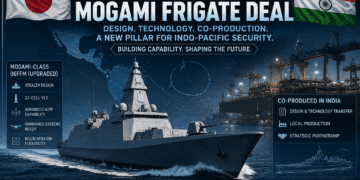
On 20 April 2026, Japan formally offered India the design, technology transfer, and co-production framework for the upgraded Mogami-class frigate, specifically the 06FFM variant currently entering production. The proposal includes design data, material supply, and a pathway for local construction in Indian shipyards.
This was not an isolated move. It followed Japan’s April 2026 decision to lift restrictions on lethal defence exports and came in parallel with its A$20 billion frigate programme with Australia.
The sequencing matters. Tokyo is not simply exporting a platform. It is building an Indo-Pacific production and interoperability network anchored around a common frigate architecture. India is being positioned as a central industrial and operational node within that network.
The dominant narrative frames this as a response to China. The deeper story is more structural. This is a test of whether India can absorb external design logic without fragmenting its already complex naval ecosystem.
Japan India Mogami Frigate Deal Begins With a News Signal but Extends Into Industrial Dependence
At the news level, the Japan India Mogami frigate deal is one of the most expansive defence-industrial offers Japan has made to any partner. It includes early-stage local construction, unlike the Australian model which begins with Japan-built hulls before transitioning to domestic production.
This positions India not just as a buyer but as a manufacturing partner from the outset. It also builds on an existing foundation. The November 2024 agreement on co-developing the UNICORN integrated mast system, involving Bharat Electronics Limited and Japanese industry partners, effectively pre-aligns the sensor layer of the platform.
However, the industrial logic behind the offer is not purely strategic alignment. Japan’s shipbuilding sector, led by Mitsubishi Heavy Industries, has long faced the constraint of low domestic production volumes.
Export orders are a mechanism to stabilize production economics, sustain workforce density, and justify capital investment in shipyards. India’s inclusion in this framework reflects that structural requirement.
This introduces a dependency layer that is often underplayed. The co-production model reportedly involves Japanese supply of specific materials and critical subsystems. That does not negate the value of the deal, but it conditions India’s autonomy.
If material supply chains remain externally anchored, India’s ability to scale production during crisis conditions becomes contingent. The deal offers industrial acceleration, but not full industrial independence.
Japan India Mogami Frigate Deal Strengthens Capability While Complicating Integration
At the operational level, the Japan India Mogami frigate deal addresses a real capability gap. The upgraded 06FFM variant expands vertical launch capacity, enhances anti-submarine warfare capability, and incorporates modular mission systems for unmanned platforms. In the context of increasing undersea activity in the Indian Ocean, this is not marginal capability. It is directly relevant to India’s maritime security posture.
Yet the integration challenge runs in the opposite direction. India’s naval architecture is already a composite system, combining Russian-origin weapons, Western sensors, and indigenous command frameworks. The Mogami introduces a new integration logic built around Japanese and Western standards. The friction point is not hardware. It is how these systems communicate, synchronize, and operate within a unified command structure.
The most immediate manifestation of this challenge lies in weapons integration. India’s reliance on the BrahMos missile creates a structural incompatibility with the platform’s baseline configuration. Integrating a larger, jointly developed missile into a Japanese-designed launch and fire control system is not just a technical task.
It involves legal constraints around third-party technology transfer and architectural adjustments to the combat system. [VERIFY BEFORE PUBLICATION: Extent of permissible third-party integration under Japan’s export control framework.]
At the decision layer, the divergence is even sharper. The Mogami-class operates with significantly reduced crew through high automation and an advanced combat information centre architecture. India’s existing frigates follow a different operational philosophy with higher crew density and different command workflows.
Operating both within the same fleet requires doctrinal adaptation, not just training. Without that adaptation, capability gains at the platform level do not translate into operational coherence.
Japan India Mogami Frigate Deal Expands Mobility but Stretches Logistics and Shipyard Capacity
The mobility advantages of the Mogami-class are clear. It is designed for flexible deployment with lower logistical burden per unit, enabling sustained presence across dispersed maritime zones. For India, this aligns with its requirement to operate across the Indian Ocean and extend into the wider Indo-Pacific.
But mobility is inseparable from sustainment. If critical maintenance inputs remain tied to Japanese supply chains, operational endurance becomes externally influenced. This is particularly relevant in high-intensity scenarios where supply chains are disrupted or reprioritized.
A more immediate constraint lies in shipyard capacity. India’s primary naval shipyards, including Mazagon Dock and Garden Reach, are already committed to multiple ongoing programmes. Introducing a new co-production line into this pipeline creates scheduling pressure.
The issue is not whether India can build the platform. It is whether it can do so without delaying existing programmes or requiring unplanned expansion of shipyard infrastructure. [VERIFY BEFORE PUBLICATION: Current yard utilization rates and expansion plans.]
A useful way to visualize this is through a production timeline overlay mapping all active naval construction programmes against available yard capacity. Such a model would likely show that India’s shipbuilding ambition is approaching saturation, and the Mogami adds further load to an already constrained system.
Japan India Mogami Frigate Deal Signals Indo-Pacific Alignment but Tests System Coherence
Strategically, the Japan India Mogami frigate deal reflects a deeper alignment between India and Japan within the Indo-Pacific. When viewed alongside Japan’s parallel programme with Australia, it suggests the emergence of a shared platform ecosystem across key regional navies. This has clear interoperability benefits.
Shared propulsion systems, maintenance cycles, and training frameworks reduce friction in joint operations without requiring formal alliance structures.
However, interoperability at the platform level does not automatically translate into system-level coherence. China’s naval advantage is not just numerical. It lies in integrated command, sensor fusion, and coordinated deployment across its fleet. India’s challenge is different. It is managing diversity, not scale.
Each additional external collaboration introduces capability but also complexity. The Mogami-class could enhance India’s fleet numerically and technologically. But unless it is integrated into a unified sensor-to-shooter architecture, it risks becoming an advanced but partially isolated asset.
The deeper question is whether India is building a fleet or an ecosystem. The Mogami deal sits directly at that intersection.
Can the Japan India Mogami Frigate Deal Scale Without Deepening India’s Integration Gap?
The Japan India Mogami frigate deal offers speed, capability, and strategic alignment. It also introduces new dependencies, integration challenges, and industrial constraints that extend beyond the platform itself. India can build these ships.
That is not in question. The real issue is whether it can absorb them into a coherent operational system.
If the Mogami becomes another standalone layer within an already heterogeneous fleet, the integration burden increases rather than decreases. If it is used deliberately to standardize automation, refine integration protocols, and inform future design programmes, it becomes a structural upgrade.
The unresolved tension is clear. As India scales its fleet through partnerships like the Japan India Mogami frigate deal, can it maintain a unified, interoperable naval architecture, or will each new collaboration deepen the fragmentation it is trying to overcome?
FAQs
What exactly has Japan offered India under this deal?
Japan has offered the upgraded Mogami-class (06FFM) with design transfer, co-production rights, and material support, allowing construction in Indian shipyards from an early stage.
Why is this deal significant beyond naval acquisition?
It represents Japan’s shift toward full-spectrum defence exports and positions India within a broader Indo-Pacific industrial and interoperability framework.
What is the biggest technical challenge in this deal?
The integration of Indian weapons systems, particularly BrahMos, into the Japanese-designed combat and launch architecture remains a major unresolved issue.
Will this affect India’s indigenous shipbuilding programmes?
Yes, it could create scheduling and capacity pressures unless managed alongside existing programmes like Project 17A and future frigate development.
Does this deal improve India’s position against China?
It enhances capability, particularly in anti-submarine warfare, but its strategic impact depends on how well the platform is integrated into India’s broader naval system.

