




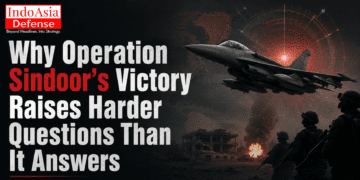












India won the four-day air campaign of May 2025. But the structural questions the operation raised about sustained combat capability remain unanswered, and the next crisis will not afford the same restraints.
Twelve months on, the contours of Operation Sindoor are clear enough to permit honest assessment. Between 1:05 and 1:30 a.m. on 7 May 2025, the Indian Air Force struck nine targets across Pakistan and Pakistan-occupied Kashmir.
The four-day campaign that followed inflicted significant attrition on the Pakistan Air Force, degraded its high-value airborne platforms, damaged multiple airbases, and ended with Islamabad requesting a halt to hostilities on 10 May.
By any reasonable operational metric, India won.
The IAF Chief, Air Chief Marshal A.P. Singh, has publicly attributed to Pakistan losses of four to five fighters, one Saab 2000 Erieye AEW&C aircraft, and damage to radars, command nodes, and runways.
Open-source satellite imagery has corroborated significant damage to airbases including Nur Khan, Bholari, Shahbaz, and several others. A C-130 transport was destroyed at Nur Khan. Hangars sheltering high-value assets, including the PAF’s F-16 fleet undergoing maintenance at Jacobabad, suffered confirmed strikes.
This was the most consequential cross-border kinetic operation India has undertaken since 1971.
And yet, a year of distance from the event permits a question the immediate aftermath could not accommodate. India demonstrated a capability. Did India demonstrate a system?
The distinction is not pedantic. It defines whether the next confrontation, when it comes, will run on the same favourable curve.
The Anatomy of “Calibrated Restraint”
The official Indian framing of Operation Sindoor leaned heavily on three adjectives. Calibrated. Focused. Non-escalatory. Foreign Secretary Vikram Misri made these terms central to the briefings of 7 May.
They served their political purpose. They signalled to Washington, to Moscow, to Beijing, and to the Gulf capitals that India was not seeking a wider war.
But beneath this vocabulary lay an operational reality that took weeks to surface.
CDS General Anil Chauhan, speaking to Bloomberg in late May 2025, became the first senior official to acknowledge that India had suffered aircraft losses on the opening night.
Captain Shiv Kumar, India’s Defence Attaché in Indonesia, subsequently elaborated in an open seminar that these losses occurred because the political leadership had constrained the IAF from striking Pakistani military installations and air defence systems.
The doctrinal implication is unambiguous.
Modern air operations open with the suppression and destruction of enemy air defences, the SEAD/DEAD sequence that targets radars, surface-to-air missiles, command nodes, and the electromagnetic infrastructure that knits them together.
This is not optional. It is the entry fee for any strike package operating in contested airspace. The IAF was denied the ability to pay that fee.
This does not mean Indian strike packages entered Pakistani airspace without any electronic support, deception, or partial suppression. They almost certainly did not.
But a systematic SEAD campaign, the kind that would have unravelled the integrated Chinese-supplied air defence architecture Pakistan now operates, was held in reserve for political reasons.
Strike aircraft therefore operated against an alerted adversary using long-range datalink-cued PL-15 missiles, with the element of surprise compromised by India’s own public signalling since the Pahalgam terror attack of 22 April.
That the operation still achieved its assigned targets says something about IAF professionalism. It says nothing about how the same force would perform if the next escalation cycle began with full operational freedom and the corresponding requirement to deliver decisive results in compressed time.
The fundamental question Operation Sindoor leaves unanswered is whether the Indian system, given both hands free, can do what it managed with one tied behind its back.
The Three-Adversary Battlespace
The single most underweighted feature of Operation Sindoor in subsequent analysis, particularly in the Indian commentariat, is that this was not a bilateral confrontation.
It was a multi-actor operational environment in which one declared adversary fought with the active rear-area support of a second nuclear power and the materiel contribution of a third regional state.
Deputy Chief of Army Staff Lieutenant General Rahul R. Singh stated this explicitly at a FICCI seminar in July 2025. Pakistan was the “front face.” China was providing comprehensive support.
Türkiye was supplying military hardware. India, in his framing, was effectively engaged with three adversaries during the 88-hour campaign.
This is not rhetorical inflation.
The Chinese contribution came in three layered tiers. The first tier was equipment and on-site technical support. In May 2026, a Chinese aerospace engineer publicly acknowledged that Aviation Industry Corporation of China personnel were present at Pakistani airbases during the operation, providing operational support for the J-10CE fleet and the PL-15 missile system. This was the first explicit Chinese admission of direct technical involvement.
The second tier was navigation, surveillance, and signals support. The BeiDou satellite constellation provided pakistani munitions with GPS-independent guidance. Chinese imagery satellites, including PRSS-1 and PakSat-MM1, reportedly delivered near-real-time imagery of Indian military deployments.
This is the assessment of Indian military sources and has been characterised in Chinese analytical writing as routine partner support, but its operational implications are anything but routine.
The third tier, and the most consequential, was real-time intelligence sharing. General Singh’s assertion that Pakistani forces continued to receive live inputs even during the DGMO-level military hotline conversations between the two countries is a serious claim.
If accurate, it represents a qualitative change in how Beijing operationalises its Pakistan relationship during crises.
The PL-15 episode deserves separate examination. According to a Reuters investigation citing both Indian and Pakistani sources, Indian Rafale pilots were briefed on the basis that the export variant of the PL-15 had a maximum engagement range of approximately 150 kilometres.
The actual engagement that contributed to Rafale attrition occurred at a range of 200 kilometres or beyond. The Pakistani PAF had received an upgraded variant, not the standard export configuration. This is not merely a missile performance discovery.
It is an intelligence failure with operational consequences, and it raises a structural question about the quality of Indian assessments regarding the China-Pakistan weapons pipeline.
The doctrinal conclusion is straightforward. The two-front threat that has occupied Indian strategic discourse for two decades is no longer a planning abstraction. It has been operationally validated within an 88-hour window. China did not merely arm Pakistan.
It provided eyes, ears, brain, and arm, a comprehensive rear-area system that allowed Pakistan to fight as a node within a larger Chinese-supported architecture.
That India still imposed favourable terms of attrition under these conditions makes the operational achievement larger, not smaller. But it also makes the planning challenge for the next crisis qualitatively different.
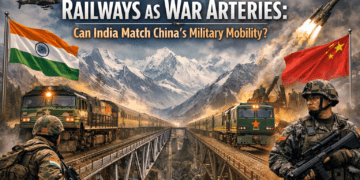
If Chinese support intensifies and Beijing simultaneously activates pressure on the Line of Actual Control, the question is whether India’s force structure has the depth to manage parallel theatres against integrated adversaries.
That question is not academic. It is the central planning problem for the IAF, the Indian Army’s Northern and Western Commands, and for the integrated defence staff for the remainder of the decade.
Stand-off Narrative Versus Penetration Reality
The Indian public narrative of Operation Sindoor settled rapidly into a satisfying frame. The operation was conducted entirely with long-range stand-off precision munitions, launched from within Indian airspace, against terrorist infrastructure that had been carefully geolocated through multi-source intelligence.
SCALP, BrahMos, HAMMER, and Crystal Maze munitions did the work. Indian aircraft never had to enter Pakistani engagement envelopes.
This frame is partially true. ORF assessments indicate that approximately six SCALP missiles struck Markaz-e-Subhan Allah at Bahawalpur and four to five Crystal Maze munitions struck the Lashkar-e-Taiba complex at Muridke. These are stand-off systems used in the manner their design envisages.
But the frame is also incomplete. If the operation had been purely stand-off, the question of aircraft attrition would not have arisen. Losses imply either penetration into engagement envelopes or vulnerability to adversary long-range engagement.
The CDS himself characterised the PAF’s deployment of long-range data-linked beyond-visual-range missiles as a “technical surprise,” which suggests Indian aircraft were detected and engaged at distances Indian planners had not fully anticipated.
This contradiction points to a deeper limitation rarely discussed in the Indian strategic literature.
The effectiveness of stand-off munitions depends almost entirely on the quality of stand-off intelligence, surveillance, and reconnaissance.
You cannot strike from beyond engagement range what you cannot see, identify, and track from beyond engagement range. India operates a respectable constellation of synthetic-aperture-radar and electro-optical satellites, but persistent real-time surveillance over denied airspace, of the kind that would allow continuous targeting cycles without manned penetration, remains a developing capability.
This limitation was particularly visible during Operation Sindoor because Pakistan was, simultaneously, receiving precisely the persistent surveillance that India had to substitute for through other means. The asymmetry was not in shooters. It was in sensors.
Magazine Depth and the Arithmetic of Sustainment
Defence Secretary R.K. Singh stated in March 2026 that India’s munitions stockpile now exceeds pre-Sindoor levels, with emergency procurement contracts having replenished and in several categories augmented inventories.
The statement is reassuring. It is also revealing. If the stockpile required emergency procurement, the obvious inference is that 88 hours of moderate-intensity operations depleted it materially.
The first night involved strikes on nine targets. The remaining days saw episodic engagement, drone exchange, and limited follow-on strikes. This was not large-scale war.
If a four-day campaign of this character significantly drew down precision munitions inventories, the planning implication for a thirty-day or sixty-day conflict is sobering.
The economics of stand-off precision compound the problem. A single SCALP munition costs approximately USD 1 million. Six SCALPs against one target at Bahawalpur represents a USD 6 million expenditure on a single facility. This is not a sustainable arithmetic for a prolonged conflict.
The decision, reported in defence trade publications, to deprioritise the BrahMos-II hypersonic programme appears to reflect exactly this realisation.
A USD 12 million per-round system, however technologically prestigious, cannot underpin a national strike doctrine if cost-per-kill cannot align with operational realities.
The BrahMos production base at Lucknow and the expanded integration facility represent meaningful capacity addition. But peacetime production rates and wartime consumption rates exist on different scales.
The gap between them is the structural vulnerability that no precision-strike celebration in the Indian press has adequately surfaced.
Sindoor was the first true validation of Indian precision-strike capability in a contested environment. It was not a validation of Indian precision-strike sustainability.
The Airframe Question No One Is Asking
If munitions are one dimension of sustainment, the platforms that deliver them are another. And here Indian defence writing, in both English and Hindi, has been notably silent.
The IAF’s authorised strength is 42 combat squadrons. Its actual strength is approximately 30. The MiG-21 fleet is in its terminal service years. Tejas Mk1A induction is hostage to HAL’s production rate, which has consistently underperformed contract commitments.
The Rafale fleet at 36 aircraft represents two squadrons, formidable but numerically limited. The Su-30MKI fleet remains the workhorse but operates with serviceability rates that vary considerably depending on spares availability.
Within any squadron, the fully serviceable airframe count is invariably lower than the establishment count. A squadron of 18 aircraft typically generates 12 to 15 mission-ready airframes on any given day.
The remainder cycle through maintenance, inspections, and minor repairs. This ratio degrades over a sustained campaign, not improves.
Modern combat aircraft are intensely maintenance-dependent. Each sortie generates inspection requirements at 25, 50, and 100 flight hour intervals. Avionics demand recalibration.
Weapon stations require checks. Engines accumulate cycles that pull aircraft into deeper depot-level maintenance.
Pilot fatigue compounds technical attrition. A campaign extending beyond ten days will see sortie generation rates, the critical metric of operational tempo, decline across every squadron involved.
India’s import dependency complicates this picture. Rafale spares come from France. Su-30 spares come from Russia, itself drained by its own war. Mirage 2000 spare parts chains are vintage and tight. A thirty-day campaign would test every link in these supply chains simultaneously.
Force multiplier platforms present an even sharper constraint. India operates six IL-78 air-to-air refuelling aircraft and a handful of AEW&C platforms including the Netra and the Phalcon.
When Pakistan lost a Saab Erieye at Bholari, it lost a meaningful fraction of its airborne surveillance capacity in a single strike. If India were to lose a single IL-78 or Netra in a future contingency, the cascading effect on strike-package tanking, ISR coverage, and battle management would constrain operational tempo across multiple sectors.
The Indian strategic conversation has correctly absorbed the lesson that magazine depth matters. It has not yet absorbed the parallel lesson that airframe depth, tanker depth, and ISR-platform depth matter equally. Weapons get headlines. Maintenance does not.
Deep Strike Versus Deep Campaign
The most important distinction Operation Sindoor surfaces, and the one Indian strategic discourse has been slowest to internalise, concerns the difference between deep-strike capability and deep-campaign capability.
Deep strike is the ability to mass precision effects against distant targets in a single, well-rehearsed mission. India demonstrated this on the night of 7 May.
The mission was carefully planned, the targets were pre-identified, the munitions were pre-positioned, and the strike package executed against the equivalent of a peacetime simulation against a real adversary. It worked, despite political constraints, despite the absence of SEAD, despite Chinese-enabled adversary readiness.
Deep campaign is something else entirely. It is the ability to sustain that precision against an adapting adversary across the second night, the seventh night, the twentieth night, and the fortieth night. It is the ability to absorb attrition without operational collapse.
It is the ability to maintain sortie rates as airframes degrade and pilots fatigue. It is the ability to keep magazines full as expenditure rates exceed production rates. It is the ability to coordinate joint operations across services, theatres, and decision nodes while under continuous adversary pressure.
Deep campaign capability is built over years of investment in industrial base, spares pipelines, training cycles, pilot pools, base hardening, dispersal infrastructure, and command-and-control resilience. It cannot be assembled in a crisis.
Operation Sindoor tested deep strike. It did not test deep campaign. The next crisis very likely will.
The S-400 Picture in Mid-2026
Few platforms have shaped the operational character of Sindoor more decisively than the S-400 system.
According to assessments cited by the IAF Chief, an S-400 unit engaged a high-value Pakistani airborne platform at approximately 300 kilometres, fundamentally redefining the operational envelope within which the PAF could safely operate its surveillance and command-and-control aircraft.
The first anniversary of Sindoor coincided, not by accident, with the delivery of India’s fourth S-400 squadron in May 2026. This squadron will deploy to the western front, likely in Rajasthan, where it will materially expand coverage of the Pakistani axis.
The fifth and final squadron under the original 2018 contract is expected by November 2026. In March 2026, the Defence Acquisition Council approved procurement of five additional squadrons, which would eventually take India’s S-400 inventory to ten units, forming the core of the Mission Sudarshan Chakra concept announced in August 2025.
This is meaningful capability accretion. It deserves to be acknowledged as such.
But three caveats temper the enthusiasm.
First, the fourth squadron is now arriving but is not yet operational. Induction, integration, and crew certification for a new S-400 unit takes months. If a contingency arose in mid-2026, the unit would not be at full operational capacity.
Second, even five squadrons cannot cover India’s full aerial perimeter. The Pakistani front, the Chinese front, the Indian Ocean approaches, and inland strategic infrastructure all compete for coverage. The decision to procure five additional squadrons is itself an admission that the original five were insufficient.
Third, and most operationally significant, the S-400 is vulnerable to saturation attack. Any air defence system, regardless of how capable individually, has a finite engagement rate.
If an adversary launches twenty cruise missiles, thirty loitering munitions, and several manned aircraft simultaneously against converging targets, even the most capable system can be overwhelmed by the engagement queue.
The medium-tier systems intended to complement S-400 in a layered architecture, including QRSAM and Akash-NG, are not yet at full induction. Until they are, S-400 is asked to do work for which it was not designed.
The S-400 is a serious system. It is not a complete answer.
The Information War India Lost
If the kinetic war was an Indian success, the information war was not. This is the most uncomfortable assessment Operation Sindoor produces, and the one Indian strategic discourse has been least willing to absorb.
Between 8 and 10 May 2025, with the guns still hot, international media coverage settled into a pattern that materially advantaged Pakistan. BBC headlines suggested Indian losses.
Reuters and Al Jazeera amplified ISPR claims of downed Indian aircraft in real time, without independent verification. The Guardian framed the conflict in terms that emphasised Indian escalation.
AP and AFP wire copy, which feeds derivative coverage across hundreds of regional outlets globally, repeatedly cited Pakistani military briefings as primary sources.
The Pahalgam terror attack that killed twenty-five Indian tourists and one Nepali citizen, which was the proximate cause of the entire crisis, was relegated to footnote status in most international coverage by the end of the first week.
This was textbook narrative inversion. The aggrieved party appeared to be the aggressor. The state sponsoring cross-border terrorism appeared to be the victim of disproportionate retaliation.
This did not happen by accident. It was the product of decades of accumulated Pakistani investment in information operations, including the ISPR media architecture, a global network of sympathetic academics, coordinated digital amplification campaigns, AI-generated content tailored for specific platforms, and a media-fluent military leadership that understood the rhythms of Western newsroom production cycles.
India’s response was structurally disadvantaged. PIB releases were largely directed at domestic audiences.
MEA briefings were factually correct but operationally slower than ISPR’s tempo. Pro-India analytical writing by figures such as John Spencer, Brahma Chellaney, and Arzan Tarapore eventually gained traction, but by the time it did, the first-impression narrative had set.
The structural diagnosis is uncomfortable but unavoidable. India does not operate a global English-language broadcast network capable of competing with BBC World, Al Jazeera English, or France 24. Doordarshan International remains a token presence.
India does not operate global wire services capable of competing with Reuters, AP, or AFP. India has not systematically cultivated a network of foreign correspondents, academics, and policy analysts capable of carrying Indian framings into international policy discourse in the way Pakistan has cultivated such networks over decades despite its smaller resource base.
The institutional culture matters here. In Indian strategic thinking, information operations are treated as ancillary to the main effort. In Pakistani strategic thinking, they are central.
Pakistan’s relative conventional weakness has forced it to invest disproportionately in asymmetric tools, and information warfare is the asymmetric tool with the longest reach and the lowest cost.
The widening Indian conventional advantage, paradoxically, has not narrowed Pakistan’s information advantage. It may have widened it.
The implication for the next crisis is direct. If India destroys ten Pakistani aircraft and loses none of its own, international headlines for the first seventy-two hours will still read some variation of “Pakistan claims downing of Indian jets.”
Indian planners need to internalise this and either invest in the infrastructure to change it or accept that battlefield victories will be accompanied by perception defeats for the foreseeable future.
The Maritime Theatre That Did Not Open
Operation Sindoor was almost entirely an air campaign. The ground exchange was limited to artillery and small-arms duels along the Line of Control. The maritime theatre was, conspicuously, quiet.
INS Vikrant’s carrier battle group deployed forward in the Arabian Sea as a signalling measure. The Pakistan Navy remained largely in port. No significant maritime engagement occurred.
This restraint was an Indian political choice, not a capability gap. India retains substantial sea-denial and sea-control capability against Pakistan, including submarines, P-8I maritime patrol aircraft, and carrier-based aviation.
But the maritime quiet of May 2025 is unlikely to characterise the next escalation.
Pakistan’s economy depends on maritime trade flowing through Karachi, which handles the majority of national imports including critical petroleum supplies. Gwadar, while strategically constructed and championed by Beijing, has limited civilian throughput but enormous symbolic and Chinese-investment value.
A serious Indian decision to interdict Pakistani maritime trade in a future contingency would compress Pakistan’s economic decision space within days.
The complication is that maritime escalation against Pakistan immediately becomes a maritime question involving China. The protection of Chinese investment at Gwadar would likely be defined by Beijing as a core interest.
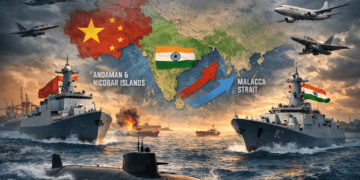
The Chinese Navy now maintains a continuous presence in the Indian Ocean Region, dating back to its 2008 anti-piracy deployment, with an established logistics facility at Djibouti and reported infrastructure access elsewhere. A maritime confrontation that began as bilateral could rapidly trilateralise.
Operation Sindoor did not test this escalation pathway. The next crisis very likely will. And Indian maritime planning, which has historically been more strategically articulate than the parallel air and ground conversations, will need to articulate how it manages a confrontation in which the adversary at sea is functionally a Chinese-Pakistani composite rather than Pakistan alone.
The China Shadow and Indian Internal Weaknesses
The strongest tendency in Indian strategic writing about Sindoor has been to read every Indian operational shortfall through the prism of Chinese support to Pakistan. This is partially correct. China was an active and consequential partner.
But the framing carries a danger. It externalises problems that are substantially internal. It allows the Indian system to escape diagnostic responsibility for failures that were structural before any Chinese involvement.
SEAD capability gaps are not a function of Chinese support to Pakistan.
They reflect decades of IAF prioritisation choices. Specialised SEAD platforms have not been a procurement priority. Anti-radiation missile inventories are modest. Dedicated electronic warfare aircraft are limited in number.
Munitions stockpile constraints are not a function of Chinese satellite imagery. They reflect the structural composition of the Indian defence budget, where revenue expenditure pressure has chronically constrained capital expenditure and war reserves.
Indian defence industrial output has been calibrated to peacetime demand patterns rather than wartime consumption rates.
The intelligence-to-strike loop’s latency, which constrained first-night targeting options, is not solely a technical problem. It is a function of organisational distances between the IB, RAW, NTRO, DIA, and service-level intelligence directorates.
This problem was identified by the Kargil Review Committee of 1999 and has been the subject of every subsequent reform commission, including the most recent CDS-led integration efforts. It remains substantially unresolved.
The information warfare deficit is not Chinese in origin either. It reflects Indian state-level under-investment in global perception infrastructure, rooted in priorities that have historically privileged domestic media management over international audience cultivation.
When these problems are read solely through the China lens, the Indian system gains a comfortable external explanation for shortcomings that require internal reform. The analytical cost is significant. It produces strategic commentary that is morally satisfying but operationally unhelpful.
The honest reading is that India faces a serious external threat made more serious by Chinese support, while simultaneously facing significant internal capability gaps that would exist even in the absence of that Chinese support. Both diagnoses are necessary. Neither is sufficient on its own.
Posture, Doctrine, and Capability
A category error pervades Indian strategic analysis of Operation Sindoor and its predecessors. Three distinct concepts get treated as if they were one.
Posture is what a state signals about how it will respond to specific provocations. It is fundamentally political. Surgical strikes in 2016, Balakot in 2019, and Sindoor in 2025 represent an evolving Indian posture, each iteration involving political acceptance of a higher escalation threshold than the previous one. Posture has shifted considerably in nine years.
Doctrine is how military organisations prepare to fight. It is an internal conceptual framework that governs training, exercise design, and force employment philosophy.
Indian air doctrine remains substantially organised around traditional air superiority concepts, with SEAD, stand-off precision, and cyber-EW integration appended as supplementary elements rather than fully synthesised into a unified operational concept.
Capability is what a force can actually do, sustained over time, at scale. It is measurable. Sortie rates. Serviceability percentages. Munitions inventories. Pilot hours. Base resilience under attack. Maintenance throughput. Doctrine without capability is wishful thinking. Capability without doctrine is undirected potential.
Operation Sindoor strengthened Indian posture. It tested doctrine partially. It exposed selective capability gaps. These three outcomes are not the same outcome, and analyses that conflate them are misleading.
The next crisis will test all three. Whether they have been sufficiently developed in concert, rather than separately, is the strategic question worth tracking over the coming year.
The Next Night and Whose Terms Define It
Operation Sindoor unfolded along a particular escalation curve. India struck terrorist infrastructure. Pakistan retaliated primarily with drones and a smaller number of missiles.
Indian air defences intercepted the majority. India returned with strikes on Pakistani airbases. Pakistan requested cessation on 10 May. The curve was bounded by mutual restraint and by political off-ramps that both leaderships chose to take.
The next curve may bend differently.
If a future Pakistani response targets Indian urban centres, or naval assets, or critical economic infrastructure, the Indian return will be quantitatively larger. Full SEAD will be necessary.
Military installations will be legitimate targets. The maritime theatre will open. The “calibration” honoured in May 2025 will likely be discarded within the first twenty-four hours.
The Chinese equation will be more direct. If Pakistani losses cross a threshold Beijing defines as unacceptable, the borrowed-knife stratagem General Singh referenced may shift toward more overt forms of involvement.
India will then face the requirement to defeat Pakistan, deter China on the LAC, sustain pressure at sea, and manage global perception simultaneously. Failure in any of these four domains can cascade into systemic failure.
Operation Sindoor was a deep-strike demonstration. One night, nine targets, precise effects. That victory belongs to India and will remain so.
The next crisis will not be a deep-strike test. It will be a deep-campaign test. The precision of the first night and the precision of the tenth night are different problems.
Modern war’s true measure of capability is not the opening salvo but the ability to sustain pressure across weeks and months. The first night is won through surprise. The tenth night is won through systems.
The systems are not yet fully built.
A year has passed. How long until the next crisis is unknowable. The question is not whether it will come.
The question is whether, by the time it does, the Indian system will have absorbed not just the comfortable lessons of May 2025 but the uncomfortable ones, and whether honest assessment will have done the institutional work that triumphalism cannot.

