



IndoAsia Defense
  • Home
  • Air
    • All
    • Air Defence
    • Drones
    • Fighters
    • ISR & Mobility
    A 250-km Missile Means Nothing If the Kill Chain Breaks

    India’s 250-km Missile Debate Is Not About Outmatching the PL-15

    Rafale F5 vs AMCA

    Rafale F5 vs AMCA: If India Buys Rafale F5, What Happens to AMCA?

    BrahMos Advantage

    BrahMos Missile Explained: The Missile That Enables India’s Stand-Off Strike Strategy

    Ghatak UCAV stealth, autonomy, integration

    Inside India’s Ghatak UCAV Program: Stealth, Autonomy, and the Integration Gap

    The F414 engine co-production agreement between Hindustan Aeronautics Limited and GE Aerospace

    India-US F414 Engine Deal Explained: Technology Transfer, Tejas Mk2, and AMCA

    What is the Su-57M1 India deal

    Su-57M1 for India: A Fifth-Generation Shortcut or a Strategic Dependency Trap?

    India indigenous long range surveillance radar with X-band drone detection capability

    450km Eyes, Machine-Speed Decisions: How India’s Indigenous Long Range Surveillance Radar Is Rewriting Air Defence

    Why Software Defined Radios Are the IAF’s Most Consequential Upgrade

    IAF Signs BEL Deal for Software Defined Radios: Rewiring India’s Air Combat Network

    How the Ghatak UCAV Stealth Design Redefines India’s Drone Warfare Doctrine

    Ghatak UCAV: India’s Carbon Composite Stealth Strategy Dissected

  • Land
    • All
    • Armour & Artillery
    • China Front
    • Future Combat
    • Pakistan Front
    Rafale F5 vs AMCA

    Rafale F5 vs AMCA: If India Buys Rafale F5, What Happens to AMCA?

    Missiles and Manufacturing Why Production Depth Defines India’s Strike Power

    Why Missile Production Depth Matters More Than Range for India

    Why Operation Sindoor's Victory Raises Harder Questions Than It Answers

    Operation Sindoor: The Uncomfortable Questions India Hasn’t Answered

    The Indo-Pacific Is Fragmenting, Not Uniting Against China

    Why the Indo-Pacific Will Not Unite Against China

    The India-South Korea defence deal

    The India-South Korea Defence Deal Through China’s Operational Lens

    Railways as War Arteries Can India Match China’s Military Mobility Before the Next Crisis

    Railways as War Arteries: Can India Match China’s Military Mobility Before the Next Crisis?

    China maritime front in Indian Ocean

    What If China Opens a Maritime Front in the Indian Ocean During a LAC Conflict?

    What is Indian military modernization strategy in 2026?

    Indian Military Modernization: Systems, Doctrine, and Capability Architecture (2026-27)

    Tank launching loitering munition in battle

    From Smoke to Strike: India’s Indigenous Loitering Munitions for T-72, T-90, and Arjun Tanks

  • Navy
    • All
    • Fleet Expansion
    • Indian Ocean
    • Maritime Security
    • Submarines
    Japan Mogami-class frigate deal overview

    Japan’s Mogami-Class Frigate Offer to India: What the Transfer Terms Reveal About Tokyo’s Indo-Pacific Calculus

    China maritime front in Indian Ocean

    What If China Opens a Maritime Front in the Indian Ocean During a LAC Conflict?

    The Strait of Hormuz Crisis

    India’s Oil Artery Under Threat: Strategic Implications of a Hormuz Crisis

    India’s VL-Shtil Missile Deal with Russia

    India’s VL-Shtil Missile Deal with Russia: Strengthening Naval Air Defense in the Indo-Pacific

    Andaman & Nicobar Command Sleeping Giant of India’s Maritime Strategy

    Andaman & Nicobar Command: Sleeping Giant of India’s Maritime Strategy

    Maritime Surveillance 2.0: Why EO/IR Modernisation Matters for India’s Ocean Security

    Maritime Surveillance 2.0: Why EO/IR Modernisation Matters for India’s Ocean Security

    2030 Will Decide the India ASEAN Maritime Equation

    2030 Will Decide the India ASEAN Maritime Equation

    India Military Transformation Series — Part 3: Maritime Power and the Indian Ocean Imperative

    India Military Transformation Series — Part 3: Maritime Power and the Indian Ocean Imperative

    Indian Navy TEDBF PPP Model: China Factor and 2030–2040 Carrier Strategy

    Indian Navy TEDBF PPP Model: China Factor and 2030–2040 Carrier Strategy

  • Indo-Pacific
    • All
    • 2035 Outlook
    • China Strategy
    • India Strategy
    • Pakistan Outlook
    General Upendra Dwivedi Smart Power

    The Army Chief Upendra Dwivedi’s “Smart Power” Speech Was a Confession, Not a Doctrine

    India defence budget

    The Two Armies India Cannot Afford to Keep Funding at Once

    The Sindoor Dividend 2.0: How India’s $93.5 Billion Defence Budget Is Rewiring Military Power for 2030

    The Sindoor Dividend 2.0: How India’s $93.5 Billion Defence Budget Is Rewiring Military Power for 2030

    Rafale F5 vs AMCA

    Rafale F5 vs AMCA: If India Buys Rafale F5, What Happens to AMCA?

    DRDO-developed Guided Pinaka

    At ₹70 Lakh Per Rocket, DRDO-developed Guided Pinaka May Represent India’s Shift Toward Scalable Precision Warfare

    The Indo-Pacific Is Fragmenting, Not Uniting Against China

    Why the Indo-Pacific Will Not Unite Against China

    Japan Mogami-class frigate deal overview

    Japan’s Mogami-Class Frigate Offer to India: What the Transfer Terms Reveal About Tokyo’s Indo-Pacific Calculus

    The India-South Korea defence deal

    The India-South Korea Defence Deal Through China’s Operational Lens

    Railways as War Arteries Can India Match China’s Military Mobility Before the Next Crisis

    Railways as War Arteries: Can India Match China’s Military Mobility Before the Next Crisis?

  • Joint
    • All
    • Integrated Ops
    • Procurement Reform
    • Theater Commands
    General Upendra Dwivedi Smart Power

    The Army Chief Upendra Dwivedi’s “Smart Power” Speech Was a Confession, Not a Doctrine

    Why Operation Sindoor's Victory Raises Harder Questions Than It Answers

    Operation Sindoor: The Uncomfortable Questions India Hasn’t Answered

    India's strategic challenge sustainability first

    India Can Strike in 22 Minutes. Can It Sustain for 22 Weeks?

    Ballistic Missile Defense system intercepting incoming missile during midcourse phase

    How Ballistic Missile Defense Works: Inside Modern Missile Interception Systems

    DAP 2026 India’s Quiet Revolution in Defence Procurement

    DAP 2026: India’s Quiet Revolution in Defence Procurement

    Integrated Battle Groups vs China’s Western Theater Command

    Integrated Battle Groups vs China’s Western Theater Command: Can Doctrine Survive the Himalayan Reality?

    Andaman & Nicobar Command Sleeping Giant of India’s Maritime Strategy

    Andaman & Nicobar Command: Sleeping Giant of India’s Maritime Strategy

    India Military Transformation Series — Part 2: The Theatre Command Reckoning

    India Military Transformation Series — Part 2: The Theatre Command Reckoning

    India AI C4ISR modernization

    India Military Transformation Series — Part 1: India AI C4ISR Modernization

  • Tech
    • All
    • AI & Autonomous Systems
    • Cyber
    • Electronic Warfare
    • Space
    Why Software Defined Radios Are the IAF’s Most Consequential Upgrade

    IAF Signs BEL Deal for Software Defined Radios: Rewiring India’s Air Combat Network

    Source Code or ICD India’s Source Code Negotiation Explained

    Source Code or ICD: India’s Source Code Negotiation Explained

    Supply Chain Weaponization

    Supply Chain Weaponization: Strategic Autonomy Meets Semiconductor Reality

    AI-driven battlefield in India's military

    The Algorithm of Borders: What India’s Military AI Push Actually Looks Like on the Ground

    India AI C4ISR modernization

    India Military Transformation Series — Part 1: India AI C4ISR Modernization

    PRAHAR Explained India Counter Terror Policy Prahaar

    PRAHAAR Explained: Why ‘PRAHAAR’ India’s National Counter-terrorism Doctrine, Signals the End of Traditional Warfare

    The Weapons Making the AMCA Unbeatable

    The Weapons Making the AMCA Unbeatable

    India’s Aerospace Ecosystem After Rafale: The 2026–2030 Industrial Test

    India’s Aerospace Ecosystem After Rafale: The 2026–2030 Industrial Test

    PLA’s Cyber Warfare Units and the Question of Indian Critical Infrastructure Resilience

    PLA’s Cyber Warfare Units and the Question of Indian Critical Infrastructure Resilience

  • Industry
    • All
    • Budget
    • Exports
    • Make in India
    • Supply Chains
    General Upendra Dwivedi Smart Power

    The Army Chief Upendra Dwivedi’s “Smart Power” Speech Was a Confession, Not a Doctrine

    India defence budget

    The Two Armies India Cannot Afford to Keep Funding at Once

    The Sindoor Dividend 2.0: How India’s $93.5 Billion Defence Budget Is Rewiring Military Power for 2030

    The Sindoor Dividend 2.0: How India’s $93.5 Billion Defence Budget Is Rewiring Military Power for 2030

    Rafale F5 vs AMCA

    Rafale F5 vs AMCA: If India Buys Rafale F5, What Happens to AMCA?

    BrahMos Advantage

    BrahMos Missile Explained: The Missile That Enables India’s Stand-Off Strike Strategy

    Missiles and Manufacturing Why Production Depth Defines India’s Strike Power

    Why Missile Production Depth Matters More Than Range for India

    India’s Defence MSME Blind Spot Could Become a Wartime Liability

    India’s Defence MSME Blind Spot Could Become a Wartime Liability

    India's strategic challenge sustainability first

    India Can Strike in 22 Minutes. Can It Sustain for 22 Weeks?

    India-UAE defence pact and Gulf strategy

    India-UAE Defence Pact: Why Abu Dhabi Is Becoming India’s Western Strategic Depth

  • Global
    • All
    • China-Pak
    • Emerging Tech
    • Middle Eeast
    • Regional Trends
    • US-India
    • US-Israel
    Rafale F5 vs AMCA

    Rafale F5 vs AMCA: If India Buys Rafale F5, What Happens to AMCA?

    India-UAE defence pact and Gulf strategy

    India-UAE Defence Pact: Why Abu Dhabi Is Becoming India’s Western Strategic Depth

    The Indo-Pacific Is Fragmenting, Not Uniting Against China

    Why the Indo-Pacific Will Not Unite Against China

    Ghatak UCAV stealth, autonomy, integration

    Inside India’s Ghatak UCAV Program: Stealth, Autonomy, and the Integration Gap

    The F414 engine co-production agreement between Hindustan Aeronautics Limited and GE Aerospace

    India-US F414 Engine Deal Explained: Technology Transfer, Tejas Mk2, and AMCA

    india military integration gap

    Is India Building Military Power Faster Than It Can Integrate It?

    India indigenous long range surveillance radar with X-band drone detection capability

    450km Eyes, Machine-Speed Decisions: How India’s Indigenous Long Range Surveillance Radar Is Rewriting Air Defence

    What is Indian military modernization strategy in 2026?

    Indian Military Modernization: Systems, Doctrine, and Capability Architecture (2026-27)

    India’s 6th-Gen Fighter Strategy FCAS vs GCAP Explained

    India’s 6th-Gen Fighter Strategy: FCAS vs GCAP Explained

  • Resources
    • India Military Capability Index
    • India vs China Military Balance
    • China Western Theater Command Guide
    • Pakistan Military Tracker 2026-27
    • India’s Military Doctrine Library
    • India vs China vs Pakistan Missile Arsenal Comparison
    • India’s Missile List
    • India Missile Range Map
    • Indo-Pacific Military Power Map
    • Indo-Pacific Defense Timeline
    • Global Military Balance Dashboard
    • Global Weapons Systems Database
    • Global Missile Systems Database
  • What If
    • China India Naval Conflict
No Result
View All Result
  • Home
  • Air
    • All
    • Air Defence
    • Drones
    • Fighters
    • ISR & Mobility
    A 250-km Missile Means Nothing If the Kill Chain Breaks

    India’s 250-km Missile Debate Is Not About Outmatching the PL-15

    Rafale F5 vs AMCA

    Rafale F5 vs AMCA: If India Buys Rafale F5, What Happens to AMCA?

    BrahMos Advantage

    BrahMos Missile Explained: The Missile That Enables India’s Stand-Off Strike Strategy

    Ghatak UCAV stealth, autonomy, integration

    Inside India’s Ghatak UCAV Program: Stealth, Autonomy, and the Integration Gap

    The F414 engine co-production agreement between Hindustan Aeronautics Limited and GE Aerospace

    India-US F414 Engine Deal Explained: Technology Transfer, Tejas Mk2, and AMCA

    What is the Su-57M1 India deal

    Su-57M1 for India: A Fifth-Generation Shortcut or a Strategic Dependency Trap?

    India indigenous long range surveillance radar with X-band drone detection capability

    450km Eyes, Machine-Speed Decisions: How India’s Indigenous Long Range Surveillance Radar Is Rewriting Air Defence

    Why Software Defined Radios Are the IAF’s Most Consequential Upgrade

    IAF Signs BEL Deal for Software Defined Radios: Rewiring India’s Air Combat Network

    How the Ghatak UCAV Stealth Design Redefines India’s Drone Warfare Doctrine

    Ghatak UCAV: India’s Carbon Composite Stealth Strategy Dissected

  • Land
    • All
    • Armour & Artillery
    • China Front
    • Future Combat
    • Pakistan Front
    Rafale F5 vs AMCA

    Rafale F5 vs AMCA: If India Buys Rafale F5, What Happens to AMCA?

    Missiles and Manufacturing Why Production Depth Defines India’s Strike Power

    Why Missile Production Depth Matters More Than Range for India

    Why Operation Sindoor's Victory Raises Harder Questions Than It Answers

    Operation Sindoor: The Uncomfortable Questions India Hasn’t Answered

    The Indo-Pacific Is Fragmenting, Not Uniting Against China

    Why the Indo-Pacific Will Not Unite Against China

    The India-South Korea defence deal

    The India-South Korea Defence Deal Through China’s Operational Lens

    Railways as War Arteries Can India Match China’s Military Mobility Before the Next Crisis

    Railways as War Arteries: Can India Match China’s Military Mobility Before the Next Crisis?

    China maritime front in Indian Ocean

    What If China Opens a Maritime Front in the Indian Ocean During a LAC Conflict?

    What is Indian military modernization strategy in 2026?

    Indian Military Modernization: Systems, Doctrine, and Capability Architecture (2026-27)

    Tank launching loitering munition in battle

    From Smoke to Strike: India’s Indigenous Loitering Munitions for T-72, T-90, and Arjun Tanks

  • Navy
    • All
    • Fleet Expansion
    • Indian Ocean
    • Maritime Security
    • Submarines
    Japan Mogami-class frigate deal overview

    Japan’s Mogami-Class Frigate Offer to India: What the Transfer Terms Reveal About Tokyo’s Indo-Pacific Calculus

    China maritime front in Indian Ocean

    What If China Opens a Maritime Front in the Indian Ocean During a LAC Conflict?

    The Strait of Hormuz Crisis

    India’s Oil Artery Under Threat: Strategic Implications of a Hormuz Crisis

    India’s VL-Shtil Missile Deal with Russia

    India’s VL-Shtil Missile Deal with Russia: Strengthening Naval Air Defense in the Indo-Pacific

    Andaman & Nicobar Command Sleeping Giant of India’s Maritime Strategy

    Andaman & Nicobar Command: Sleeping Giant of India’s Maritime Strategy

    Maritime Surveillance 2.0: Why EO/IR Modernisation Matters for India’s Ocean Security

    Maritime Surveillance 2.0: Why EO/IR Modernisation Matters for India’s Ocean Security

    2030 Will Decide the India ASEAN Maritime Equation

    2030 Will Decide the India ASEAN Maritime Equation

    India Military Transformation Series — Part 3: Maritime Power and the Indian Ocean Imperative

    India Military Transformation Series — Part 3: Maritime Power and the Indian Ocean Imperative

    Indian Navy TEDBF PPP Model: China Factor and 2030–2040 Carrier Strategy

    Indian Navy TEDBF PPP Model: China Factor and 2030–2040 Carrier Strategy

  • Indo-Pacific
    • All
    • 2035 Outlook
    • China Strategy
    • India Strategy
    • Pakistan Outlook
    General Upendra Dwivedi Smart Power

    The Army Chief Upendra Dwivedi’s “Smart Power” Speech Was a Confession, Not a Doctrine

    India defence budget

    The Two Armies India Cannot Afford to Keep Funding at Once

    The Sindoor Dividend 2.0: How India’s $93.5 Billion Defence Budget Is Rewiring Military Power for 2030

    The Sindoor Dividend 2.0: How India’s $93.5 Billion Defence Budget Is Rewiring Military Power for 2030

    Rafale F5 vs AMCA

    Rafale F5 vs AMCA: If India Buys Rafale F5, What Happens to AMCA?

    DRDO-developed Guided Pinaka

    At ₹70 Lakh Per Rocket, DRDO-developed Guided Pinaka May Represent India’s Shift Toward Scalable Precision Warfare

    The Indo-Pacific Is Fragmenting, Not Uniting Against China

    Why the Indo-Pacific Will Not Unite Against China

    Japan Mogami-class frigate deal overview

    Japan’s Mogami-Class Frigate Offer to India: What the Transfer Terms Reveal About Tokyo’s Indo-Pacific Calculus

    The India-South Korea defence deal

    The India-South Korea Defence Deal Through China’s Operational Lens

    Railways as War Arteries Can India Match China’s Military Mobility Before the Next Crisis

    Railways as War Arteries: Can India Match China’s Military Mobility Before the Next Crisis?

  • Joint
    • All
    • Integrated Ops
    • Procurement Reform
    • Theater Commands
    General Upendra Dwivedi Smart Power

    The Army Chief Upendra Dwivedi’s “Smart Power” Speech Was a Confession, Not a Doctrine

    Why Operation Sindoor's Victory Raises Harder Questions Than It Answers

    Operation Sindoor: The Uncomfortable Questions India Hasn’t Answered

    India's strategic challenge sustainability first

    India Can Strike in 22 Minutes. Can It Sustain for 22 Weeks?

    Ballistic Missile Defense system intercepting incoming missile during midcourse phase

    How Ballistic Missile Defense Works: Inside Modern Missile Interception Systems

    DAP 2026 India’s Quiet Revolution in Defence Procurement

    DAP 2026: India’s Quiet Revolution in Defence Procurement

    Integrated Battle Groups vs China’s Western Theater Command

    Integrated Battle Groups vs China’s Western Theater Command: Can Doctrine Survive the Himalayan Reality?

    Andaman & Nicobar Command Sleeping Giant of India’s Maritime Strategy

    Andaman & Nicobar Command: Sleeping Giant of India’s Maritime Strategy

    India Military Transformation Series — Part 2: The Theatre Command Reckoning

    India Military Transformation Series — Part 2: The Theatre Command Reckoning

    India AI C4ISR modernization

    India Military Transformation Series — Part 1: India AI C4ISR Modernization

  • Tech
    • All
    • AI & Autonomous Systems
    • Cyber
    • Electronic Warfare
    • Space
    Why Software Defined Radios Are the IAF’s Most Consequential Upgrade

    IAF Signs BEL Deal for Software Defined Radios: Rewiring India’s Air Combat Network

    Source Code or ICD India’s Source Code Negotiation Explained

    Source Code or ICD: India’s Source Code Negotiation Explained

    Supply Chain Weaponization

    Supply Chain Weaponization: Strategic Autonomy Meets Semiconductor Reality

    AI-driven battlefield in India's military

    The Algorithm of Borders: What India’s Military AI Push Actually Looks Like on the Ground

    India AI C4ISR modernization

    India Military Transformation Series — Part 1: India AI C4ISR Modernization

    PRAHAR Explained India Counter Terror Policy Prahaar

    PRAHAAR Explained: Why ‘PRAHAAR’ India’s National Counter-terrorism Doctrine, Signals the End of Traditional Warfare

    The Weapons Making the AMCA Unbeatable

    The Weapons Making the AMCA Unbeatable

    India’s Aerospace Ecosystem After Rafale: The 2026–2030 Industrial Test

    India’s Aerospace Ecosystem After Rafale: The 2026–2030 Industrial Test

    PLA’s Cyber Warfare Units and the Question of Indian Critical Infrastructure Resilience

    PLA’s Cyber Warfare Units and the Question of Indian Critical Infrastructure Resilience

  • Industry
    • All
    • Budget
    • Exports
    • Make in India
    • Supply Chains
    General Upendra Dwivedi Smart Power

    The Army Chief Upendra Dwivedi’s “Smart Power” Speech Was a Confession, Not a Doctrine

    India defence budget

    The Two Armies India Cannot Afford to Keep Funding at Once

    The Sindoor Dividend 2.0: How India’s $93.5 Billion Defence Budget Is Rewiring Military Power for 2030

    The Sindoor Dividend 2.0: How India’s $93.5 Billion Defence Budget Is Rewiring Military Power for 2030

    Rafale F5 vs AMCA

    Rafale F5 vs AMCA: If India Buys Rafale F5, What Happens to AMCA?

    BrahMos Advantage

    BrahMos Missile Explained: The Missile That Enables India’s Stand-Off Strike Strategy

    Missiles and Manufacturing Why Production Depth Defines India’s Strike Power

    Why Missile Production Depth Matters More Than Range for India

    India’s Defence MSME Blind Spot Could Become a Wartime Liability

    India’s Defence MSME Blind Spot Could Become a Wartime Liability

    India's strategic challenge sustainability first

    India Can Strike in 22 Minutes. Can It Sustain for 22 Weeks?

    India-UAE defence pact and Gulf strategy

    India-UAE Defence Pact: Why Abu Dhabi Is Becoming India’s Western Strategic Depth

  • Global
    • All
    • China-Pak
    • Emerging Tech
    • Middle Eeast
    • Regional Trends
    • US-India
    • US-Israel
    Rafale F5 vs AMCA

    Rafale F5 vs AMCA: If India Buys Rafale F5, What Happens to AMCA?

    India-UAE defence pact and Gulf strategy

    India-UAE Defence Pact: Why Abu Dhabi Is Becoming India’s Western Strategic Depth

    The Indo-Pacific Is Fragmenting, Not Uniting Against China

    Why the Indo-Pacific Will Not Unite Against China

    Ghatak UCAV stealth, autonomy, integration

    Inside India’s Ghatak UCAV Program: Stealth, Autonomy, and the Integration Gap

    The F414 engine co-production agreement between Hindustan Aeronautics Limited and GE Aerospace

    India-US F414 Engine Deal Explained: Technology Transfer, Tejas Mk2, and AMCA

    india military integration gap

    Is India Building Military Power Faster Than It Can Integrate It?

    India indigenous long range surveillance radar with X-band drone detection capability

    450km Eyes, Machine-Speed Decisions: How India’s Indigenous Long Range Surveillance Radar Is Rewriting Air Defence

    What is Indian military modernization strategy in 2026?

    Indian Military Modernization: Systems, Doctrine, and Capability Architecture (2026-27)

    India’s 6th-Gen Fighter Strategy FCAS vs GCAP Explained

    India’s 6th-Gen Fighter Strategy: FCAS vs GCAP Explained

  • Resources
    • India Military Capability Index
    • India vs China Military Balance
    • China Western Theater Command Guide
    • Pakistan Military Tracker 2026-27
    • India’s Military Doctrine Library
    • India vs China vs Pakistan Missile Arsenal Comparison
    • India’s Missile List
    • India Missile Range Map
    • Indo-Pacific Military Power Map
    • Indo-Pacific Defense Timeline
    • Global Military Balance Dashboard
    • Global Weapons Systems Database
    • Global Missile Systems Database
  • What If
    • China India Naval Conflict
No Result
View All Result
IndoAsia Defense
No Result
View All Result
Home Indo-Pacific India Strategy

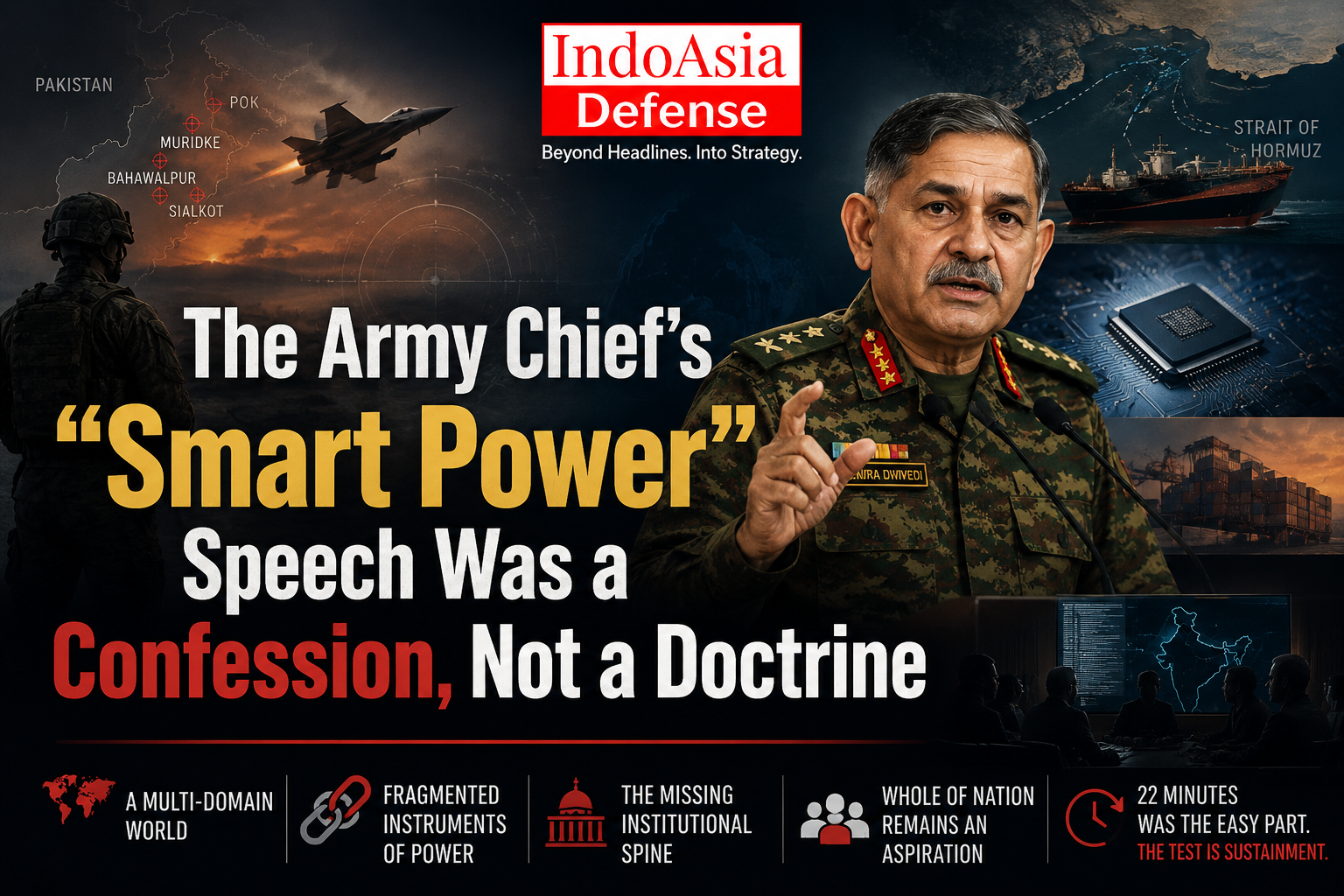
The Army Chief Upendra Dwivedi’s “Smart Power” Speech Was a Confession, Not a Doctrine

Operation Sindoor demonstrated that India can execute a precise military strike. General Upendra Dwivedi's Smart Power speech raised a more difficult question: can the Indian state coordinate its military, industrial, economic, and technological instruments under prolonged strategic pressure?

IndoAsia Defense by IndoAsia Defense
June 5, 2026
in India Strategy, Make in India, Procurement Reform, Supply Chains
0
General Upendra Dwivedi Smart Power

General Dwivedi's Smart Power Doctrine Reveals India's Real Security Challenge

0
SHARES
3
VIEWS
Share on LinkedinShare on FacebookShare on Twitter

On 19 May 2026, at the Manekshaw Centre in New Delhi, General Upendra Dwivedi gave the headline writers exactly what they came for. Operation Sindoor, a year on. The 22-minute strike window. Nine targets across Bahawalpur, Muridke, Sialkot and Pakistan-administered Kashmir. The deliberate halt at 88 hours. All of it dutifully reported the next morning, and forgotten by the one after.

The most consequential sentence in that speech was about none of those things. It was about India. And it read less like a statement of doctrine than an admission the Army does not often make from a public stage.

Speaking at a Centre for Land Warfare Studies seminar titled “Security to Prosperity: Smart Power for Sustained National Growth,” Dwivedi argued that the boundary between security and prosperity has effectively dissolved. He reached for the familiar DIME framework, the diplomatic, informational, military and economic instruments of statecraft, and said it now needs a fifth element, technology, plus a “whole of nation” approach to make the other four move together.

Read that again. When a serving Chief of Army Staff stands at a think-tank podium and calls for the nation’s instruments to act as one coherent whole, he is telling you, plainly, that they currently do not. The call is the diagnosis. Everything worth analysing in the speech follows from that single inversion.

The 22-Minute Strike Was the Easy Part

The operational facts of Sindoor are now in the public record. The strike on the night of 6–7 May 2025 answered the 22 April Pahalgam attack, which killed twenty-six civilians. It was a tri-service action against nine terror-linked targets, executed with precision-guided munitions, inside a defined 22-minute window, and then stopped after 88 hours.

Dwivedi framed that halt as “smart power in its most complete expression”: the discipline to know which instrument to apply, at what intensity, and when to stop. It is a clean story. It is also where the analysis has to slow down, because the clean story conceals the harder question.

Choice or constraint?

A halt is restraint only if continuing was a real option. If India stopped because it chose to, the 88-hour ceiling demonstrates escalation control, the ability to hold the upper hand even as pressure builds. If India stopped because continuing was becoming difficult, whether through magazine depth, the arithmetic of sustained precision strikes, diplomatic pressure, or the management of Pakistani nuclear signalling, then the halt was a constraint wearing the costume of a choice.

From outside, we cannot know which it was, and honesty requires saying so. But the distinction is not cosmetic. The entire logic of escalation dominance rests on one assumption: that the option to go further actually exists. If that option was thinner than the official framing suggests, an adversary will read the constraint before India’s own commentary does. Posture is what you signal. Capability is what survives contact.

Doctrine is the theory that connects the two. Operation Sindoor showed India can compress the first strike into twenty-two minutes. It said almost nothing about what happens in the eighty-ninth hour of a crisis that does not end on India’s schedule.

Striking is a solved problem. Sustaining the position after the strike, on terms you set, is the unsolved one.

Two Vulnerabilities, Not One Supply Chain

Dwivedi offered two illustrations of how interdependence has become coercion: the Strait of Hormuz, which he called a zone of active contestation, and semiconductors, whose selective availability he described as a tool of leverage.

He also noted, correctly, that global defence spending has crossed 2.7 trillion dollars, more than the entire UN budget for the Sustainable Development Goals.

It is tempting to file both examples under “supply-chain risk” and move on. That would be an analytical error, because they are different vulnerabilities with different clocks and different cures.

Hormuz is a vulnerability of geography, and it is immediate. India imports the large majority of its crude, and depending on the year, roughly 40 to 50 percent of it transits Hormuz; that share has risen recently as Indian refiners trimmed Russian purchases.

The cushion is thinner than the headline storage figures suggest. The dedicated Strategic Petroleum Reserve covers only about nine to ten days of imports.

Counting the commercial stocks held by state oil companies, total national storage reaches roughly seventy days, but a sustained chokepoint disruption bites into an economy long before tanks run dry.

This vulnerability is not fixed by another fighter squadron. It is fixed by storage, bypass routes, and diplomatic reach in the Gulf. The answer does not sit with the armed forces at all.

The semiconductor vulnerability is structural, and it is long. India has finally moved past the announcement stage: the Tata–PSMC fab at Dholera is under construction with first silicon targeted for late 2026, and Micron’s assembly and test facility at Sanand was inaugurated in February 2026. But the relevant detail is the node.

These plants are built for 28-nanometre and larger geometries, the mature nodes that run cars, appliances and industrial electronics. That is sensible industrial policy.

It is not sovereignty over the advanced silicon that sits inside seekers, AESA radars and modern datalinks. Those chips still come from abroad, and India’s own roadmap places domestic leading-edge production somewhere around the middle of the next decade. What comes from abroad can be withheld at precisely the moment it is most needed.

One vulnerability needs an answer by next monsoon. The other will resist solution for a decade. Collapsing them into a single talking point is rhetorically convenient and strategically dangerous.

DIME Is Breaking Down, and Adding a Letter Will Not Fix It

The deeper problem with the speech is not the content of the prescription but what the prescription reveals. A state can wield national power “as one coherent act” only if it has a spine to coordinate it. India does not have that spine, and the gap is older and more domestic than any external threat.

Start with the most authoritative tell, the one that sits at the top of any honest evidence hierarchy: published doctrine. India has no public national security strategy. There is no document that states the country’s threats, ranks its priorities, and sequences its resources accordingly.

This is not the same as having no thinking; the thinking exists, scattered across ministries and service headquarters, each optimising for its own mandate. What is missing is the standing machinery to fuse it under pressure.

This is why “add technology to DIME” misreads the problem. The DIME construct assumed that diplomacy, information, military force and economics were separable boxes, each managed by its own institution. Technology dissolves that assumption.

A single satellite constellation supports military targeting, civilian communications, and the timing layer that financial markets run on. A single undersea cable carries both a nation’s data and the heartbeat of its payments system.

A single class of chip sits in a missile’s guidance section and in a consumer handset. Technology does not stand beside the four pillars. It runs through all of them at once. So the real question is not where to insert a “T.”

It is who, in a real crisis, sits at one table and reads a shock that strikes diplomacy, information, economy and military readiness simultaneously. Today there is no clear answer. “Whole of nation” is the polite name for that empty chair.

The Fragmentation Is Indian, Not Chinese

There is a reflex in Indian strategic writing to explain every domestic shortfall through Beijing. China did X, therefore India failed to do Y. It is the easy frame, and because it is easy, it has become the default. It is also, often, wrong.

India’s fragmentation is not a reaction to China. Its roots are internal, and they predate China’s rise by decades.

The acquisition system routinely takes the better part of a decade to move a platform from sanction to induction, a pathology with no connection to the Line of Actual Control. The industrial base is fractured, with DRDO, the defence public-sector undertakings and private industry behaving more as rivals than as a single production ecosystem.

The budget itself is the constraint that gets least attention: revenue expenditure, dominated by salaries and pensions, steadily crowds out the capital expenditure that buys new capability, so even agreed modernisation competes for a shrinking slice.

And the services pursue their own institutional interests, which is why theaterisation, the single most important structural reform on the table, has stalled in debate for years rather than moving to implementation.

None of this was authored in Beijing. Treating China as the cause is a way of deferring the diagnosis. If the real driver is internal, the cure is internal too. The external threat is a factor in the timing. It is not the origin of the disease.

Long Wars Are Won in Factories

Ukraine settled an argument that two decades of expeditionary, precision-centric thinking had let drift. Long wars are not decided by the courage of the first echelon. They are decided by the depth of the magazine and the throughput of the factory behind it.

Artillery consumption ran into the millions of rounds a year, and even the most advanced Western industrial bases struggled to keep pace with demand they had stopped planning for.

Dwivedi’s emphasis on industrial capacity and research systems is the right instinct. The trouble is that India’s record here is unforgiving, and recent rather than historical.

A 2017 audit by the Comptroller and Auditor General found that for roughly 40% of the 152 critical ammunition types, war-wastage reserves stood at only about ten days of intense fighting, against a stated norm of forty days and a minimum acceptable level of twenty.

The worst shortfalls were in artillery and tank ammunition, precisely the natures that decide a sustained land fight. Emergency procurement powers were subsequently delegated to the Vice Chief, and the picture has reportedly improved since.

But the structural point survives every revision. Buying stock is one thing. Producing it continuously, for months, while under fire, is another. The first is solved with money. The second is solved only with industrial capacity that exists before the war begins.

Make the scale human. Sustaining an armoured regiment through a Ladakh winter is not a question of valour but of tonnage: fuel hauled up hundreds of kilometres of fragile road, in temperatures where hydraulic and lubricating fluids stop behaving predictably, week after week, before a single round is fired.

India lost in 1962 less to tactics than to that logistics chain. Kargil in 1999 was won with artillery, but even then the adequacy of shell stocks was a live worry. The lesson keeps arriving, and keeps being half-learned.

India today sits in the most dangerous phase of all: independent enough to make large claims, not yet independent enough to fight a long war alone. Critical engines, advanced electronics and key sub-systems still arrive from abroad. “Atmanirbhar Bharat” is a compelling slogan and an incomplete reality, and the gap between the two is exactly where an adversary would aim.

China Is the Mirror, Not the Cause

Respecting an adversary’s capability is not pessimism; it is the precondition for serious analysis. China has to be read concretely, not as a slogan, and the comparison is sobering.

The scale is the place to begin. The People’s Liberation Army Navy is now the largest in the world by hull count, with over 370 ships and submarines per the Pentagon’s most recent China Military Power Report.

The fleet behind the fleet matters even more: the Office of Naval Intelligence estimates Chinese shipbuilding capacity at many times that of the United States, on the order of half of total global capacity.

In a long war, that is the decisive metric. The side that can build hulls, shells and spares faster is the side that endures, and the relevant comparison is not the Indian Navy’s tonnage in isolation but the tonnage Chinese yards can launch in the time it takes India to commission a single major combatant.

Then there is the plateau. Over the past decade China has laid down a dense lattice of roads, rail, airfields and dual-use border settlements across Tibet, which means it can now move and sustain forces at altitude through the year, at speed and in mass. That is the logistics depth whose absence broke India in 1962. The advantage has changed hands.

And beneath both sits the deepest point. China’s fusion of technology, industry and military, its formally declared Military-Civil Fusion policy, is precisely the “whole of nation” integration Dwivedi was asking for. The difference is that in China it already exists as state architecture, while in India it remains an aspiration voiced from a podium.

Hold the discipline here, or the analysis slides back into its old habit. China is not the cause of India’s internal weaknesses. It is the clearest mirror of them. Placed alongside Beijing, India’s gaps look sharper, but those gaps would persist with or without China across the Himalayas. What China demands is not a faster trigger but the capacity to last.

This is also why the two-front problem cannot be met with a single template. Pakistan weaponises instability: the sudden crisis, the border flare-up, the proxy. Its strength lies in the shock, not the duration, and against it India needs the fast, precise response Sindoor demonstrated.

China plays the long structural game across technology, industry, the sea lanes and the frontier, and against it India needs endurance. The exhaustion built into India’s position is that Pakistan keeps seizing the attention while China quietly builds the architecture that will matter a decade out. Mistaking the urgent for the important is the costliest error available.

India and the PLA, by Axis

A number in isolation says nothing. Squadron strength, fleet size, a budget line: each becomes analysis only against adversary force structure, in a specific geography, under realistic conditions.

The balance below is read across the axes that decide a sustained campaign, not the headline counts that decide a news cycle.

Axis India China (PLA) The operative gap
Defence budget ~$93.5 bn, FY2026–27 (Rs 7.85 lakh crore), up ~15% ~$277 bn official, 2026 (1.91 trn yuan), up 7%; widely held to understate real spend China outspends India by roughly three to four times. India’s topline also flatters the gap: revenue costs (pay, pensions) crowd out the capital slice that buys capability.
Naval force structure ~130–140 warships; 2 carriers; ~19 submarines, mostly conventional plus SSBNs 370+ battle-force ships (Pentagon CMPR); 3 carriers incl. Fujian; 60+ submarines PLAN is roughly three times India’s hull count and projected toward 435 ships by 2030. The Indian Ocean is India’s home advantage; the wider balance is not.
Industrial throughput Targeting 175–200 ships by 2035; indigenous build improving but slow (P75(I) took ~6 years post-DAP-2020 to reach contract) ~50% of global shipbuilding capacity, on the order of 230x the US (US ONI estimate); launching hulls faster than any peer In a long war, replacement rate decides the outcome. This is China’s single largest structural advantage, and the hardest for India to close.
Air combat power 29–30 fighter squadrons against 42 authorised; a shortfall near 250–300 aircraft Largest air force in Asia; expanding fifth-generation J-20 fleet, J-35 entering service [VERIFY BEFORE PUBLICATION: current PLAAF combat-aircraft total] India’s problem is depth and sortie generation sustained over a 30-day campaign, not single-platform quality. A Rafale is excellent; thirty fewer squadrons is the constraint.
Border logistics & geography Border infrastructure improving (tunnels, roads, forward airfields), but altitude sustainment stays costly and weather-bound Dense Tibet rail, road and airfield network plus dual-use border settlements; year-round mass sustainment on the plateau In infrastructure terms, the 1962 logistics disadvantage has shifted toward Beijing. The Himalayas no longer protect India the way they once did.
Magazine depth & sustainment 2017 CAG audit: ~40% of ammunition types at ~10 days of intense war against a 40-day norm; improvement claimed since Near self-sufficient defence-industrial base across naval, missile and munitions classes India can buy stock with money. Producing it continuously, under fire, for months, is the unsolved problem, and it is solved only by factories that exist before the war.
ISR density Growing (MQ-9B SeaGuardian, planned military-satellite constellations) but coverage still thin Far larger military and ISR satellite fleet; denser, more persistent real-time coverage of the contested space Whoever sees first, targets first. India is closing the gap, from well behind.
Civil-military integration No published national security strategy; theaterisation stalled in debate; fragmented DRDO–DPSU–private base Formal Military-Civil Fusion; integrated mobilisation architecture already standing The “whole of nation” coherence Dwivedi called for is, in China, existing state machinery rather than an aspiration.
Alliances & external support Quad (US, Japan, Australia), France, Russia; strategic autonomy keeps partner enabling contingent Largely self-reliant base; deepening tilt toward Russia; arms Pakistan (eight submarines, combat jets) India’s partner support is real but conditional, and cannot be assumed in a specific contingency. China is also actively manufacturing India’stwo-front bind.

Figures are weighted by source reliability: India’s Union Budget 2026–27 and PRS analysis; the US DoD China Military Power Report; US Office of Naval Intelligence estimates on shipbuilding; the 2017 CAG audit on ammunition reserves.

Hull and aircraft totals are approximate, since trackers differ on what counts as a front-line combatant, and flagged figures should be reconciled against the current IISS Military Balance before publication.

The Test Is Not Whether India Can Strike

“Read the world as it is, not as you wish it to be,” Dwivedi told his audience. The instruction applies to his own speech.

Sindoor proved India can organise a strike inside twenty-two minutes. But modern coercion does not run on a 22-minute clock. It runs for weeks, and it arrives from several directions at once: cargo held up at a port, insurance premiums climbing, markets wobbling, a disinformation surge, and somewhere in the middle of it, a small incident on the line.

In that kind of crisis, the question is not whether India can act. It is whether the Indian state can act as one when the petroleum ministry, the finance ministry, the services and the foreign office all have to move in the same direction at the same time.

And underneath even that lies the question the speech circled but never named, the one no published document currently answers. On the eighty-ninth hour, who holds the authority to decide?

Tags: Explainer
Previous Post

The Two Armies India Cannot Afford to Keep Funding at Once

IndoAsia Defense

IndoAsia Defense

IndoAsia Defense Team is a specialist research and analysis group focused on India’s military modernization and Indo-Pacific strategic dynamics. The platform delivers structured, data-driven insights on doctrine, force posture, defense technology, and regional power balance.

Leave a Reply Cancel reply

Your email address will not be published. Required fields are marked *

Category

  • Air
  • Global
  • Indo-Pacific
  • Industry
  • Joint
  • Land
  • Navy
  • Tech

Defence Capabilities

  • Air Defence
  • Drones
  • Fighters
  • ISR & Mobility
  • China Military
  • Emerging Tech
  • Regional Trends
  • U.S. Posture

Strategy

  • 2035 Outlook
  • China Strategy
  • India Strategy
  • Pakistan Outlook
  • Budget
  • Exports
  • Make in India
  • Supply Chains

Operations

  • Integrated Ops
  • Procurement Reform
  • Theater Commands
  • Armour & Artillery
  • China Front
  • Future Combat
  • Pakistan Front
  • Fleet Expansion

Resources

  • India vs China Military Balance
  • Indo-Pacific Military Power Map
  • Global Military Balance Dashboard
  • Global Weapons Systems Database
  • Global Missile Systems Database
  • Indo-Pacific Defense Timeline
  • India Military Capability Index
  • About
  • Contact
  • Privacy & Policy
  • Editorial Policy
  • Cookie Policy
  • Disclaimer
  • Terms And Conditions
Facebook Linkedin X-twitter
© 2026 IndoAsia Defense. All Rights Reserved.
No Result
View All Result
  • Home
  • Air
    • Air Defence
    • Drones
    • Fighters
    • ISR & Mobility
  • Land
    • Armour & Artillery
    • China Front
    • Future Combat
    • Pakistan Front
  • Navy
    • Fleet Expansion
    • Indian Ocean
    • Maritime Security
    • Submarines
  • Indo-Pacific
    • 2035 Outlook
    • China Strategy
    • India Strategy
    • Pakistan Outlook
  • Joint
    • Integrated Ops
    • Procurement Reform
    • Theater Commands
  • Tech
    • AI & Autonomous Systems
    • Cyber
    • Electronic Warfare
    • Space
  • Industry
    • Budget
    • Exports
    • Make in India
    • Supply Chains
  • Global
    • China-Pak
    • Emerging Tech
    • Regional Trends
    • US-India