















Defence Supply Chain India Explained
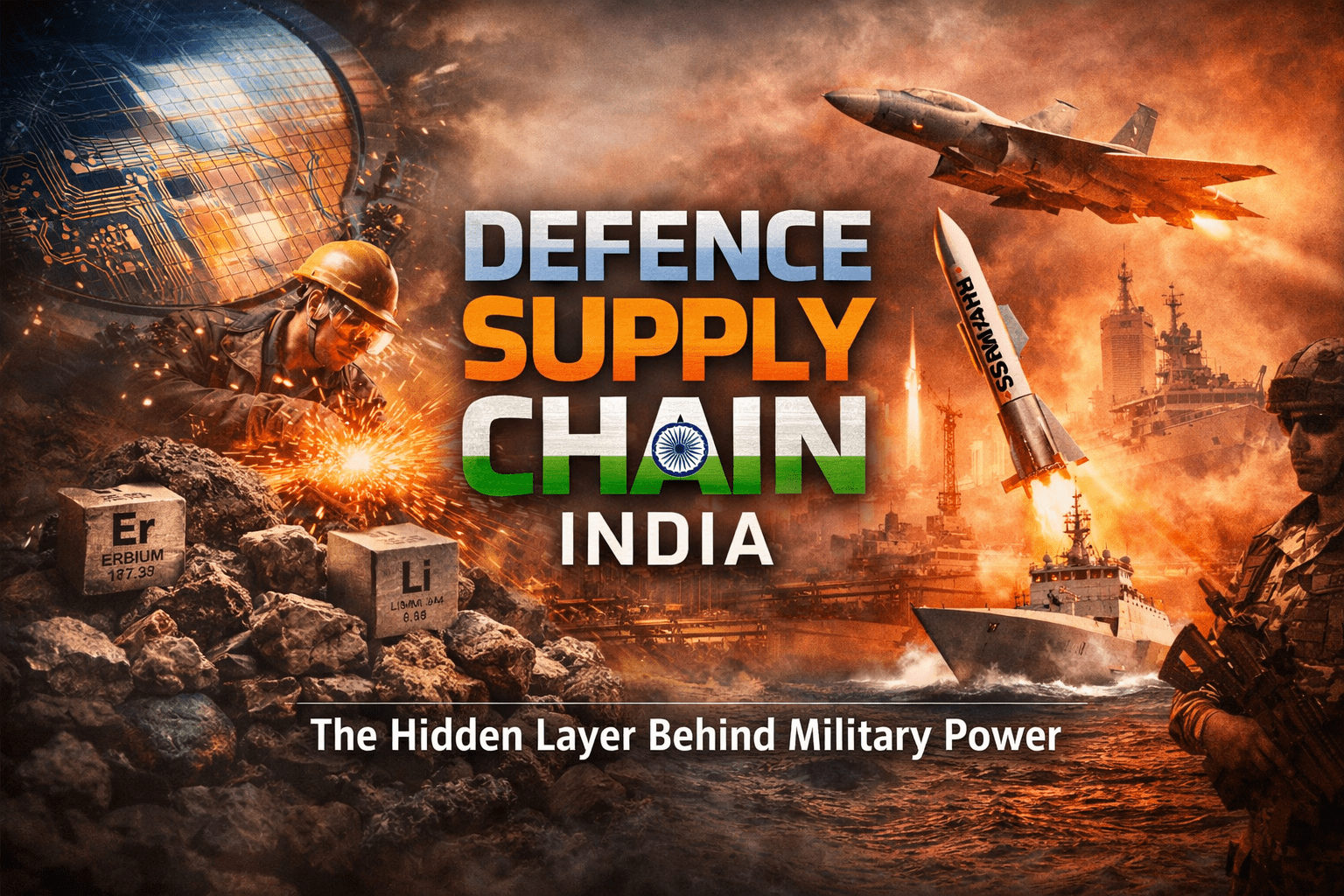
The defence supply chain India question sits beneath the visible layers of military capability. Fighter aircraft, warships, and missile systems tend to dominate public discussion, but these platforms are only the surface expression of a deeper industrial structure. The real determinant of sustained military power lies in supply chains.
The defence supply chain India framework is not simply about logistics or procurement efficiency. It is about control over inputs, materials, and technologies that enable production to continue under stress.
Without this control, even advanced manufacturing capacity becomes fragile. Systems can be designed and assembled domestically, but if critical components remain externally dependent, the overall structure remains vulnerable.
This is why supply chains are increasingly viewed as strategic assets. Within the broader context of defence manufacturing India and long-term industrial planning, supply chain resilience determines whether capability can be sustained in conflict conditions. It is not an auxiliary layer. It is foundational.
The Material Foundation of Modern Warfare
Modern defence systems depend on a complex network of materials that are not easily substitutable. Rare earth elements are essential for advanced electronics and guidance systems. Lithium and cobalt underpin energy storage and battery technologies. Specialized alloys such as titanium enable aerospace platforms to withstand stress and temperature extremes.
China’s dominance in several of these areas is well documented. It controls a significant share of rare earth processing and has established integrated supply chains that connect extraction, refinement, and manufacturing. This creates a strategic advantage that extends beyond raw materials into industrial leverage.
India’s position is more constrained. While domestic reserves exist in certain categories, processing capacity remains limited. Much of the value addition in critical materials still occurs outside India.
This creates a structural dependency that is not immediately visible at the platform level but becomes critical in sustained production scenarios.
The implications of this imbalance extend directly into the defence supply chain India debate. Material control is not just about availability. It is about continuity under disruption.
Electronics and Semiconductor Dependence
If materials form the base layer of the defence supply chain, electronics form the operational core. Modern military systems rely on semiconductors, sensors, and communication modules that enable precision, connectivity, and real-time decision-making.
China has invested heavily in building a domestic electronics ecosystem that supports both civilian and military applications. Its ability to integrate semiconductor production with defence manufacturing allows for greater control over system design and performance.
India, by contrast, is still developing its semiconductor ecosystem. While progress has been made in chip design and certain areas of electronics manufacturing, fabrication capacity remains limited. This creates dependence on external supply chains for critical components.
The issue is not simply technological. It is structural. Without domestic control over electronics, defence manufacturing India remains partially dependent, regardless of advances in platform production.
Supply Chain Vulnerability in Conflict Scenarios
The true test of any supply chain lies in its performance under stress. In peacetime, dependencies can be managed through imports, stockpiling, and diversified sourcing. In conflict conditions, these options narrow significantly.
A disruption in supply chains can affect multiple layers simultaneously. Production of missile systems can slow due to component shortages. Electronics integration can be delayed due to semiconductor constraints. Maintenance cycles for deployed systems can be affected by the availability of spares.
The risk is not hypothetical. It is embedded in the structure of global supply chains. For India, this creates a strategic vulnerability that cannot be addressed solely through procurement reform.
Within the framework of the India defence industrial policy 2047, supply chain resilience is increasingly recognized as a critical component of self-reliance. However, translating this recognition into capability requires sustained investment and coordination across sectors.
Industrial Strategy and Supply Chain Integration
The defence supply chain India challenge cannot be addressed in isolation. It must be integrated into broader industrial strategy. Manufacturing capacity, supply chains, and technological ecosystems must evolve together.
This requires a shift in how industrial policy is structured. Incentives must extend beyond final assembly to include upstream components. Partnerships must focus not only on technology transfer but also on supply chain development. Domestic capability must be built across multiple layers simultaneously.
The relationship between supply chains and industrial capacity can be understood through a simple comparison:
| Layer | Strong Supply Chain | Weak Supply Chain |
|---|---|---|
| Production Continuity | Stable | Disrupted |
| Cost Control | Predictable | Volatile |
| Wartime Readiness | High | Uncertain |
| Technological Autonomy | Increasing | Limited |
This comparison highlights a core reality. Supply chain strength determines whether industrial capacity can function effectively under pressure.
The Role of Private Industry
Private sector participation plays a critical role in strengthening supply chains. Unlike centralized production models, private industry often develops distributed supplier networks that increase flexibility and resilience.
In India, private firms are increasingly contributing to defence manufacturing in India by investing in component production, subsystem integration, and supply chain development. This creates a more diversified industrial base.
However, coordination remains a challenge. Supply chains require integration across multiple tiers of suppliers, each with different capabilities and constraints. Without effective coordination mechanisms, fragmentation can persist.
Strengthening supply chains therefore requires not only investment, but also institutional alignment.
Global Supply Chains and Strategic Competition
The defence supply chain India issue cannot be understood purely in domestic terms. It is shaped by global competition over resources, technology, and manufacturing capacity.
China’s position within global supply chains provides it with leverage that extends beyond its own military capabilities. Control over critical inputs allows it to influence production in other countries. This creates a form of indirect power that operates through economic and industrial channels.
India’s response must therefore operate at both domestic and international levels. Domestic capacity must be strengthened, but external partnerships must also be structured to reduce vulnerability. Diversification becomes a strategic objective.
This dynamic reflects a broader shift in global geopolitics, where supply chains are becoming arenas of competition rather than neutral economic systems.
Scenario: Defence Supply Chain India by 2035
Looking ahead, the evolution of defence supply chain India will depend on how effectively current constraints are addressed. Several trajectories are possible.
In a positive trajectory, India develops domestic processing capacity for critical materials, expands semiconductor fabrication, and integrates supply chains across defence sectors. This reduces dependency and increases resilience under stress.
In a constrained trajectory, progress remains uneven. Dependence on external suppliers persists in key areas, limiting the effectiveness of domestic manufacturing during periods of disruption.
The difference between these outcomes will depend on long-term policy consistency, investment levels, and the ability to align industrial and strategic objectives.
Conclusion: The Foundation of Strategic Autonomy
The defence supply chain India question ultimately defines the limits of military and industrial capability. Without secure supply chains, even advanced manufacturing systems remain vulnerable.
Supply chains are not a secondary consideration. They form the foundation upon which military power is built. They determine whether production can be sustained, whether systems can be maintained, and whether capability can be translated into operational effectiveness.
In this sense, supply chain sovereignty is not an extension of defence policy. It is central to it.
FAQs
What is defence supply chain India?
Defence supply chain India refers to the network of materials, components, and technologies required to produce and sustain military systems within the country.
Why are supply chains important for defence?
Supply chains ensure continuity of production, availability of critical components, and the ability to sustain military operations during conflict.
What are India’s key supply chain vulnerabilities?
India’s main vulnerabilities lie in critical materials processing, semiconductor manufacturing, and dependence on imported components for advanced systems.
How can India strengthen its defence supply chains?
India can improve supply chain resilience by investing in domestic manufacturing, developing semiconductor capabilities, and diversifying global partnerships.
How does supply chain affect defence self-reliance India?
Supply chain strength directly impacts self-reliance by determining whether domestic production can operate independently of external dependencies.

