


















IndoAsia Defense
  • Home
  • Air
    • All
    • Air Defence
    • Drones
    • Fighters
    • ISR & Mobility
    Ghatak UCAV stealth, autonomy, integration

    Inside India’s Ghatak UCAV Program: Stealth, Autonomy, and the Integration Gap

    The F414 engine co-production agreement between Hindustan Aeronautics Limited and GE Aerospace

    India-US F414 Engine Deal Explained: Technology Transfer, Tejas Mk2, and AMCA

    What is the Su-57M1 India deal

    Su-57M1 for India: A Fifth-Generation Shortcut or a Strategic Dependency Trap?

    India indigenous long range surveillance radar with X-band drone detection capability

    450km Eyes, Machine-Speed Decisions: How India’s Indigenous Long Range Surveillance Radar Is Rewriting Air Defence

    Why Software Defined Radios Are the IAF’s Most Consequential Upgrade

    IAF Signs BEL Deal for Software Defined Radios: Rewiring India’s Air Combat Network

    How the Ghatak UCAV Stealth Design Redefines India’s Drone Warfare Doctrine

    Ghatak UCAV: India’s Carbon Composite Stealth Strategy Dissected

    Ballistic Missile Defense system intercepting incoming missile during midcourse phase

    How Ballistic Missile Defense Works: Inside Modern Missile Interception Systems

    Swarm logistics drones delivering military supplies in high-altitude Himalayan terrain with Indian Army presence

    Swarm Logistics Drones in Himalayan Warfare: Can India Close the Supply Gap with China?

    India’s 6th-Gen Fighter Strategy FCAS vs GCAP Explained

    India’s 6th-Gen Fighter Strategy: FCAS vs GCAP Explained

  • Land
    • All
    • Armour & Artillery
    • China Front
    • Future Combat
    • Pakistan Front
    The Indo-Pacific Is Fragmenting, Not Uniting Against China

    Why the Indo-Pacific Will Not Unite Against China

    The India-South Korea defence deal

    The India-South Korea Defence Deal Through China’s Operational Lens

    Railways as War Arteries Can India Match China’s Military Mobility Before the Next Crisis

    Railways as War Arteries: Can India Match China’s Military Mobility Before the Next Crisis?

    China maritime front in Indian Ocean

    What If China Opens a Maritime Front in the Indian Ocean During a LAC Conflict?

    What is Indian military modernization strategy in 2026?

    Indian Military Modernization: Systems, Doctrine, and Capability Architecture (2026-27)

    Tank launching loitering munition in battle

    From Smoke to Strike: India’s Indigenous Loitering Munitions for T-72, T-90, and Arjun Tanks

    How China Mobilizes Forces Along the LAC Speed, Systems, and Strategic Control

    How China Mobilizes Forces Along the LAC: Systems, Speed, and Strategic Signaling

    Ballistic Missile Defense system intercepting incoming missile during midcourse phase

    How Ballistic Missile Defense Works: Inside Modern Missile Interception Systems

    Swarm logistics drones delivering military supplies in high-altitude Himalayan terrain with Indian Army presence

    Swarm Logistics Drones in Himalayan Warfare: Can India Close the Supply Gap with China?

  • Navy
    • All
    • Fleet Expansion
    • Indian Ocean
    • Maritime Security
    • Submarines
    Mogami-class frigate deal overview

    Japan’s Mogami-Class Frigate Offer to India: What the Transfer Terms Reveal About Tokyo’s Indo-Pacific Calculus

    China maritime front in Indian Ocean

    What If China Opens a Maritime Front in the Indian Ocean During a LAC Conflict?

    The Strait of Hormuz Crisis

    India’s Oil Artery Under Threat: Strategic Implications of a Hormuz Crisis

    India’s VL-Shtil Missile Deal with Russia

    India’s VL-Shtil Missile Deal with Russia: Strengthening Naval Air Defense in the Indo-Pacific

    Andaman & Nicobar Command Sleeping Giant of India’s Maritime Strategy

    Andaman & Nicobar Command: Sleeping Giant of India’s Maritime Strategy

    Maritime Surveillance 2.0: Why EO/IR Modernisation Matters for India’s Ocean Security

    Maritime Surveillance 2.0: Why EO/IR Modernisation Matters for India’s Ocean Security

    2030 Will Decide the India ASEAN Maritime Equation

    2030 Will Decide the India ASEAN Maritime Equation

    India Military Transformation Series — Part 3: Maritime Power and the Indian Ocean Imperative

    India Military Transformation Series — Part 3: Maritime Power and the Indian Ocean Imperative

    Indian Navy TEDBF PPP Model: China Factor and 2030–2040 Carrier Strategy

    Indian Navy TEDBF PPP Model: China Factor and 2030–2040 Carrier Strategy

  • Indo-Pacific
    • All
    • 2035 Outlook
    • China Strategy
    • India Strategy
    • Pakistan Outlook
    DRDO-developed Guided Pinaka

    At ₹70 Lakh Per Rocket, DRDO-developed Guided Pinaka May Represent India’s Shift Toward Scalable Precision Warfare

    The Indo-Pacific Is Fragmenting, Not Uniting Against China

    Why the Indo-Pacific Will Not Unite Against China

    Mogami-class frigate deal overview

    Japan’s Mogami-Class Frigate Offer to India: What the Transfer Terms Reveal About Tokyo’s Indo-Pacific Calculus

    The India-South Korea defence deal

    The India-South Korea Defence Deal Through China’s Operational Lens

    Railways as War Arteries Can India Match China’s Military Mobility Before the Next Crisis

    Railways as War Arteries: Can India Match China’s Military Mobility Before the Next Crisis?

    india military integration gap

    Is India Building Military Power Faster Than It Can Integrate It?

    China maritime front in Indian Ocean

    What If China Opens a Maritime Front in the Indian Ocean During a LAC Conflict?

    Can India Fight Beyond 30 Days? Inside India’s War Sustainment Reality

    Can India Fight Beyond 30 Days? Inside India’s War Sustainment Reality

    What is Indian military modernization strategy in 2026?

    Indian Military Modernization: Systems, Doctrine, and Capability Architecture (2026-27)

  • Joint
    • All
    • Integrated Ops
    • Procurement Reform
    • Theater Commands
    India's strategic challenge sustainability first

    India Can Strike in 22 Minutes. Can It Sustain for 22 Weeks?

    Ballistic Missile Defense system intercepting incoming missile during midcourse phase

    How Ballistic Missile Defense Works: Inside Modern Missile Interception Systems

    India defence proposals Rs 2.38 trillion showing S-400 system, strike drones, fighter jets and military architecture shift

    India Defence Proposals Rs 2.38 Trillion: Why This Approval Changes How India Will Fight, Not Just What It Buys

    DAP 2026 India’s Quiet Revolution in Defence Procurement

    DAP 2026: India’s Quiet Revolution in Defence Procurement

    Integrated Battle Groups vs China’s Western Theater Command

    Integrated Battle Groups vs China’s Western Theater Command: Can Doctrine Survive the Himalayan Reality?

    Andaman & Nicobar Command Sleeping Giant of India’s Maritime Strategy

    Andaman & Nicobar Command: Sleeping Giant of India’s Maritime Strategy

    India Military Transformation Series — Part 2: The Theatre Command Reckoning

    India Military Transformation Series — Part 2: The Theatre Command Reckoning

    India AI C4ISR modernization

    India Military Transformation Series — Part 1: India AI C4ISR Modernization

    India’s Two-Front Theatre Command: Preparing for Simultaneous Conflict

    India’s Two-Front Theatre Command: Preparing for Simultaneous Conflict

  • Tech
    • All
    • AI & Autonomous Systems
    • Cyber
    • Electronic Warfare
    • Space
    Why Software Defined Radios Are the IAF’s Most Consequential Upgrade

    IAF Signs BEL Deal for Software Defined Radios: Rewiring India’s Air Combat Network

    Source Code or ICD India’s Source Code Negotiation Explained

    Source Code or ICD: India’s Source Code Negotiation Explained

    Supply Chain Weaponization

    Supply Chain Weaponization: Strategic Autonomy Meets Semiconductor Reality

    AI-driven battlefield in India's military

    The Algorithm of Borders: What India’s Military AI Push Actually Looks Like on the Ground

    India AI C4ISR modernization

    India Military Transformation Series — Part 1: India AI C4ISR Modernization

    PRAHAR Explained India Counter Terror Policy Prahaar

    PRAHAAR Explained: Why ‘PRAHAAR’ India’s National Counter-terrorism Doctrine, Signals the End of Traditional Warfare

    The Weapons Making the AMCA Unbeatable

    The Weapons Making the AMCA Unbeatable

    India’s Aerospace Ecosystem After Rafale: The 2026–2030 Industrial Test

    India’s Aerospace Ecosystem After Rafale: The 2026–2030 Industrial Test

    PLA’s Cyber Warfare Units and the Question of Indian Critical Infrastructure Resilience

    PLA’s Cyber Warfare Units and the Question of Indian Critical Infrastructure Resilience

  • Industry
    • All
    • Budget
    • Exports
    • Make in India
    • Supply Chains
    India's strategic challenge sustainability first

    India Can Strike in 22 Minutes. Can It Sustain for 22 Weeks?

    India-UAE defence pact and Gulf strategy

    India-UAE Defence Pact: Why Abu Dhabi Is Becoming India’s Western Strategic Depth

    Ghatak UCAV stealth, autonomy, integration

    Inside India’s Ghatak UCAV Program: Stealth, Autonomy, and the Integration Gap

    The India-South Korea defence deal

    The India-South Korea Defence Deal Through China’s Operational Lens

    The F414 engine co-production agreement between Hindustan Aeronautics Limited and GE Aerospace

    India-US F414 Engine Deal Explained: Technology Transfer, Tejas Mk2, and AMCA

    Why Software Defined Radios Are the IAF’s Most Consequential Upgrade

    IAF Signs BEL Deal for Software Defined Radios: Rewiring India’s Air Combat Network

    How the Ghatak UCAV Stealth Design Redefines India’s Drone Warfare Doctrine

    Ghatak UCAV: India’s Carbon Composite Stealth Strategy Dissected

    Swarm logistics drones delivering military supplies in high-altitude Himalayan terrain with Indian Army presence

    Swarm Logistics Drones in Himalayan Warfare: Can India Close the Supply Gap with China?

    India defence proposals Rs 2.38 trillion showing S-400 system, strike drones, fighter jets and military architecture shift

    India Defence Proposals Rs 2.38 Trillion: Why This Approval Changes How India Will Fight, Not Just What It Buys

  • Global
    • All
    • China-Pak
    • Emerging Tech
    • Middle Eeast
    • Regional Trends
    • US-India
    • US-Israel
    India-UAE defence pact and Gulf strategy

    India-UAE Defence Pact: Why Abu Dhabi Is Becoming India’s Western Strategic Depth

    The Indo-Pacific Is Fragmenting, Not Uniting Against China

    Why the Indo-Pacific Will Not Unite Against China

    Ghatak UCAV stealth, autonomy, integration

    Inside India’s Ghatak UCAV Program: Stealth, Autonomy, and the Integration Gap

    The F414 engine co-production agreement between Hindustan Aeronautics Limited and GE Aerospace

    India-US F414 Engine Deal Explained: Technology Transfer, Tejas Mk2, and AMCA

    india military integration gap

    Is India Building Military Power Faster Than It Can Integrate It?

    India indigenous long range surveillance radar with X-band drone detection capability

    450km Eyes, Machine-Speed Decisions: How India’s Indigenous Long Range Surveillance Radar Is Rewriting Air Defence

    What is Indian military modernization strategy in 2026?

    Indian Military Modernization: Systems, Doctrine, and Capability Architecture (2026-27)

    India defence proposals Rs 2.38 trillion showing S-400 system, strike drones, fighter jets and military architecture shift

    India Defence Proposals Rs 2.38 Trillion: Why This Approval Changes How India Will Fight, Not Just What It Buys

    India’s 6th-Gen Fighter Strategy FCAS vs GCAP Explained

    India’s 6th-Gen Fighter Strategy: FCAS vs GCAP Explained

  • Resources
    • India Military Capability Index
    • India vs China Military Balance
    • China Western Theater Command Guide
    • Pakistan Military Tracker 2026-27
    • India’s Military Doctrine Library
    • India vs China vs Pakistan Missile Arsenal Comparison
    • India’s Missile List
    • India Missile Range Map
    • Indo-Pacific Military Power Map
    • Indo-Pacific Defense Timeline
    • Global Military Balance Dashboard
    • Global Weapons Systems Database
    • Global Missile Systems Database
  • What If
    • China India Naval Conflict
No Result
View All Result
  • Home
  • Air
    • All
    • Air Defence
    • Drones
    • Fighters
    • ISR & Mobility
    Ghatak UCAV stealth, autonomy, integration

    Inside India’s Ghatak UCAV Program: Stealth, Autonomy, and the Integration Gap

    The F414 engine co-production agreement between Hindustan Aeronautics Limited and GE Aerospace

    India-US F414 Engine Deal Explained: Technology Transfer, Tejas Mk2, and AMCA

    What is the Su-57M1 India deal

    Su-57M1 for India: A Fifth-Generation Shortcut or a Strategic Dependency Trap?

    India indigenous long range surveillance radar with X-band drone detection capability

    450km Eyes, Machine-Speed Decisions: How India’s Indigenous Long Range Surveillance Radar Is Rewriting Air Defence

    Why Software Defined Radios Are the IAF’s Most Consequential Upgrade

    IAF Signs BEL Deal for Software Defined Radios: Rewiring India’s Air Combat Network

    How the Ghatak UCAV Stealth Design Redefines India’s Drone Warfare Doctrine

    Ghatak UCAV: India’s Carbon Composite Stealth Strategy Dissected

    Ballistic Missile Defense system intercepting incoming missile during midcourse phase

    How Ballistic Missile Defense Works: Inside Modern Missile Interception Systems

    Swarm logistics drones delivering military supplies in high-altitude Himalayan terrain with Indian Army presence

    Swarm Logistics Drones in Himalayan Warfare: Can India Close the Supply Gap with China?

    India’s 6th-Gen Fighter Strategy FCAS vs GCAP Explained

    India’s 6th-Gen Fighter Strategy: FCAS vs GCAP Explained

  • Land
    • All
    • Armour & Artillery
    • China Front
    • Future Combat
    • Pakistan Front
    The Indo-Pacific Is Fragmenting, Not Uniting Against China

    Why the Indo-Pacific Will Not Unite Against China

    The India-South Korea defence deal

    The India-South Korea Defence Deal Through China’s Operational Lens

    Railways as War Arteries Can India Match China’s Military Mobility Before the Next Crisis

    Railways as War Arteries: Can India Match China’s Military Mobility Before the Next Crisis?

    China maritime front in Indian Ocean

    What If China Opens a Maritime Front in the Indian Ocean During a LAC Conflict?

    What is Indian military modernization strategy in 2026?

    Indian Military Modernization: Systems, Doctrine, and Capability Architecture (2026-27)

    Tank launching loitering munition in battle

    From Smoke to Strike: India’s Indigenous Loitering Munitions for T-72, T-90, and Arjun Tanks

    How China Mobilizes Forces Along the LAC Speed, Systems, and Strategic Control

    How China Mobilizes Forces Along the LAC: Systems, Speed, and Strategic Signaling

    Ballistic Missile Defense system intercepting incoming missile during midcourse phase

    How Ballistic Missile Defense Works: Inside Modern Missile Interception Systems

    Swarm logistics drones delivering military supplies in high-altitude Himalayan terrain with Indian Army presence

    Swarm Logistics Drones in Himalayan Warfare: Can India Close the Supply Gap with China?

  • Navy
    • All
    • Fleet Expansion
    • Indian Ocean
    • Maritime Security
    • Submarines
    Mogami-class frigate deal overview

    Japan’s Mogami-Class Frigate Offer to India: What the Transfer Terms Reveal About Tokyo’s Indo-Pacific Calculus

    China maritime front in Indian Ocean

    What If China Opens a Maritime Front in the Indian Ocean During a LAC Conflict?

    The Strait of Hormuz Crisis

    India’s Oil Artery Under Threat: Strategic Implications of a Hormuz Crisis

    India’s VL-Shtil Missile Deal with Russia

    India’s VL-Shtil Missile Deal with Russia: Strengthening Naval Air Defense in the Indo-Pacific

    Andaman & Nicobar Command Sleeping Giant of India’s Maritime Strategy

    Andaman & Nicobar Command: Sleeping Giant of India’s Maritime Strategy

    Maritime Surveillance 2.0: Why EO/IR Modernisation Matters for India’s Ocean Security

    Maritime Surveillance 2.0: Why EO/IR Modernisation Matters for India’s Ocean Security

    2030 Will Decide the India ASEAN Maritime Equation

    2030 Will Decide the India ASEAN Maritime Equation

    India Military Transformation Series — Part 3: Maritime Power and the Indian Ocean Imperative

    India Military Transformation Series — Part 3: Maritime Power and the Indian Ocean Imperative

    Indian Navy TEDBF PPP Model: China Factor and 2030–2040 Carrier Strategy

    Indian Navy TEDBF PPP Model: China Factor and 2030–2040 Carrier Strategy

  • Indo-Pacific
    • All
    • 2035 Outlook
    • China Strategy
    • India Strategy
    • Pakistan Outlook
    DRDO-developed Guided Pinaka

    At ₹70 Lakh Per Rocket, DRDO-developed Guided Pinaka May Represent India’s Shift Toward Scalable Precision Warfare

    The Indo-Pacific Is Fragmenting, Not Uniting Against China

    Why the Indo-Pacific Will Not Unite Against China

    Mogami-class frigate deal overview

    Japan’s Mogami-Class Frigate Offer to India: What the Transfer Terms Reveal About Tokyo’s Indo-Pacific Calculus

    The India-South Korea defence deal

    The India-South Korea Defence Deal Through China’s Operational Lens

    Railways as War Arteries Can India Match China’s Military Mobility Before the Next Crisis

    Railways as War Arteries: Can India Match China’s Military Mobility Before the Next Crisis?

    india military integration gap

    Is India Building Military Power Faster Than It Can Integrate It?

    China maritime front in Indian Ocean

    What If China Opens a Maritime Front in the Indian Ocean During a LAC Conflict?

    Can India Fight Beyond 30 Days? Inside India’s War Sustainment Reality

    Can India Fight Beyond 30 Days? Inside India’s War Sustainment Reality

    What is Indian military modernization strategy in 2026?

    Indian Military Modernization: Systems, Doctrine, and Capability Architecture (2026-27)

  • Joint
    • All
    • Integrated Ops
    • Procurement Reform
    • Theater Commands
    India's strategic challenge sustainability first

    India Can Strike in 22 Minutes. Can It Sustain for 22 Weeks?

    Ballistic Missile Defense system intercepting incoming missile during midcourse phase

    How Ballistic Missile Defense Works: Inside Modern Missile Interception Systems

    India defence proposals Rs 2.38 trillion showing S-400 system, strike drones, fighter jets and military architecture shift

    India Defence Proposals Rs 2.38 Trillion: Why This Approval Changes How India Will Fight, Not Just What It Buys

    DAP 2026 India’s Quiet Revolution in Defence Procurement

    DAP 2026: India’s Quiet Revolution in Defence Procurement

    Integrated Battle Groups vs China’s Western Theater Command

    Integrated Battle Groups vs China’s Western Theater Command: Can Doctrine Survive the Himalayan Reality?

    Andaman & Nicobar Command Sleeping Giant of India’s Maritime Strategy

    Andaman & Nicobar Command: Sleeping Giant of India’s Maritime Strategy

    India Military Transformation Series — Part 2: The Theatre Command Reckoning

    India Military Transformation Series — Part 2: The Theatre Command Reckoning

    India AI C4ISR modernization

    India Military Transformation Series — Part 1: India AI C4ISR Modernization

    India’s Two-Front Theatre Command: Preparing for Simultaneous Conflict

    India’s Two-Front Theatre Command: Preparing for Simultaneous Conflict

  • Tech
    • All
    • AI & Autonomous Systems
    • Cyber
    • Electronic Warfare
    • Space
    Why Software Defined Radios Are the IAF’s Most Consequential Upgrade

    IAF Signs BEL Deal for Software Defined Radios: Rewiring India’s Air Combat Network

    Source Code or ICD India’s Source Code Negotiation Explained

    Source Code or ICD: India’s Source Code Negotiation Explained

    Supply Chain Weaponization

    Supply Chain Weaponization: Strategic Autonomy Meets Semiconductor Reality

    AI-driven battlefield in India's military

    The Algorithm of Borders: What India’s Military AI Push Actually Looks Like on the Ground

    India AI C4ISR modernization

    India Military Transformation Series — Part 1: India AI C4ISR Modernization

    PRAHAR Explained India Counter Terror Policy Prahaar

    PRAHAAR Explained: Why ‘PRAHAAR’ India’s National Counter-terrorism Doctrine, Signals the End of Traditional Warfare

    The Weapons Making the AMCA Unbeatable

    The Weapons Making the AMCA Unbeatable

    India’s Aerospace Ecosystem After Rafale: The 2026–2030 Industrial Test

    India’s Aerospace Ecosystem After Rafale: The 2026–2030 Industrial Test

    PLA’s Cyber Warfare Units and the Question of Indian Critical Infrastructure Resilience

    PLA’s Cyber Warfare Units and the Question of Indian Critical Infrastructure Resilience

  • Industry
    • All
    • Budget
    • Exports
    • Make in India
    • Supply Chains
    India's strategic challenge sustainability first

    India Can Strike in 22 Minutes. Can It Sustain for 22 Weeks?

    India-UAE defence pact and Gulf strategy

    India-UAE Defence Pact: Why Abu Dhabi Is Becoming India’s Western Strategic Depth

    Ghatak UCAV stealth, autonomy, integration

    Inside India’s Ghatak UCAV Program: Stealth, Autonomy, and the Integration Gap

    The India-South Korea defence deal

    The India-South Korea Defence Deal Through China’s Operational Lens

    The F414 engine co-production agreement between Hindustan Aeronautics Limited and GE Aerospace

    India-US F414 Engine Deal Explained: Technology Transfer, Tejas Mk2, and AMCA

    Why Software Defined Radios Are the IAF’s Most Consequential Upgrade

    IAF Signs BEL Deal for Software Defined Radios: Rewiring India’s Air Combat Network

    How the Ghatak UCAV Stealth Design Redefines India’s Drone Warfare Doctrine

    Ghatak UCAV: India’s Carbon Composite Stealth Strategy Dissected

    Swarm logistics drones delivering military supplies in high-altitude Himalayan terrain with Indian Army presence

    Swarm Logistics Drones in Himalayan Warfare: Can India Close the Supply Gap with China?

    India defence proposals Rs 2.38 trillion showing S-400 system, strike drones, fighter jets and military architecture shift

    India Defence Proposals Rs 2.38 Trillion: Why This Approval Changes How India Will Fight, Not Just What It Buys

  • Global
    • All
    • China-Pak
    • Emerging Tech
    • Middle Eeast
    • Regional Trends
    • US-India
    • US-Israel
    India-UAE defence pact and Gulf strategy

    India-UAE Defence Pact: Why Abu Dhabi Is Becoming India’s Western Strategic Depth

    The Indo-Pacific Is Fragmenting, Not Uniting Against China

    Why the Indo-Pacific Will Not Unite Against China

    Ghatak UCAV stealth, autonomy, integration

    Inside India’s Ghatak UCAV Program: Stealth, Autonomy, and the Integration Gap

    The F414 engine co-production agreement between Hindustan Aeronautics Limited and GE Aerospace

    India-US F414 Engine Deal Explained: Technology Transfer, Tejas Mk2, and AMCA

    india military integration gap

    Is India Building Military Power Faster Than It Can Integrate It?

    India indigenous long range surveillance radar with X-band drone detection capability

    450km Eyes, Machine-Speed Decisions: How India’s Indigenous Long Range Surveillance Radar Is Rewriting Air Defence

    What is Indian military modernization strategy in 2026?

    Indian Military Modernization: Systems, Doctrine, and Capability Architecture (2026-27)

    India defence proposals Rs 2.38 trillion showing S-400 system, strike drones, fighter jets and military architecture shift

    India Defence Proposals Rs 2.38 Trillion: Why This Approval Changes How India Will Fight, Not Just What It Buys

    India’s 6th-Gen Fighter Strategy FCAS vs GCAP Explained

    India’s 6th-Gen Fighter Strategy: FCAS vs GCAP Explained

  • Resources
    • India Military Capability Index
    • India vs China Military Balance
    • China Western Theater Command Guide
    • Pakistan Military Tracker 2026-27
    • India’s Military Doctrine Library
    • India vs China vs Pakistan Missile Arsenal Comparison
    • India’s Missile List
    • India Missile Range Map
    • Indo-Pacific Military Power Map
    • Indo-Pacific Defense Timeline
    • Global Military Balance Dashboard
    • Global Weapons Systems Database
    • Global Missile Systems Database
  • What If
    • China India Naval Conflict
No Result
View All Result
IndoAsia Defense
No Result
View All Result
Home Industry Make in India

How PLI Schemes Are Reshaping India’s Military Electronics Ecosystem

India’s PLI schemes are quietly transforming the country’s military electronics ecosystem. From AESA radars and missile seekers to electronic warfare systems and GaN semiconductors, this analysis examines how industrial policy could reshape India’s defense technology base.

IndoAsia Defense by IndoAsia Defense
March 14, 2026
in Industry, Make in India, Supply Chains
0
How PLI Schemes Are Reshaping India's Military Electronics Ecosystem
0
SHARES
23
VIEWS
Share on LinkedinShare on FacebookShare on Twitter

India’s defense electronics story is usually told in press releases. A radar gets tested, a missile gets certified, a minister cuts a ribbon at a new facility.

But buried within it is a far more uncomfortable truth: the highest-value, most operationally decisive components, the radars, the seekers, the electronic warfare suites, the avionics mission computers, remain overwhelmingly foreign.

What rarely gets examined is the plumbing beneath all of it: where the actual components come from, who owns the IP inside, and what happens if the phone stops getting answered in Tel Aviv or Moscow when things go sideways. That is the story worth telling.

For a country fighting a two-front deterrence problem across the Himalayas and the Indian Ocean simultaneously, that is not just an economic inconvenience. It is a strategic vulnerability of the first order.

Production Linked Incentive (PLI) schemes, now being extended and recalibrated toward defense electronics, are where New Delhi is placing its corrective bet.

The question worth examining is not whether PLI will generate investment. It already has.
By March 2025, PLI schemes across fourteen sectors had attracted over $21 billion in realized investment, generating $190.9 billion in production output.
The question is not whether PLI will generate factories. It will.
The question is whether it can generate the specific, technically irreducible capabilities that sit at the very top of the electronics pyramid and that no supplier will hand over voluntarily.

The Ugly Arithmetic of Import Dependency that Nobody Wants to Print

Start with the uncomfortable numbers. India imports roughly 60 to 65 percent of its defense equipment by value.

But that aggregate figure obscures something important: not all defense electronics are created equal.

A printed circuit board for a communications terminal is a fundamentally different manufacturing challenge than a Gallium Nitride transmit-receive module for an AESA radar.

Importing boots is not the same as importing the seekers inside your air-to-air missiles.

One you can replace with local leather.

The other requires years of RF engineering, signal processing software, and materials qualification to replicate, assuming anyone will teach you how.

These are the capabilities that sit at the apex of the technology pyramid, and they are precisely what India lacks indigenously at scale.
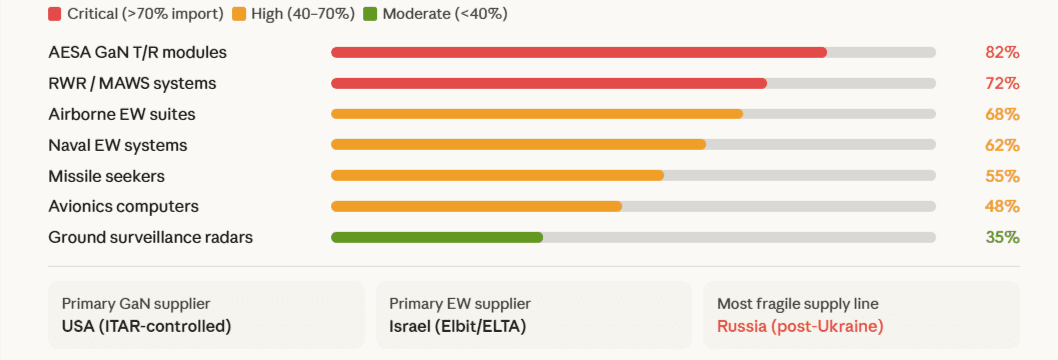
India defense electronics: import dependency vs strategic risk (2025 est.)

Source: DRDO disclosures, MoD annual reports, SIPRI Arms Transfers Database, analyst estimates.

The GaN number at the top is the one that should concern every Indian strategic planner. Gallium Nitride is to modern radar and electronic warfare what silicon was to computing in the 1980s.

AESA radars depend on GaN-based transmit-receive modules for their power efficiency, their resistance to jamming, and their reliability under thermal stress.

China has aggressively indigenized GaN production. The United States tightly controls GaN exports under ITAR and EAR.

India currently imports the vast majority of its GaN components, and even the most promising domestic efforts: including iDEX’s contract covering GaN semiconductors; remain years away from production-qualified yield rates at military specification.


Why the Hardest Stuff Is the Most Important Stuff

There is a tempting narrative that India has already “solved” defense electronics. The Uttam radar exists. The Astra missile flies. Tejas Mk1A is in production.

That narrative confuses prototype-level achievement with industrial-scale sovereignty, and it is dangerously misleading.

A prototype that works in a test environment and a production line that delivers qualified hardware consistently at scale are separated by years of process engineering, yield improvement, supplier qualification, and certification work. India has the first.

It is building toward the second. PLI is the lever designed to close that gap faster.

The structural problem is that defense electronics is not a monolithic industry. It is a layered stack – raw materials, wafers, components, sub-assemblies, systems, software and a dependency at any layer propagates upward through everything above it.

India can assemble a radar without owning the semiconductor inside it, but that assembly is only as sovereign as the supply of the chip.

PLI schemes that operate only at the system level (the top of the stack) do not solve the dependency. They paper over it with a domestic nameplate.

The Supplier Web India Does Not Draw Publicly 
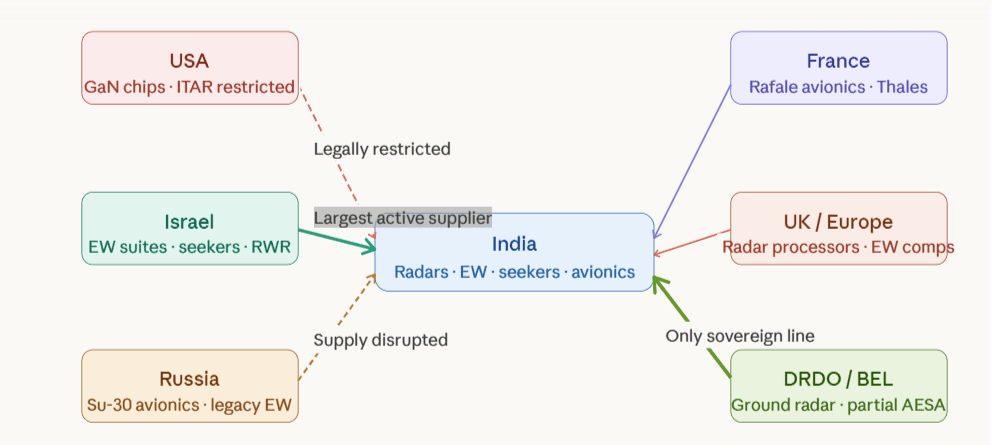
The Supplier Web India Does Not Draw Publicly

Line weight = relative supply volume. 
Dashed = politically fragile or export-controlled.
Green (DRDO/BEL) is the single fully sovereign supply relationship India currently holds.

Look at that diagram geometrically. India sits at the center of five external supply relationships, and only one — the DRDO/BEL line — is fully under its own political control.

The thickest commercially active line runs through Israel, which has become the single most important supplier of operationally current EW and seeker technology.

The American line carries the most strategically critical components but is also the most legally restricted.

The Russian line, once substantial, has become structurally unreliable in ways that the Ukraine war made permanent rather than temporary.

France and Europe supply the Rafale ecosystem but remain outside India’s control in any crisis.

PLI’s job is to build a sixth line – a genuinely sovereign domestic one – thick enough to eventually replace the others for the most critical applications.

The Ecosystem That Doesn’t Build Itself

Getting from “India needs indigenous EW systems” to “India has a functioning EW industrial base” is not a straight line. It moves through five distinct stages, each with its own specific bottlenecks, and skipping any of them almost always fails.
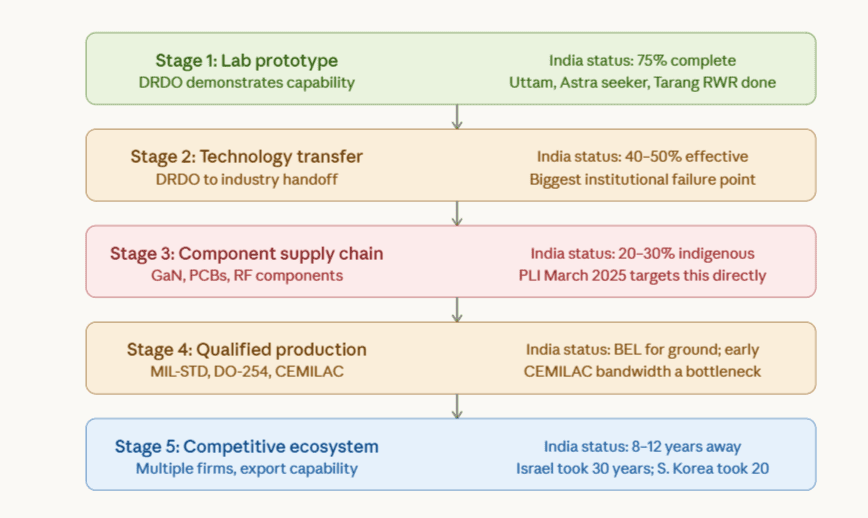
The Ecosystem That Doesn't Build Itself

India is stuck between Stages 2 and 3 for most priority electronics categories. The prototype is done. The transfer is partial and slow.

The components are still coming from abroad. PLI operates most effectively at Stage 3 – the component supply chain – and that is precisely where the March 2025 scheme is pointed.

The alignment is better than it appears from outside.

But Stage 2’s broken technology transfer pipeline continues to throttle progress regardless of how much money flows into Stage 3, because you cannot manufacture what has not been transferred in manufacturable form.

The tech transfer problem is institutional, not financial. DRDO scientists are not incentivized to produce designs that a factory can absorb without extensive re-engineering.

HAL and BEL receive those designs but lack the process engineering workforce to translate them into production. Private firms face classification barriers that limit what they are even permitted to receive.

No PLI scheme fixes any of that. It requires a parallel institutional reform program that is considerably less photogenic than a factory opening.

The Doctrine Connection Most Analysts Are Skipping

Electronic warfare is not a supplementary capability you add to a force after sorting out the platforms. It is the enabling layer without which platforms become targets.

The lesson from Armenia-Azerbaijan, from Ukraine, from every contested airspace engagement since 2020, points toward the same conclusion: electromagnetic spectrum dominance in the opening hours of a conflict determines whether your fighters arrive at the target or become the target.

India’s two-front problem makes this especially acute. China operates a deeply integrated EW architecture along the LAC, regularly updated with lessons absorbed from observing other conflicts.

Pakistan has been selectively acquiring Turkish KORAL electronic warfare systems and Chinese ground-based jamming platforms calibrated against known Indian radar frequencies.

Neither threat is static. Both are being actively upgraded.

An India that builds indigenous EW suites — with full visibility into the software-defined jamming algorithms and the threat library management software — is an India with genuine operational sovereignty over its own electronic battlefield.

An India that assembles imported jammers under license is an India whose EW capability can be shaped, constrained, and in extremis withheld by supplier politics.

Export license conditions on defense electronics regularly include end-use restrictions governing where and how systems can be employed in real conflict.

That is not hypothetical. It is standard practice in every bilateral defense relationship India has.

This doctrinal argument is the one that PLI advocates should be making loudly, and largely are not. The economic case for indigenization is defensible but not compelling on its own.

The strategic sovereignty case – that a country cannot plan confidently around a capability it does not own – is far more urgent, and it is the argument that should be driving the speed and depth of the PLI investment.

Who Adjusts, and How

The beneficiaries of a successful PLI push in defense electronics are fairly predictable: Bharat Electronics Limited, Data Patterns, Astra Microwave, MTAR Technologies, and a second tier of private firms quietly building RF engineering and embedded systems capability.

The Uttam AESA radar, now significantly indigenized with technology transfer from DRDO to HAL, is planned for integration into Tejas Mk1A and future programs.

BEL stands as the primary production house, but the broader intent is to build a competitive private-sector ecosystem alongside the public incumbents.

The adjustment is most consequential for Israel. Israel Aerospace Industries and Elbit Systems have been central suppliers for India’s EW and avionics requirements for over two decades.

A successful PLI-driven indigenization program does not eliminate Israeli defense cooperation – that relationship has too many layers for a single policy lever to unwind – but it does shift the dynamic from dependency to selective partnership.

In contract negotiations, technology transfer discussions, and crisis-period supply decisions, that is a meaningfully different position for India to occupy.

Russia is the harder case and the more pressing one. Su-30MKI avionics remain heavily Russian, and the Ukraine war demonstrated with uncomfortable clarity what happens to maintenance supply chains when geopolitical conditions shift rapidly.

India is still issuing Requests for Information for Su-30 self-protection jammers, which reveals the depth of that legacy dependency.

PLI can accelerate the path off Russian avionics, but only if the incentive structure rewards the genuinely difficult work of integrating new indigenous systems into certified Russian-origin airframes – which is as much a regulatory problem as a manufacturing one.

The Budget Picture, Plainly Laid Out
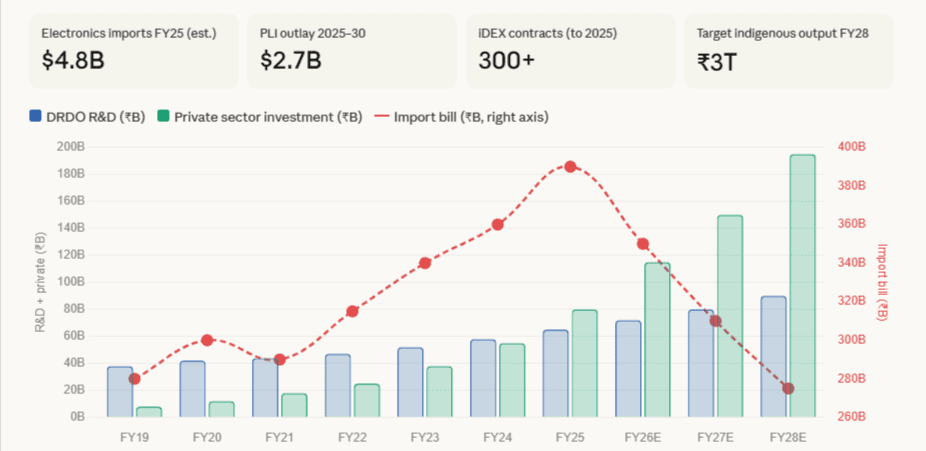
India defense electronics: investment trend vs import bill (FY19–FY28E)
Sources: MoD annual reports, SIPRI Arms Transfers Database, iDEX program data, analyst projections for FY26–28.

The projected crossover — where domestic investment compresses the import bill – does not happen automatically.

It requires the PLI money to flow toward capability-building rather than assembly, and it requires the institutional reforms around technology transfer and certification to keep pace.

Without those, you get rising investment numbers and a flat import line, which is exactly what India’s defense sector has produced for most of the last decade.

The Regional Ripple: What the Neighbors Are Watching

China’s immediate reaction to India’s defense electronics indigenization drive is not alarm. It is patient observation.

Beijing understands that the gap between announced intention and operational capability in India’s defense sector is historically wide.

What it watches for is the inflection point: the moment when a private Indian firm demonstrates GaN T/R module production at military-qualified yield rates, or when DRDO’s EW laboratory delivers a software-defined jammer that matches Israeli performance parameters.

That inflection point, when it arrives, directly changes the electronic warfare balance along the LAC in ways that affect Chinese operational planning.

Australia and Japan are watching the semiconductor dimension. QUAD technology cooperation has been building toward trusted supply chains for defense-critical components.

A PLI-backed GaN manufacturing capability in India would not simply serve Indian requirements – it would qualify India as a contributor to a broader Indo-Pacific semiconductor architecture.

That is a fundamentally different strategic conversation than where India sits today as a net consumer of other people’s foundry output.

For Southeast Asian partners – Vietnam, Indonesia, the Philippines – the signal is different but equally significant. India has been positioning itself as an alternative defense supplier. BrahMos has established the template.

A credible domestic radar and EW production base, backed by PLI-scale incentives, opens the pathway to exporting sensor systems into a region actively diversifying away from single-country dependence.

That is a long game, but it starts with building the industrial base today.

The Three Scenarios Over the Next Five Years

PLI defense electronics: realistic scenarios to 2030

Optimistic — GaN breaks through                                                                                                30% probability

A PLI-backed firm qualifies GaN T/R module production by 2027. Uttam radar reaches 85%+ indigenous content. BVR seeker production scales under RCI Hyderabad. India begins exploring defense electronics exports to Gulf and SEA markets by 2029. QUAD supply chain contribution becomes real, not aspirational.

Requires: GaN foundry investment, CEMILAC pipeline reform, sustained long-term procurement commitments to de-risk private capital.

—————————————————————————————————————————–

Base case — Incremental progress, persistent gaps                                                                    50% probability

Avionics and ground radar reach 75–80% indigenous content by 2028. Airborne EW lags two to three years behind. GaN dependency persists but is partially mitigated via QUAD-linked supply agreements with the US and Japan. Private sector grows but remains second tier to BEL and HAL in volume and certification depth.

Requires: Current trajectory maintained. No major institutional reform needed, but no major setbacks either.
—————————————————————————————————————————–

Pessimistic — PLI captures assembly, not technology                                                                 20% probability

Incentives are captured by firms assembling foreign components under Indian nameplates. The technology transfer bottleneck remains unaddressed. Import bill stays high. GaN gap widens as Chinese capability accelerates well beyond current levels. Crisis supply chain vulnerability remains structurally unchanged.

Risk factors: Weak IP enforcement, slow DRDO transfer culture, insufficient CEMILAC capacity, procurement short-termism rewarding price over indigenous content depth.

—————————————————————————————————————————–

Scenario probabilities are the author's independent assessment based on current program trajectories, institutional track record, and policy signal analysis.


The base case is not a failure – it represents genuine, compounding progress across avionics and ground systems.

But it also leaves India perpetually dependent on foreign suppliers for the hardest and most operationally decisive technologies: GaN semiconductors, advanced EW algorithm libraries, airborne self-protection systems capable of operating effectively against current-generation Chinese and Pakistani threats.

Base case India is more resilient than today’s India. It is not a sovereign India.

The pessimistic scenario is the one that keeps institutional reformers awake. India’s defense industrial history has a recurring pattern: well-designed incentive programs that get exploited at the margin rather than the center.

Firms learn quickly how to satisfy the letter of indigenization requirements while sourcing the critical technology from abroad.

PLI’s design must specifically and aggressively close that loophole – through indigenous content verification, IP ownership criteria, and production qualification standards that reward depth, not declarations.

What Most Analysts Are Getting Wrong

The mainstream commentary on India’s defense electronics PLI swings between two positions. The optimists count announcements.

The pessimists count delays. Both camps are missing the structural shift that is actually happening: the private sector’s perception of defense electronics as a viable long-term business is changing, and that change is difficult to reverse once it takes hold.

Data Patterns went from a small avionics components supplier to a publicly listed firm with a credible defense electronics order book. Astra Microwave has built a legitimate position in radar sub-assemblies.

A cohort of iDEX-backed startups has demonstrated genuine technical capability in EW signal processing and embedded RF systems. This is not yet an industrial ecosystem.

It is the beginning of one, and beginnings in deep technology industries are genuinely difficult to create and surprisingly fast to compound once they are established.

The question PLI is actually answering is not “can India design these things” – the answer to that has been yes for a decade.

The question is whether India can build them commercially, at production scale, with consistent quality, and at a price that makes defense procurement genuinely prefer the domestic option over the imported one. That is a much harder problem. PLI is the right instrument for it.

Whether it is designed with enough precision and followed up with enough institutional seriousness is the only question that still matters.

The Sensor Bet, Plainly Said

There is a version of this story where PLI works as intended: factories are built, component supply chains are developed, Indian nameplates appear on systems with genuinely high indigenous content, and the import bill for defense electronics begins a sustained decline.

There is another version where PLI does what industrial policy in India has sometimes done: generate impressive statistics around activity that does not move the capability needle.

PLI-Driven Defense Electronics: Projected Indigenous Content Growth (2024–2030)

PLI-Driven Defense Electronics: Projected Indigenous Content Growth (2024–2030)


The difference between those two versions is not primarily technical. India’s engineers can build this — that much is no longer in dispute.

The difference is institutional.

Does DRDO transfer technology in forms that industry can absorb?

Does CEMILAC process certifications fast enough to make production investment worthwhile?

Does procurement policy reward genuine indigenous content depth, or just nominal compliance?

Does a private firm building GaN T/R modules get treated as a strategic national asset, or as another vendor in a price negotiation?

None of those questions have clean answers yet.

But they are the only questions that matter for whether PLI in military electronics produces sensors – or produces paperwork.

And India’s threat environment, on both its active frontiers, does not offer the luxury of a slow answer.

“The capability India builds in its electronics workshops over the next five years will matter more to the outcome of a Himalayan contingency than almost any platform procurement decision currently on the table.”

————————————————————————————————————————

References: Government of India PIB, PLI Scheme Progress Report March 2025; DRDO Indian Defence Research Wing, Astra AESA Seeker Development Briefing, February 2026.

Tags: In Focus
Previous Post

India’s Precision Strike Doctrine Explained: Missiles, Sensors, and Strategic Control

Next Post

How India’s S-400 Air Defense System Works: Full Explainer

IndoAsia Defense

IndoAsia Defense

IndoAsia Defense Team is a specialist research and analysis group focused on India’s military modernization and Indo-Pacific strategic dynamics. The platform delivers structured, data-driven insights on doctrine, force posture, defense technology, and regional power balance.

Next Post
How India's S-400 System Works

How India’s S-400 Air Defense System Works: Full Explainer

Leave a Reply Cancel reply

Login with your Social ID

Your email address will not be published. Required fields are marked *

Category

  • Air
  • Global
  • Indo-Pacific
  • Industry
  • Joint
  • Land
  • Navy
  • Tech

Defence Capabilities

  • Air Defence
  • Drones
  • Fighters
  • ISR & Mobility
  • China Military
  • Emerging Tech
  • Regional Trends
  • U.S. Posture

Strategy

  • 2035 Outlook
  • China Strategy
  • India Strategy
  • Pakistan Outlook
  • Budget
  • Exports
  • Make in India
  • Supply Chains

Operations

  • Integrated Ops
  • Procurement Reform
  • Theater Commands
  • Armour & Artillery
  • China Front
  • Future Combat
  • Pakistan Front
  • Fleet Expansion

Resources

  • India vs China Military Balance
  • Indo-Pacific Military Power Map
  • Global Military Balance Dashboard
  • Global Weapons Systems Database
  • Global Missile Systems Database
  • Indo-Pacific Defense Timeline
  • India Military Capability Index
  • About
  • Contact
  • Privacy & Policy
  • Editorial Policy
  • Cookie Policy
  • Disclaimer
  • Terms And Conditions
Facebook Linkedin X-twitter
© 2026 IndoAsia Defense. All Rights Reserved.
No Result
View All Result
  • Home
  • Air
    • Air Defence
    • Drones
    • Fighters
    • ISR & Mobility
  • Land
    • Armour & Artillery
    • China Front
    • Future Combat
    • Pakistan Front
  • Navy
    • Fleet Expansion
    • Indian Ocean
    • Maritime Security
    • Submarines
  • Indo-Pacific
    • 2035 Outlook
    • China Strategy
    • India Strategy
    • Pakistan Outlook
  • Joint
    • Integrated Ops
    • Procurement Reform
    • Theater Commands
  • Tech
    • AI & Autonomous Systems
    • Cyber
    • Electronic Warfare
    • Space
  • Industry
    • Budget
    • Exports
    • Make in India
    • Supply Chains
  • Global
    • China-Pak
    • Emerging Tech
    • Regional Trends
    • US-India