


IndoAsia Defense
  • Home
  • Air
    • All
    • Air Defence
    • Drones
    • Fighters
    • ISR & Mobility
    A 250-km Missile Means Nothing If the Kill Chain Breaks

    India’s 250-km Missile Debate Is Not About Outmatching the PL-15

    Rafale F5 vs AMCA

    Rafale F5 vs AMCA: If India Buys Rafale F5, What Happens to AMCA?

    BrahMos Advantage

    BrahMos Missile Explained: The Missile That Enables India’s Stand-Off Strike Strategy

    Ghatak UCAV stealth, autonomy, integration

    Inside India’s Ghatak UCAV Program: Stealth, Autonomy, and the Integration Gap

    The F414 engine co-production agreement between Hindustan Aeronautics Limited and GE Aerospace

    India-US F414 Engine Deal Explained: Technology Transfer, Tejas Mk2, and AMCA

    What is the Su-57M1 India deal

    Su-57M1 for India: A Fifth-Generation Shortcut or a Strategic Dependency Trap?

    India indigenous long range surveillance radar with X-band drone detection capability

    450km Eyes, Machine-Speed Decisions: How India’s Indigenous Long Range Surveillance Radar Is Rewriting Air Defence

    Why Software Defined Radios Are the IAF’s Most Consequential Upgrade

    IAF Signs BEL Deal for Software Defined Radios: Rewiring India’s Air Combat Network

    How the Ghatak UCAV Stealth Design Redefines India’s Drone Warfare Doctrine

    Ghatak UCAV: India’s Carbon Composite Stealth Strategy Dissected

  • Land
    • All
    • Armour & Artillery
    • China Front
    • Future Combat
    • Pakistan Front
    Rafale F5 vs AMCA

    Rafale F5 vs AMCA: If India Buys Rafale F5, What Happens to AMCA?

    Missiles and Manufacturing Why Production Depth Defines India’s Strike Power

    Why Missile Production Depth Matters More Than Range for India

    Why Operation Sindoor's Victory Raises Harder Questions Than It Answers

    Operation Sindoor: The Uncomfortable Questions India Hasn’t Answered

    The Indo-Pacific Is Fragmenting, Not Uniting Against China

    Why the Indo-Pacific Will Not Unite Against China

    The India-South Korea defence deal

    The India-South Korea Defence Deal Through China’s Operational Lens

    Railways as War Arteries Can India Match China’s Military Mobility Before the Next Crisis

    Railways as War Arteries: Can India Match China’s Military Mobility Before the Next Crisis?

    China maritime front in Indian Ocean

    What If China Opens a Maritime Front in the Indian Ocean During a LAC Conflict?

    What is Indian military modernization strategy in 2026?

    Indian Military Modernization: Systems, Doctrine, and Capability Architecture (2026-27)

    Tank launching loitering munition in battle

    From Smoke to Strike: India’s Indigenous Loitering Munitions for T-72, T-90, and Arjun Tanks

  • Navy
    • All
    • Fleet Expansion
    • Indian Ocean
    • Maritime Security
    • Submarines
    Nicobar project

    Great Nicobar Project: Why India’s $9 Billion Port Could Reshape the Indian Ocean

    Japan Mogami-class frigate deal overview

    Japan’s Mogami-Class Frigate Offer to India: What the Transfer Terms Reveal About Tokyo’s Indo-Pacific Calculus

    China maritime front in Indian Ocean

    What If China Opens a Maritime Front in the Indian Ocean During a LAC Conflict?

    The Strait of Hormuz Crisis

    India’s Oil Artery Under Threat: Strategic Implications of a Hormuz Crisis

    India’s VL-Shtil Missile Deal with Russia

    India’s VL-Shtil Missile Deal with Russia: Strengthening Naval Air Defense in the Indo-Pacific

    Andaman & Nicobar Command Sleeping Giant of India’s Maritime Strategy

    Andaman & Nicobar Command: Sleeping Giant of India’s Maritime Strategy

    Maritime Surveillance 2.0: Why EO/IR Modernisation Matters for India’s Ocean Security

    Maritime Surveillance 2.0: Why EO/IR Modernisation Matters for India’s Ocean Security

    2030 Will Decide the India ASEAN Maritime Equation

    2030 Will Decide the India ASEAN Maritime Equation

    India Military Transformation Series — Part 3: Maritime Power and the Indian Ocean Imperative

    India Military Transformation Series — Part 3: Maritime Power and the Indian Ocean Imperative

  • Indo-Pacific
    • All
    • 2035 Outlook
    • China Strategy
    • India Strategy
    • Pakistan Outlook
    Saudi-Pakistan-Turkey defence pact

    Saudi Arabia, Pakistan and Turkey Have a Defence Pact. What Does It Mean for India?

    General Upendra Dwivedi Smart Power

    The Army Chief Upendra Dwivedi’s “Smart Power” Speech Was a Confession, Not a Doctrine

    India defence budget

    The Two Armies India Cannot Afford to Keep Funding at Once

    The Sindoor Dividend 2.0: How India’s $93.5 Billion Defence Budget Is Rewiring Military Power for 2030

    The Sindoor Dividend 2.0: How India’s $93.5 Billion Defence Budget Is Rewiring Military Power for 2030

    Rafale F5 vs AMCA

    Rafale F5 vs AMCA: If India Buys Rafale F5, What Happens to AMCA?

    DRDO-developed Guided Pinaka

    At ₹70 Lakh Per Rocket, DRDO-developed Guided Pinaka May Represent India’s Shift Toward Scalable Precision Warfare

    The Indo-Pacific Is Fragmenting, Not Uniting Against China

    Why the Indo-Pacific Will Not Unite Against China

    Japan Mogami-class frigate deal overview

    Japan’s Mogami-Class Frigate Offer to India: What the Transfer Terms Reveal About Tokyo’s Indo-Pacific Calculus

    The India-South Korea defence deal

    The India-South Korea Defence Deal Through China’s Operational Lens

  • Joint
    • All
    • Integrated Ops
    • Procurement Reform
    • Theater Commands
    General Upendra Dwivedi Smart Power

    The Army Chief Upendra Dwivedi’s “Smart Power” Speech Was a Confession, Not a Doctrine

    Why Operation Sindoor's Victory Raises Harder Questions Than It Answers

    Operation Sindoor: The Uncomfortable Questions India Hasn’t Answered

    India's strategic challenge sustainability first

    India Can Strike in 22 Minutes. Can It Sustain for 22 Weeks?

    Ballistic Missile Defense system intercepting incoming missile during midcourse phase

    How Ballistic Missile Defense Works: Inside Modern Missile Interception Systems

    DAP 2026 India’s Quiet Revolution in Defence Procurement

    DAP 2026: India’s Quiet Revolution in Defence Procurement

    Integrated Battle Groups vs China’s Western Theater Command

    Integrated Battle Groups vs China’s Western Theater Command: Can Doctrine Survive the Himalayan Reality?

    Andaman & Nicobar Command Sleeping Giant of India’s Maritime Strategy

    Andaman & Nicobar Command: Sleeping Giant of India’s Maritime Strategy

    India Military Transformation Series — Part 2: The Theatre Command Reckoning

    India Military Transformation Series — Part 2: The Theatre Command Reckoning

    India AI C4ISR modernization

    India Military Transformation Series — Part 1: India AI C4ISR Modernization

  • Tech
    • All
    • AI & Autonomous Systems
    • Cyber
    • Electronic Warfare
    • Space
    Why Software Defined Radios Are the IAF’s Most Consequential Upgrade

    IAF Signs BEL Deal for Software Defined Radios: Rewiring India’s Air Combat Network

    Source Code or ICD India’s Source Code Negotiation Explained

    Source Code or ICD: India’s Source Code Negotiation Explained

    Supply Chain Weaponization

    Supply Chain Weaponization: Strategic Autonomy Meets Semiconductor Reality

    AI-driven battlefield in India's military

    The Algorithm of Borders: What India’s Military AI Push Actually Looks Like on the Ground

    India AI C4ISR modernization

    India Military Transformation Series — Part 1: India AI C4ISR Modernization

    PRAHAR Explained India Counter Terror Policy Prahaar

    PRAHAAR Explained: Why ‘PRAHAAR’ India’s National Counter-terrorism Doctrine, Signals the End of Traditional Warfare

    The Weapons Making the AMCA Unbeatable

    The Weapons Making the AMCA Unbeatable

    India’s Aerospace Ecosystem After Rafale: The 2026–2030 Industrial Test

    India’s Aerospace Ecosystem After Rafale: The 2026–2030 Industrial Test

    PLA’s Cyber Warfare Units and the Question of Indian Critical Infrastructure Resilience

    PLA’s Cyber Warfare Units and the Question of Indian Critical Infrastructure Resilience

  • Industry
    • All
    • Budget
    • Exports
    • Make in India
    • Supply Chains
    General Upendra Dwivedi Smart Power

    The Army Chief Upendra Dwivedi’s “Smart Power” Speech Was a Confession, Not a Doctrine

    India defence budget

    The Two Armies India Cannot Afford to Keep Funding at Once

    The Sindoor Dividend 2.0: How India’s $93.5 Billion Defence Budget Is Rewiring Military Power for 2030

    The Sindoor Dividend 2.0: How India’s $93.5 Billion Defence Budget Is Rewiring Military Power for 2030

    Rafale F5 vs AMCA

    Rafale F5 vs AMCA: If India Buys Rafale F5, What Happens to AMCA?

    BrahMos Advantage

    BrahMos Missile Explained: The Missile That Enables India’s Stand-Off Strike Strategy

    Missiles and Manufacturing Why Production Depth Defines India’s Strike Power

    Why Missile Production Depth Matters More Than Range for India

    India’s Defence MSME Blind Spot Could Become a Wartime Liability

    India’s Defence MSME Blind Spot Could Become a Wartime Liability

    India's strategic challenge sustainability first

    India Can Strike in 22 Minutes. Can It Sustain for 22 Weeks?

    India-UAE defence pact and Gulf strategy

    India-UAE Defence Pact: Why Abu Dhabi Is Becoming India’s Western Strategic Depth

  • Global
    • All
    • China-Pak
    • Emerging Tech
    • Middle East
    • Regional Trends
    • US-India
    • US-Israel
    Saudi-Pakistan-Turkey defence pact

    Saudi Arabia, Pakistan and Turkey Have a Defence Pact. What Does It Mean for India?

    Rafale F5 vs AMCA

    Rafale F5 vs AMCA: If India Buys Rafale F5, What Happens to AMCA?

    India-UAE defence pact and Gulf strategy

    India-UAE Defence Pact: Why Abu Dhabi Is Becoming India’s Western Strategic Depth

    The Indo-Pacific Is Fragmenting, Not Uniting Against China

    Why the Indo-Pacific Will Not Unite Against China

    Ghatak UCAV stealth, autonomy, integration

    Inside India’s Ghatak UCAV Program: Stealth, Autonomy, and the Integration Gap

    The F414 engine co-production agreement between Hindustan Aeronautics Limited and GE Aerospace

    India-US F414 Engine Deal Explained: Technology Transfer, Tejas Mk2, and AMCA

    india military integration gap

    Is India Building Military Power Faster Than It Can Integrate It?

    India indigenous long range surveillance radar with X-band drone detection capability

    450km Eyes, Machine-Speed Decisions: How India’s Indigenous Long Range Surveillance Radar Is Rewriting Air Defence

    What is Indian military modernization strategy in 2026?

    Indian Military Modernization: Systems, Doctrine, and Capability Architecture (2026-27)

  • Resources
    • India Military Capability Index
    • India vs China Military Balance
    • China Western Theater Command Guide
    • Pakistan Military Tracker 2026-27
    • India’s Military Doctrine Library
    • India vs China vs Pakistan Missile Arsenal Comparison
    • India’s Missile List
    • India Missile Range Map
    • Indo-Pacific Military Power Map
    • Indo-Pacific Defense Timeline
    • Global Military Balance Dashboard
    • Global Weapons Systems Database
    • Global Missile Systems Database
No Result
View All Result
  • Home
  • Air
    • All
    • Air Defence
    • Drones
    • Fighters
    • ISR & Mobility
    A 250-km Missile Means Nothing If the Kill Chain Breaks

    India’s 250-km Missile Debate Is Not About Outmatching the PL-15

    Rafale F5 vs AMCA

    Rafale F5 vs AMCA: If India Buys Rafale F5, What Happens to AMCA?

    BrahMos Advantage

    BrahMos Missile Explained: The Missile That Enables India’s Stand-Off Strike Strategy

    Ghatak UCAV stealth, autonomy, integration

    Inside India’s Ghatak UCAV Program: Stealth, Autonomy, and the Integration Gap

    The F414 engine co-production agreement between Hindustan Aeronautics Limited and GE Aerospace

    India-US F414 Engine Deal Explained: Technology Transfer, Tejas Mk2, and AMCA

    What is the Su-57M1 India deal

    Su-57M1 for India: A Fifth-Generation Shortcut or a Strategic Dependency Trap?

    India indigenous long range surveillance radar with X-band drone detection capability

    450km Eyes, Machine-Speed Decisions: How India’s Indigenous Long Range Surveillance Radar Is Rewriting Air Defence

    Why Software Defined Radios Are the IAF’s Most Consequential Upgrade

    IAF Signs BEL Deal for Software Defined Radios: Rewiring India’s Air Combat Network

    How the Ghatak UCAV Stealth Design Redefines India’s Drone Warfare Doctrine

    Ghatak UCAV: India’s Carbon Composite Stealth Strategy Dissected

  • Land
    • All
    • Armour & Artillery
    • China Front
    • Future Combat
    • Pakistan Front
    Rafale F5 vs AMCA

    Rafale F5 vs AMCA: If India Buys Rafale F5, What Happens to AMCA?

    Missiles and Manufacturing Why Production Depth Defines India’s Strike Power

    Why Missile Production Depth Matters More Than Range for India

    Why Operation Sindoor's Victory Raises Harder Questions Than It Answers

    Operation Sindoor: The Uncomfortable Questions India Hasn’t Answered

    The Indo-Pacific Is Fragmenting, Not Uniting Against China

    Why the Indo-Pacific Will Not Unite Against China

    The India-South Korea defence deal

    The India-South Korea Defence Deal Through China’s Operational Lens

    Railways as War Arteries Can India Match China’s Military Mobility Before the Next Crisis

    Railways as War Arteries: Can India Match China’s Military Mobility Before the Next Crisis?

    China maritime front in Indian Ocean

    What If China Opens a Maritime Front in the Indian Ocean During a LAC Conflict?

    What is Indian military modernization strategy in 2026?

    Indian Military Modernization: Systems, Doctrine, and Capability Architecture (2026-27)

    Tank launching loitering munition in battle

    From Smoke to Strike: India’s Indigenous Loitering Munitions for T-72, T-90, and Arjun Tanks

  • Navy
    • All
    • Fleet Expansion
    • Indian Ocean
    • Maritime Security
    • Submarines
    Nicobar project

    Great Nicobar Project: Why India’s $9 Billion Port Could Reshape the Indian Ocean

    Japan Mogami-class frigate deal overview

    Japan’s Mogami-Class Frigate Offer to India: What the Transfer Terms Reveal About Tokyo’s Indo-Pacific Calculus

    China maritime front in Indian Ocean

    What If China Opens a Maritime Front in the Indian Ocean During a LAC Conflict?

    The Strait of Hormuz Crisis

    India’s Oil Artery Under Threat: Strategic Implications of a Hormuz Crisis

    India’s VL-Shtil Missile Deal with Russia

    India’s VL-Shtil Missile Deal with Russia: Strengthening Naval Air Defense in the Indo-Pacific

    Andaman & Nicobar Command Sleeping Giant of India’s Maritime Strategy

    Andaman & Nicobar Command: Sleeping Giant of India’s Maritime Strategy

    Maritime Surveillance 2.0: Why EO/IR Modernisation Matters for India’s Ocean Security

    Maritime Surveillance 2.0: Why EO/IR Modernisation Matters for India’s Ocean Security

    2030 Will Decide the India ASEAN Maritime Equation

    2030 Will Decide the India ASEAN Maritime Equation

    India Military Transformation Series — Part 3: Maritime Power and the Indian Ocean Imperative

    India Military Transformation Series — Part 3: Maritime Power and the Indian Ocean Imperative

  • Indo-Pacific
    • All
    • 2035 Outlook
    • China Strategy
    • India Strategy
    • Pakistan Outlook
    Saudi-Pakistan-Turkey defence pact

    Saudi Arabia, Pakistan and Turkey Have a Defence Pact. What Does It Mean for India?

    General Upendra Dwivedi Smart Power

    The Army Chief Upendra Dwivedi’s “Smart Power” Speech Was a Confession, Not a Doctrine

    India defence budget

    The Two Armies India Cannot Afford to Keep Funding at Once

    The Sindoor Dividend 2.0: How India’s $93.5 Billion Defence Budget Is Rewiring Military Power for 2030

    The Sindoor Dividend 2.0: How India’s $93.5 Billion Defence Budget Is Rewiring Military Power for 2030

    Rafale F5 vs AMCA

    Rafale F5 vs AMCA: If India Buys Rafale F5, What Happens to AMCA?

    DRDO-developed Guided Pinaka

    At ₹70 Lakh Per Rocket, DRDO-developed Guided Pinaka May Represent India’s Shift Toward Scalable Precision Warfare

    The Indo-Pacific Is Fragmenting, Not Uniting Against China

    Why the Indo-Pacific Will Not Unite Against China

    Japan Mogami-class frigate deal overview

    Japan’s Mogami-Class Frigate Offer to India: What the Transfer Terms Reveal About Tokyo’s Indo-Pacific Calculus

    The India-South Korea defence deal

    The India-South Korea Defence Deal Through China’s Operational Lens

  • Joint
    • All
    • Integrated Ops
    • Procurement Reform
    • Theater Commands
    General Upendra Dwivedi Smart Power

    The Army Chief Upendra Dwivedi’s “Smart Power” Speech Was a Confession, Not a Doctrine

    Why Operation Sindoor's Victory Raises Harder Questions Than It Answers

    Operation Sindoor: The Uncomfortable Questions India Hasn’t Answered

    India's strategic challenge sustainability first

    India Can Strike in 22 Minutes. Can It Sustain for 22 Weeks?

    Ballistic Missile Defense system intercepting incoming missile during midcourse phase

    How Ballistic Missile Defense Works: Inside Modern Missile Interception Systems

    DAP 2026 India’s Quiet Revolution in Defence Procurement

    DAP 2026: India’s Quiet Revolution in Defence Procurement

    Integrated Battle Groups vs China’s Western Theater Command

    Integrated Battle Groups vs China’s Western Theater Command: Can Doctrine Survive the Himalayan Reality?

    Andaman & Nicobar Command Sleeping Giant of India’s Maritime Strategy

    Andaman & Nicobar Command: Sleeping Giant of India’s Maritime Strategy

    India Military Transformation Series — Part 2: The Theatre Command Reckoning

    India Military Transformation Series — Part 2: The Theatre Command Reckoning

    India AI C4ISR modernization

    India Military Transformation Series — Part 1: India AI C4ISR Modernization

  • Tech
    • All
    • AI & Autonomous Systems
    • Cyber
    • Electronic Warfare
    • Space
    Why Software Defined Radios Are the IAF’s Most Consequential Upgrade

    IAF Signs BEL Deal for Software Defined Radios: Rewiring India’s Air Combat Network

    Source Code or ICD India’s Source Code Negotiation Explained

    Source Code or ICD: India’s Source Code Negotiation Explained

    Supply Chain Weaponization

    Supply Chain Weaponization: Strategic Autonomy Meets Semiconductor Reality

    AI-driven battlefield in India's military

    The Algorithm of Borders: What India’s Military AI Push Actually Looks Like on the Ground

    India AI C4ISR modernization

    India Military Transformation Series — Part 1: India AI C4ISR Modernization

    PRAHAR Explained India Counter Terror Policy Prahaar

    PRAHAAR Explained: Why ‘PRAHAAR’ India’s National Counter-terrorism Doctrine, Signals the End of Traditional Warfare

    The Weapons Making the AMCA Unbeatable

    The Weapons Making the AMCA Unbeatable

    India’s Aerospace Ecosystem After Rafale: The 2026–2030 Industrial Test

    India’s Aerospace Ecosystem After Rafale: The 2026–2030 Industrial Test

    PLA’s Cyber Warfare Units and the Question of Indian Critical Infrastructure Resilience

    PLA’s Cyber Warfare Units and the Question of Indian Critical Infrastructure Resilience

  • Industry
    • All
    • Budget
    • Exports
    • Make in India
    • Supply Chains
    General Upendra Dwivedi Smart Power

    The Army Chief Upendra Dwivedi’s “Smart Power” Speech Was a Confession, Not a Doctrine

    India defence budget

    The Two Armies India Cannot Afford to Keep Funding at Once

    The Sindoor Dividend 2.0: How India’s $93.5 Billion Defence Budget Is Rewiring Military Power for 2030

    The Sindoor Dividend 2.0: How India’s $93.5 Billion Defence Budget Is Rewiring Military Power for 2030

    Rafale F5 vs AMCA

    Rafale F5 vs AMCA: If India Buys Rafale F5, What Happens to AMCA?

    BrahMos Advantage

    BrahMos Missile Explained: The Missile That Enables India’s Stand-Off Strike Strategy

    Missiles and Manufacturing Why Production Depth Defines India’s Strike Power

    Why Missile Production Depth Matters More Than Range for India

    India’s Defence MSME Blind Spot Could Become a Wartime Liability

    India’s Defence MSME Blind Spot Could Become a Wartime Liability

    India's strategic challenge sustainability first

    India Can Strike in 22 Minutes. Can It Sustain for 22 Weeks?

    India-UAE defence pact and Gulf strategy

    India-UAE Defence Pact: Why Abu Dhabi Is Becoming India’s Western Strategic Depth

  • Global
    • All
    • China-Pak
    • Emerging Tech
    • Middle East
    • Regional Trends
    • US-India
    • US-Israel
    Saudi-Pakistan-Turkey defence pact

    Saudi Arabia, Pakistan and Turkey Have a Defence Pact. What Does It Mean for India?

    Rafale F5 vs AMCA

    Rafale F5 vs AMCA: If India Buys Rafale F5, What Happens to AMCA?

    India-UAE defence pact and Gulf strategy

    India-UAE Defence Pact: Why Abu Dhabi Is Becoming India’s Western Strategic Depth

    The Indo-Pacific Is Fragmenting, Not Uniting Against China

    Why the Indo-Pacific Will Not Unite Against China

    Ghatak UCAV stealth, autonomy, integration

    Inside India’s Ghatak UCAV Program: Stealth, Autonomy, and the Integration Gap

    The F414 engine co-production agreement between Hindustan Aeronautics Limited and GE Aerospace

    India-US F414 Engine Deal Explained: Technology Transfer, Tejas Mk2, and AMCA

    india military integration gap

    Is India Building Military Power Faster Than It Can Integrate It?

    India indigenous long range surveillance radar with X-band drone detection capability

    450km Eyes, Machine-Speed Decisions: How India’s Indigenous Long Range Surveillance Radar Is Rewriting Air Defence

    What is Indian military modernization strategy in 2026?

    Indian Military Modernization: Systems, Doctrine, and Capability Architecture (2026-27)

  • Resources
    • India Military Capability Index
    • India vs China Military Balance
    • China Western Theater Command Guide
    • Pakistan Military Tracker 2026-27
    • India’s Military Doctrine Library
    • India vs China vs Pakistan Missile Arsenal Comparison
    • India’s Missile List
    • India Missile Range Map
    • Indo-Pacific Military Power Map
    • Indo-Pacific Defense Timeline
    • Global Military Balance Dashboard
    • Global Weapons Systems Database
    • Global Missile Systems Database
No Result
View All Result
IndoAsia Defense
No Result
View All Result
Home Global Middle East

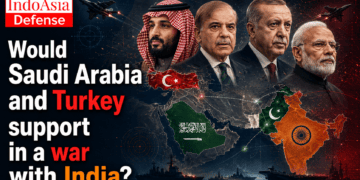
Saudi Arabia, Pakistan and Turkey Have a Defence Pact. What Does It Mean for India?

Saudi Arabia, Pakistan and Turkey have created a new collective-defence framework under the Mecca Joint Defence Agreement. It is not NATO, but its emerging military, institutional and defence-industrial architecture could have important implications for India and regional deterrence.

IndoAsia Defense by IndoAsia Defense
August 11, 2026
in Middle East, Pakistan Outlook
0
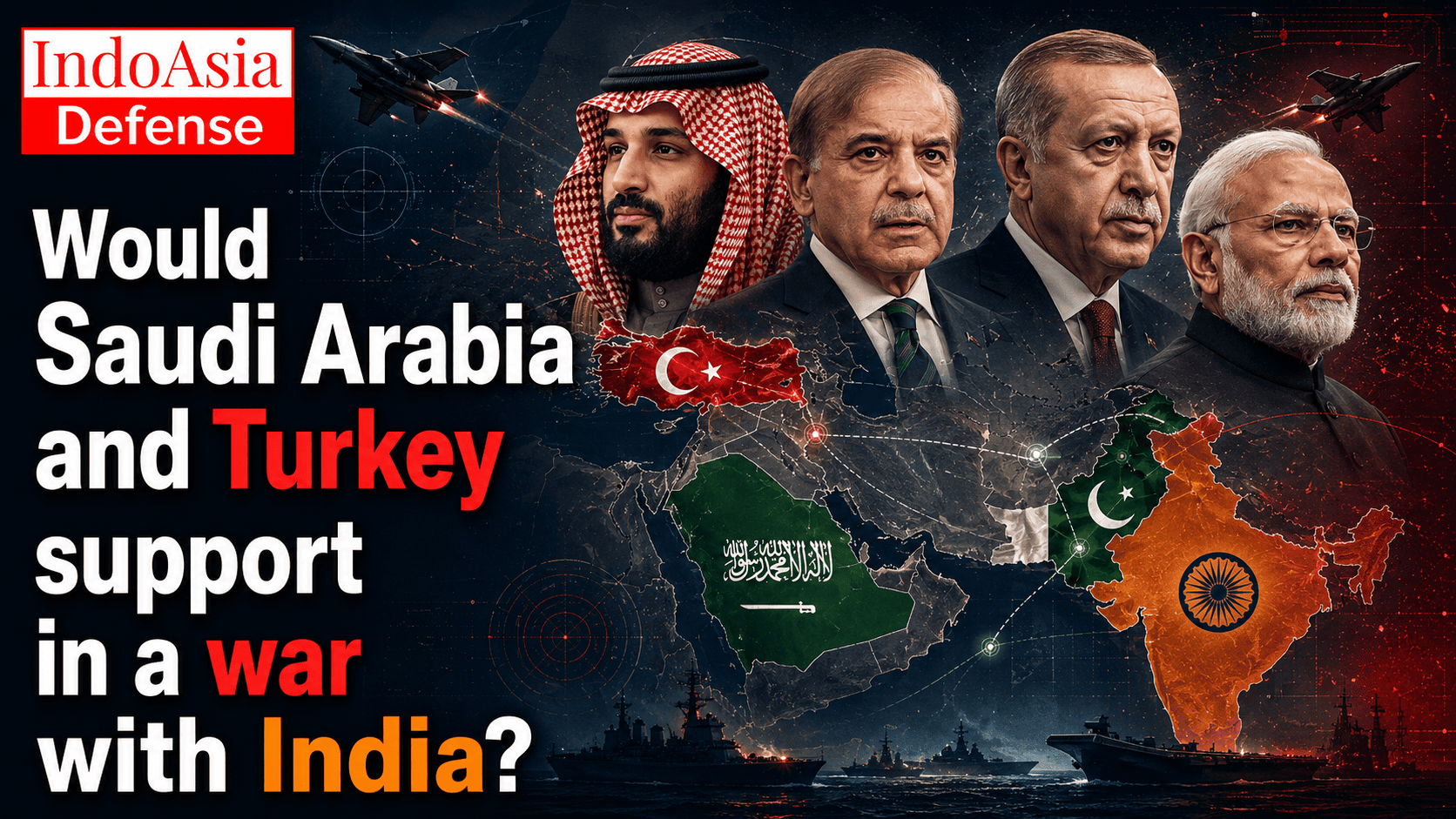
Saudi-Pakistan-Turkey defence pact

Saudi Arabia Pakistan Turkey defence pact and its strategic implications for India

0
SHARES
4
VIEWS
Share on LinkedinShare on FacebookShare on Twitter

On 7 August 2026, Saudi Crown Prince Mohammed bin Salman, Pakistani Prime Minister Shehbaz Sharif and Turkish President Recep Tayyip Erdoğan signed an agreement in Mecca whose central clause carries consequences well beyond West Asia: an armed attack against any one of the three states will be regarded as an attack against all three.

The Saudi-Pakistan-Turkey defence pact is intended to create a new framework for collective deterrence across West and South Asia. The Mecca Joint Defence Agreement builds on the bilateral Strategic Mutual Defence Agreement that Riyadh and Islamabad signed in September 2025, itself the formalisation of a security relationship running back nearly eight decades. The joint statement leans on more than one register to explain why: it invokes Islamic solidarity, yes, but also shared strategic interests and defence cooperation that predates any of the current crises.

That framing matters, because reducing the pact to religious kinship misses the harder-nosed calculations sitting underneath it, three states independently concluding that a single external security guarantor is no longer a bet worth making alone.

Turkish Foreign Minister Hakan Fidan did not hedge on the comparison that followed. The arrangement, he said, is technically the same as NATO’s Article 5. That claim deserves scrutiny rather than either acceptance or dismissal, because the honest answer is that the pact is simultaneously less than NATO today and more institutionally serious than most first read it to be.

What the Clause Actually Commits Signatories To

The agreement’s language is a collective-defence clause, not an automatic-war clause, and the distinction is the single most important thing to understand about it. Fidan has explained the operative mechanism: a state under attack must request assistance and specify what kind of support it needs, and that support can range from intelligence and logistics to ammunition or, if the threat is severe enough, military units. Nothing compels Ankara or Islamabad to send troops the moment Riyadh is struck.

For India, another ambiguity sits even earlier than the question of assistance: who determines that a member has been attacked in the first place. In a crisis where New Delhi and Islamabad present entirely different accounts of who struck first, Saudi and Turkish interpretation of that trigger could end up mattering almost as much as the treaty clause itself.

That ambiguity is not a loophole. It is the design. A mutual defence clause without automatic, undifferentiated military commitment lets each state calibrate its response to its own threat map while still banking the deterrent value of the headline promise. It is precisely how NATO’s Article 5 has functioned in practice for seventy years: invoked once, in 2001, and answered with contributions that varied enormously by member.

The Institutional Layer Is Thinner Than NATO, But It Is Real

It would be a mistake to treat this as a purely symbolic signing. Fidan has described a structure taking shape underneath the clause: a political and military committee bringing together foreign ministers, defence ministers and chiefs of general staff, meeting at set intervals, and a permanent secretariat to be based in Saudi Arabia, tasked with overseeing implementation and, eventually, joint exercises.

None of this existed before 7 August. Work on the framework had reportedly been underway for close to two years and eight months before the signing.

That is still a long way from Brussels. NATO’s deterrence rests on decades of integrated command, standing multinational formations, interoperability protocols hammered out through repeated exercises, and a nuclear-sharing architecture built over generations.

The Mecca framework currently has a committee structure and an address for a secretariat. Fidan himself has acknowledged the gap, noting that joint exercises will be necessary before the three militaries can establish whether their weapons systems and communications are even compatible with each other in a shared combat scenario.

The right way to think about this is not whether the Mecca pact resembles NATO in August 2026. It is what a secretariat, a standing ministerial committee and a stated ambition to bring in additional members, Fidan has named Egypt as a likely future candidate, look like by 2030. Institutions built to administer a treaty tend to expand their own mandate over time. That is a pattern, not a certainty, but it is the pattern worth watching rather than the treaty text alone.

The Nuclear Question Is Real, and the Signals Have Been Inconsistent

Pakistan’s presence puts a nuclear-armed state inside a formal collective-defence structure for the first time since the pact’s predecessor was signed last year. SIPRI’s most recent estimate, published in its 2026 Yearbook, puts India’s stockpile at approximately 190 warheads as of January 2026 and Pakistan’s at approximately 170, with both countries continuing to diversify delivery systems.

The public position from Islamabad and Riyadh is that nothing in the agreement extends Pakistan’s nuclear deterrent to its new partners. But the signalling from Pakistani officials has not been uniform. Pakistan’s Defence Minister Khawaja Asif has at different points implied that the arrangement places Saudi Arabia under Pakistan’s nuclear umbrella, a suggestion Islamabad has since downplayed rather than confirmed outright.

That inconsistency is itself informative. Whether or not the doctrine formally changes, the ambiguity is doing strategic work: it forces Iran, and anyone else weighing an attack on a treaty member, to factor in a possibility Islamabad has neither confirmed nor closed off.

Asif has gone further in ways the carefully worded official text was built to avoid. He has called for a united Muslim military front and named the threat in terms the joint statement never does, explicitly invoking Israel and India. That is not the pact’s legal text, but it is the same government that signed it, describing its purpose in language considerably less neutral than “collective deterrence against any act of aggression.” India should read the treaty and the defence minister’s public framing of it as two different data points, not one.

The Pact Has Already Faced Its First Real Test

Two days after the Mecca signing, Houthi forces struck Saudi Aramco’s Jazan refinery with a drone, the latest in a campaign that had already declared a naval blockade against Saudi Arabia in the Red Sea. Reuters reported it was not clear whether or how either Pakistan or Turkey would join any Saudi response. Nothing has, as of this writing.

That is not evidence the pact is hollow. It is evidence that the consultation mechanism Fidan described, request assistance, specify the kind needed, works exactly as slowly and deliberately as it was designed to. A drone strike on a refinery, however serious for Saudi Arabia, is not the kind of existential threat the clause appears calibrated to answer immediately.

What the episode does confirm is that Riyadh’s actual wartime experience with this arrangement is only beginning, and that credibility will be built crisis by crisis rather than established by the signature alone.

There is already a working precedent for what “assistance” looks like in practice, and it predates the trilateral pact. Under the bilateral Saudi-Pakistan agreement, Islamabad deployed roughly 8,000 troops, a squadron of JF-17 fighters, two squadrons of drones and a Chinese-made HQ-9 air defence battery to Saudi Arabia during the 2026 Iran war, with reports of that footprint later expanding toward 13,000 troops after a ceasefire.

None of it involved Pakistani forces engaging Iranian missiles directly. It was training, advisory support and a visible, financed presence, exactly the kind of calibrated, non-automatic contribution the Mecca framework now formalises for three states instead of two.

What This Changes for India, and What It Does Not

For India, the Saudi-Pakistan-Turkey defence pact creates strategic questions that extend well beyond the wording of its collective-defence clause. India’s public response has been measured through both iterations of this pact. Responding to questions on 11 August, Ministry of External Affairs spokesperson Randhir Jaiswal said New Delhi was examining the agreement’s implications both for national security and for regional stability, and that India would take all necessary measures to safeguard its interests.

That is close to the language used after the September 2025 bilateral pact, and the continuity is deliberate. It signals that India does not intend to overreact to a document whose operational meaning is still being written.

The exposure runs along three tracks that do not move at the same speed. The first is economic leverage, and it favours India. New Delhi’s relationship with Riyadh, worth tens of billions of dollars in trade, energy and remittances from millions of Indian workers in the Kingdom, gives India real weight that Islamabad cannot match.

Saudi Arabia has shown no appetite for letting a framework built partly around Pakistan damage a partnership this economically load-bearing, and Gulf pragmatism has historically outlasted pan-Islamic solidarity whenever the two have pulled in different directions.

The second is financial and favours Pakistan, if only incrementally. Islamabad has spent years trying to compete against an Indian defence budget several times its size. A steady flow of Gulf capital and financed equipment, the pattern already visible in the deployment to Saudi Arabia, narrows that gap slowly rather than dramatically.

More consequentially, Pakistan could increasingly become the hinge between two overlapping defence relationships, its long-established military partnership with China to the east, and an emerging Saudi-Turkish security architecture to the west.

That is an inference about Pakistan’s position, not evidence of any institutional link between the two, since China sits nowhere in the Mecca text. Collective defence also cuts both ways: the pact may widen Islamabad’s options in South Asia while narrowing its freedom to stay aloof from future Saudi or Turkish crises that have nothing to do with India.

The third track is the one getting the least attention and probably deserves the most: precedent. A collective-defence clause built by three regional middle powers hedging against the reliability of a single great-power guarantor is a template other states are watching. Fidan’s own comments about Egypt suggest Ankara sees it that way too.

If the architecture matures rather than stalls, secretariat, standing committee, joint exercises, the template becomes an alternative organising logic for West Asian security, one India has less practice navigating than the transactional, interest-based diplomacy it built with the region since the 1990s.

None of this adds up to an imminent military threat to India. It adds up to something slower and harder to counter with a single diplomatic démarche: a West Asia where new institutions, rather than only new alignments, start setting the terms of who gets support, and how fast, in the next regional crisis.

The Saudi-Pakistan-Turkey defence pact does not yet represent an immediate military threat to India, but the institutions developing underneath it could reshape the regional security environment over time. The treaty’s most consequential sentence may not be the one about an attack on one being an attack on all. It may turn out to be whatever the Saudi-based secretariat decides to do with the two years and eight months of groundwork already put into building it.

Tags: Editor’s Pick
Previous Post

Great Nicobar Project: Why India’s $9 Billion Port Could Reshape the Indian Ocean

IndoAsia Defense

IndoAsia Defense

IndoAsia Defense Team is a specialist research and analysis group focused on India’s military modernization and Indo-Pacific strategic dynamics. The platform delivers structured, data-driven insights on doctrine, force posture, defense technology, and regional power balance.

Leave a Reply Cancel reply

Your email address will not be published. Required fields are marked *

Category

  • Air
  • Global
  • Indo-Pacific
  • Industry
  • Joint
  • Land
  • Navy
  • Tech

Defence Capabilities

  • Air Defence
  • Drones
  • Fighters
  • ISR & Mobility
  • China Military
  • Emerging Tech
  • Regional Trends
  • U.S. Posture

Strategy

  • 2035 Outlook
  • China Strategy
  • India Strategy
  • Pakistan Outlook
  • Budget
  • Exports
  • Make in India
  • Supply Chains

Operations

  • Integrated Ops
  • Procurement Reform
  • Theater Commands
  • Armour & Artillery
  • China Front
  • Future Combat
  • Pakistan Front
  • Fleet Expansion

Resources

  • India vs China Military Balance
  • Indo-Pacific Military Power Map
  • Global Military Balance Dashboard
  • Global Weapons Systems Database
  • Global Missile Systems Database
  • Indo-Pacific Defense Timeline
  • India Military Capability Index
  • About
  • Contact
  • Privacy & Policy
  • Editorial Policy
  • Cookie Policy
  • Disclaimer
  • Terms And Conditions
Facebook Linkedin X-twitter
© 2026 IndoAsia Defense. All Rights Reserved.
No Result
View All Result
  • Home
  • Air
    • Air Defence
    • Drones
    • Fighters
    • ISR & Mobility
  • Land
    • Armour & Artillery
    • China Front
    • Future Combat
    • Pakistan Front
  • Navy
    • Fleet Expansion
    • Indian Ocean
    • Maritime Security
    • Submarines
  • Indo-Pacific
    • 2035 Outlook
    • China Strategy
    • India Strategy
    • Pakistan Outlook
  • Joint
    • Integrated Ops
    • Procurement Reform
    • Theater Commands
  • Tech
    • AI & Autonomous Systems
    • Cyber
    • Electronic Warfare
    • Space
  • Industry
    • Budget
    • Exports
    • Make in India
    • Supply Chains
  • Global
    • China-Pak
    • Emerging Tech
    • Regional Trends
    • US-India