






















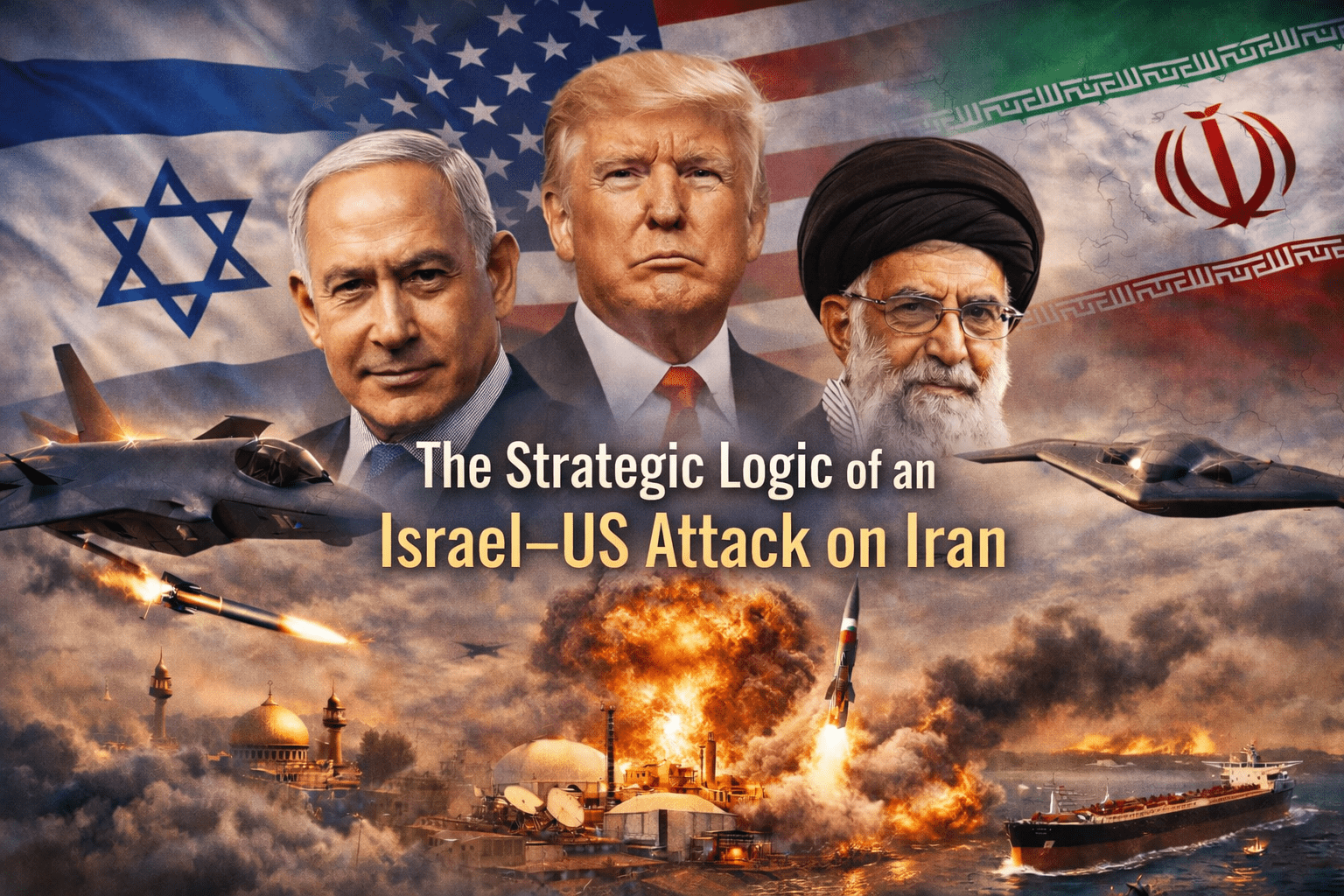
An Israel–US attack on Iran would not be a “war” in the classical sense. It would be a calibrated, highly technical, politically engineered act of coercion—designed to change behavior without triggering regional collapse. That distinction matters.
The conversation often gets trapped in binaries: strike or no strike, war or peace, success or failure. But the real strategic question is different: What would such an attack be trying to achieve in 2026—and what second-order consequences would follow?
To understand this, we need to unpack three layers: military feasibility, escalation architecture, and geopolitical realignment.
The Military Layer: Precision, Not Regime Change
This would not resemble Iraq in 2003. There would be no armored columns pushing toward Tehran. Instead, we would likely see a tightly sequenced air and cyber campaign:
– Deep-penetration stealth platforms like the F-35I Adir
– Long-range strike assets such as the B-2 Spirit
– Cyber disruption targeting air defense grids and command networks
– Electronic warfare suppression of Iranian radar coverage
The objective would be degradation, not annihilation.
But here’s the hard truth: Iran’s nuclear program is no longer a single-site vulnerability. It is dispersed, hardened, and politically embedded. Even a technically successful strike would likely delay—rather than eliminate—its capabilities.
That means the strike would not be an end-state. It would be a signal.
And signals invite responses.
The Escalation Architecture: Iran’s Asymmetric Reply

That leverage sits in three domains:
-
Proxy firepower — groups like Hezbollah and Houthis can stretch Israel and Gulf states across multiple fronts.
-
Maritime chokepoints — the Strait of Hormuz handles a significant share of global energy flows. Even temporary disruption spikes insurance rates and oil futures.
-
Ballistic and drone salvos — Iran’s missile force is survivable and geographically distributed.
The likely Iranian response would not be a single retaliatory strike on Tel Aviv or a direct assault on US bases. It would be layered pressure: rocket fire from Lebanon, drone harassment in the Gulf, cyber intrusions against regional infrastructure.
Tehran understands escalation ladders. It will calibrate its retaliation to avoid regime-threatening escalation while demonstrating that deterrence cuts both ways.
This is where risk compounds. Once proxy fronts ignite, local actors gain agency. Miscalculation becomes far more likely than deliberate escalation.
The American Calculation: Credibility vs Containment
For Washington, participation in such a strike would not simply be about Iran. It would be about global deterrence architecture.
The United States is balancing multiple theaters—Europe, Indo-Pacific, and the Middle East. A joint strike would signal that red lines on nuclear proliferation still carry enforcement weight.
But enforcement has costs.
Every munition expended in West Asia is a munition not stockpiled for the Pacific. Every deployment cycle stresses logistics already stretched by Ukraine and Indo-Pacific contingencies. The strike would therefore be tightly bounded—time-limited, target-limited, politically framed as non-escalatory.
The real American objective would be to restore uncertainty in Iran’s strategic calculus: to remind Tehran that threshold games carry consequences.
But credibility, once demonstrated kinetically, demands follow-through. If Iran rebuilds quickly, Washington faces a dilemma—strike again or absorb erosion.
Israel’s Strategic Imperative: The Nuclear Clock
For Israel, the calculation is more existential. The fear is not immediate annihilation. It is long-term strategic compression.
A nuclear-threshold Iran alters Israel’s deterrence geometry. Even without a declared weapon, enrichment capability shifts psychological balance. Israeli planners view this as a narrowing window—what they often frame as a “point of no return.”
The concern is not just capability, but intent under crisis conditions. A state with latent nuclear capacity gains bargaining leverage in every future conflict.
This is why Israel has historically acted preemptively when it perceives irreversible thresholds.
Energy, Markets, and the Silent Front
The first visible impact of an attack would not be battlefield footage. It would be oil prices.
Energy markets react faster than governments. Insurance premiums for Gulf shipping would spike. Brent crude could surge sharply within hours. Asian importers—India, Japan, South Korea—would feel the ripple immediately.
Here lies a frequently ignored dimension: an Israel–US strike is not only a military event; it is an economic shockwave.
Countries dependent on Gulf energy flows would be forced into diplomatic balancing acts. Quiet mediation would accelerate. Public neutrality would mask private pressure.
The Regional Realignment Question
The Abraham Accords architecture has already altered the regional map. Gulf states are no longer uniformly hostile to Israel. But they are also deeply exposed to Iranian retaliation.
If Gulf capitals quietly support an operation while publicly distancing themselves, it will expose the layered diplomacy now defining West Asia.
Meanwhile, Russia and China would exploit instability rhetorically and economically—positioning themselves as “stability brokers” while benefiting from elevated energy prices.
This is where the strike’s strategic meaning expands beyond Iran.
It becomes a test of whether US-led security architecture in the Middle East still functions cohesively under stress.
What This Development Actually Signifies
An Israel–US attack on Iran would not signify the start of a total war. It would signify something subtler—and arguably more consequential.
It would mark the end of the ambiguity phase around Iran’s nuclear threshold status.
For years, the region has operated under calibrated tension: shadow wars, cyber sabotage, limited strikes in Syria. A direct strike on Iranian soil would collapse that ambiguity.
The message would be clear: threshold strategies are no longer insulated from overt force.
But ambiguity, paradoxically, has been stabilizing. Once removed, actors are forced into clearer postures.
Clarity reduces misreading—but increases rigidity.
And rigid systems are more prone to fracture under stress.
The Missing Dimension: Domestic Political Incentives
One dimension rarely discussed openly is domestic political timing. Leadership in both Israel and the United States operates under electoral and coalition constraints. Strategic moves often intersect with internal legitimacy narratives.
Iran, too, uses external confrontation to consolidate domestic cohesion.
In other words, this is not only interstate deterrence. It is also regime signaling to internal audiences.
Ignoring this layer leads to flawed forecasts.
Strategic Conclusion: The War After the Strike
The first night would dominate headlines. The real story would unfold over the next twelve months.
Would Iran sprint toward weaponization as a deterrent shield?
Would Gulf states accelerate missile defense integration?
Would energy importers deepen diversification away from chokepoints?
Would US force posture in the region expand—or contract after a limited demonstration?
The strike itself would be finite. The strategic aftershocks would not.
Ultimately, an Israel–US attack on Iran would represent a transition—from shadow deterrence to overt enforcement.
It would not solve the Iran question. It would redefine it.
And once redefined, every actor in the region—from Tel Aviv to Tehran, from Washington to Riyadh—would operate under a new strategic ceiling.
The true significance, therefore, is not destruction.
It is recalibration.

