

















When India began seriously exploring parallel Russian and indigenous upgrade tracks for the Sukhoi Su-30MKI, the instinctive reaction was to treat it as bureaucratic hedging — a safety net in case one path falters.
That interpretation is too shallow.
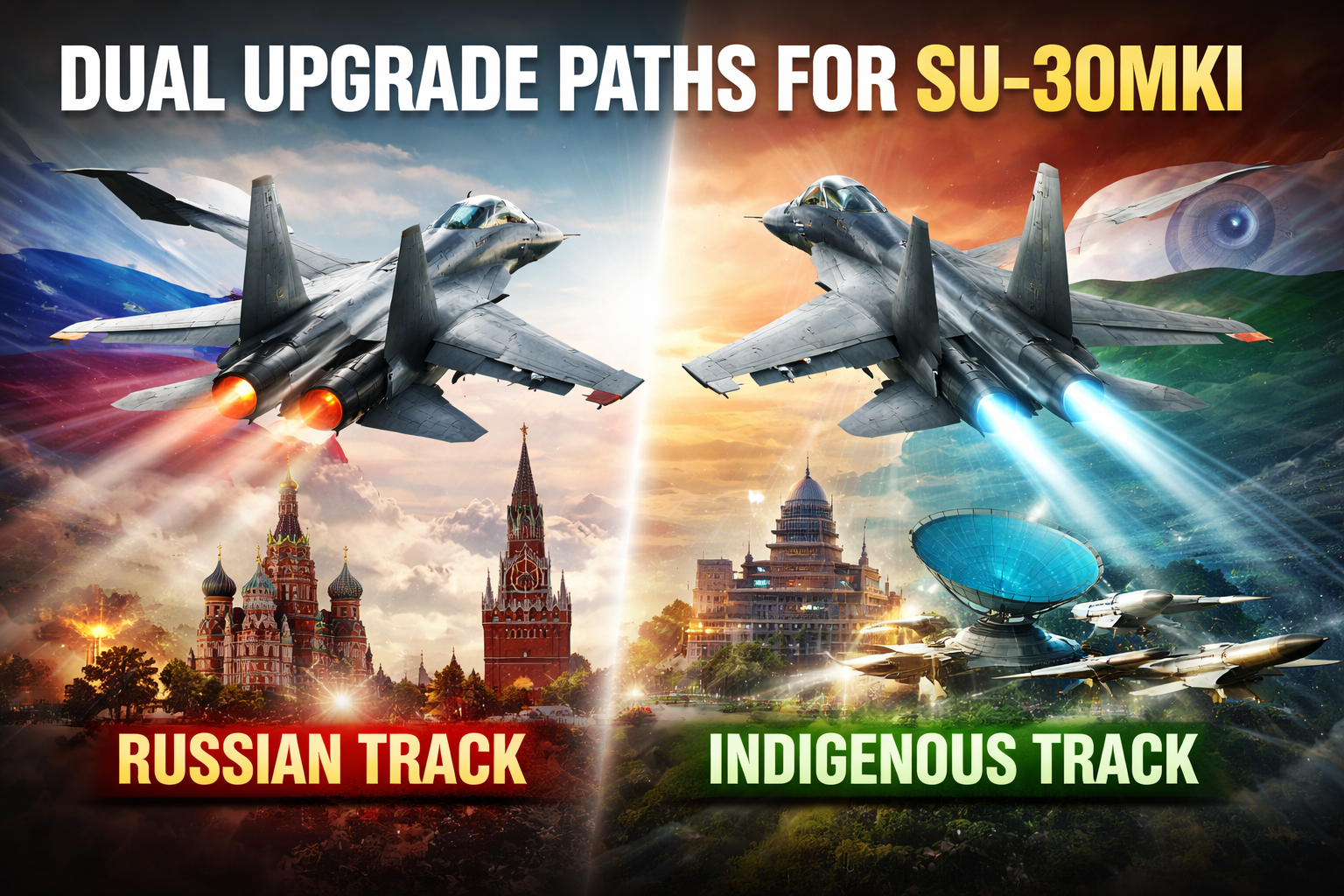
What is unfolding is a deliberate experiment in dual-source modernization: one path optimized for speed and structural familiarity with Russia, the other optimized for software sovereignty and long-term strategic autonomy.
The aircraft is constant. The philosophy behind upgrading it is not.
The Russian Track: Speed, Familiarity, and Structural Continuity
The Russian-assisted path builds on the Su-30MKI’s original DNA. The airframe, flight control logic, and much of the systems architecture are rooted in Russian design philosophy. That matters because integration risk decreases when upgrades align with original engineering lineage.
A Russian-backed upgrade could emphasize:
-
Engine improvements (potentially leveraging advanced variants derived from newer Russian platforms)
-
Enhanced electronic warfare suites
-
Radar and sensor refresh within compatible architecture
-
Faster certification due to baseline familiarity
This approach offers a critical advantage: tempo.
Instead of waiting for full domestic sensor maturation and software validation cycles, the IAF can inject measurable capability improvements into a large portion of the fleet within a shorter timeframe. In operational terms, that compresses vulnerability windows.
But the Russian path carries structural implications beyond readiness.
Every engine upgrade deepens maintenance alignment. Every EW suite refresh embeds signal processing logic that may not be fully sovereign. Every imported subsystem extends lifecycle dependency.
The Russian track strengthens near-term combat density. It does not automatically strengthen strategic autonomy.
The Indigenous Track: Control of the Digital Spine
The indigenous upgrade — often framed as the “Super Sukhoi” vision — is not just a hardware refresh. It is an attempt to rewrite the aircraft’s digital backbone.
This path emphasizes:
-
Indigenous AESA radar integration
-
Indian mission computers
-
Domestic electronic warfare architecture
-
Full compatibility with Indian missile and datalink ecosystems
The difference is subtle but profound.
Under an indigenous architecture, India controls:
-
Software update cycles
-
Threat library evolution
-
Missile integration timelines
-
Encryption and datalink logic
In modern air combat, the side that controls the software layer controls future lethality adaptation.
The indigenous path is slower not because it lacks ambition, but because sovereignty is technically harder. Radar certification, EW tuning, flight validation — these are multi-year engineering commitments.
But once achieved, they reduce external leverage over the platform’s evolution.
A 2032 Scenario: How the Two Tracks Diverge Operationally
Consider a 2032 high-altitude standoff over Ladakh.
Opposing forces include advanced Chinese aircraft such as the Chengdu J-20 operating within a mature sensor network.
If the majority of India’s Su-30MKIs follow the Russian upgrade track, the fleet benefits from:
-
Faster engine improvements
-
Rapid EW reinforcement
-
Broad-scale survivability gains
This enhances numbers-based deterrence.
If a significant portion follows the indigenous path, India gains:
-
Deeper missile-network integration
-
Software agility for rapid countermeasure updates
-
Greater data fusion compatibility with domestic assets
This enhances adaptive lethality.
In war-game modeling, both matter. The Russian path stabilizes force density. The indigenous path accelerates network sovereignty.
Parallel modernization ensures India does not have to choose between density and sovereignty in the short term.
The Engine Question: Strategic Lock-In vs Deferred Commitment
Engines represent long-horizon geopolitical anchors.
If India adopts advanced Russian engine lines at scale, it strengthens interoperability with Russian-origin systems but deepens dependency. Training pipelines, spare ecosystems, and overhaul facilities align accordingly.
If India maintains existing engine baselines while indigenizing avionics, it preserves flexibility but may sacrifice performance margins.
The dual-track model postpones a definitive alignment decision.
That postponement is strategic. It keeps India from locking into a single supply ecosystem prematurely while still extracting operational benefits.
Cost Architecture: Two Risk Profiles
A fully indigenous upgrade demands heavy upfront investment in R&D, validation, and production ramp-up. The risk is technical delay. The reward is long-term independence.
A Russian-assisted upgrade lowers development uncertainty and speeds fielding but increases lifecycle import exposure.
By running both tracks, India spreads financial and technical risk across time. Instead of betting entirely on sovereignty or entirely on speed, it hedges.
This is not duplication. It is diversification.
Logistics: Fragmentation or Phased Convergence?
The fear of variant fragmentation is real.
Different radar baselines. Different EW stacks. Potential engine divergence.
Yet the Indian Air Force has historically managed heterogeneous fleets, including the Dassault Rafale alongside Russian-origin platforms.
The decisive variable is convergence planning.
If Russian upgrades are treated as Phase I enhancements and gradually harmonized with indigenous software layers over time, logistics strain remains transitional.
If divergence becomes permanent, lifecycle cost balloons.
The choice will not be determined by hardware alone, but by integration governance.
China’s Template: Continuous Substitution
China’s modernization of the Shenyang J-11 provides context. Beijing did not discard its Russian-derived fleet. It progressively replaced subsystems with indigenous alternatives. Engines, avionics, and radar systems were domestically substituted over successive variants.
India’s indigenous track echoes that substitution philosophy.
The Russian track ensures the fleet remains relevant during substitution.
In effect, India is attempting a hybridized version of China’s rolling modernization model — adapted to a democratic procurement ecosystem.
The Strategic Core: Parallelism as Doctrine
The deeper transformation here is doctrinal.
India appears to be moving from singular modernization events toward continuous, overlapping upgrade cycles. Instead of upgrading once and freezing configuration for decades, the Su-30MKI is becoming a living platform — evolving through layered enhancements.
- The Russian track delivers immediacy.
- The indigenous track delivers sovereignty.
- Together, they create optionality.
In a volatile security environment, optionality is resilience.
The Verdict on Su-30MKI upgrade strategy
The Su-30MKI itself is not the story.
The story is that India refuses to choose between readiness and autonomy — and is instead attempting to build both simultaneously.
If managed with disciplined convergence, the dual-track upgrade could become a template for future platforms.
If mismanaged, it risks structural complexity without coherence.
The aircraft may be Russian in origin.
But the modernization philosophy unfolding around it is distinctly Indian — pragmatic, layered, and unwilling to be constrained by a single path.

