





















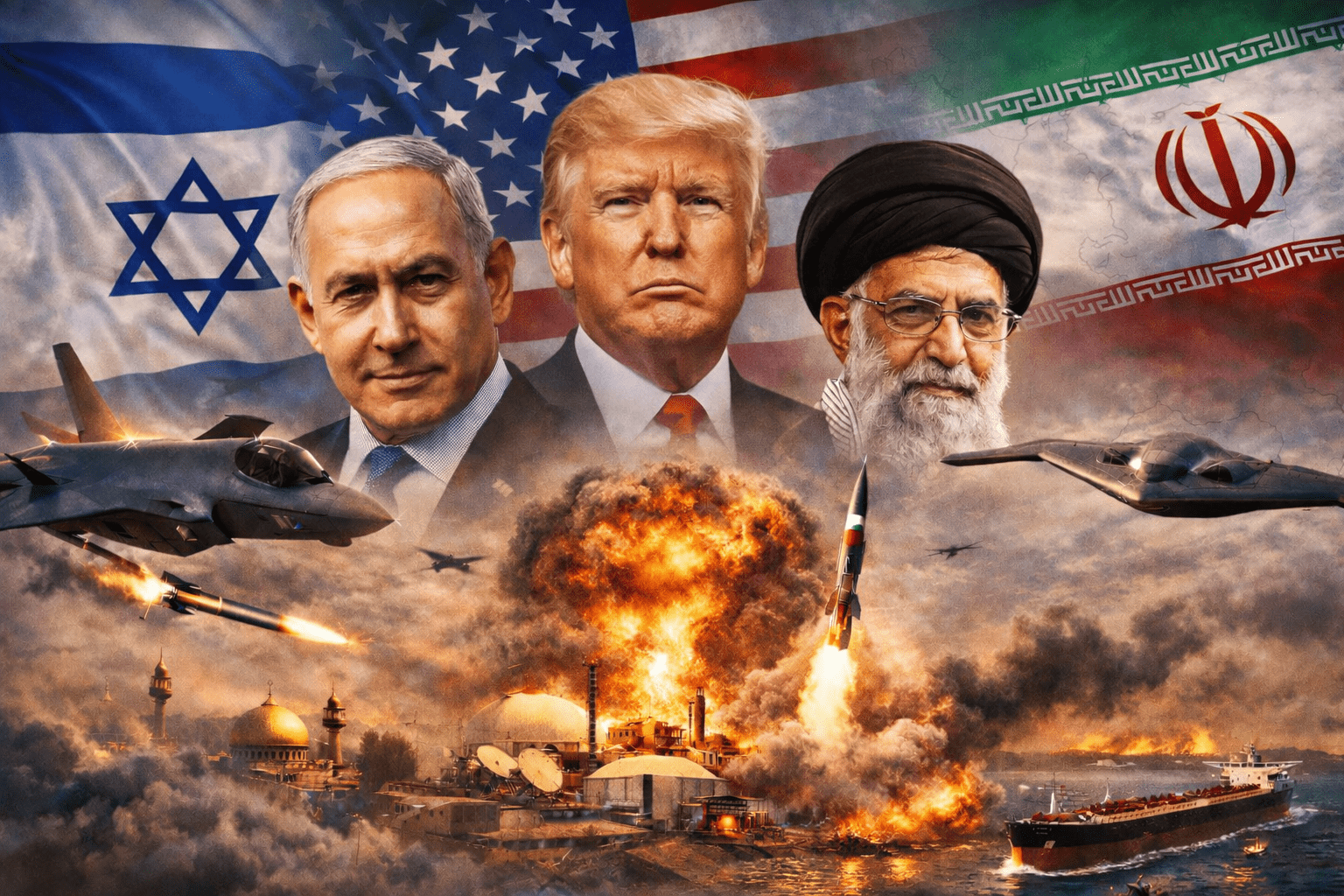
In a dramatic and explosive turn of events, the United States and Israel launched joint military strikes against Iran early Saturday morning, marking a significant escalation in an already volatile Middle East.
The operation, which the US has dubbed “Operation Epic Fury,” has triggered retaliatory attacks from Tehran and drawn urgent reactions from world leaders concerned about a widening regional war.
This blog post breaks down what we know so far about the attacks, the stated objectives, the global response, and what this could mean for the future.
What Happened?
Explosions were heard in the Iranian capital, Tehran, with thick smoke rising over the city. Initial reports from Israeli officials confirmed that the strikes were a “preemptive” action, conducted in close coordination with the United States.
The attacks reportedly targeted high-value locations, including the compound of Iran’s Supreme Leader, Ayatollah Ali Khamenei, as well as key military and government infrastructure in cities such as Isfahan, Qom, and Kermanshah.
According to an Israeli security official, the operation was the result of “months of close and joint planning,” with the specific timing agreed upon weeks ago. This planning occurred even as diplomatic talks between the US and Iran regarding the latter’s nuclear program were reportedly showing “significant progress.”
Trump’s “Massive and Ongoing” Campaign
President Donald Trump confirmed the attack in an eight-minute video shared on his Truth Social platform, announcing that the US military had begun “major combat operations” to “defend the American people by eliminating imminent threats from the Iranian regime.”
President Trump outlined ambitious and extensive war goals, vowing to:
-
Destroy Iran’s missile capabilities and “raze their missile industry.”
-
“Annihilate” the Iranian Navy.
-
Ensure that Iran “can never have a nuclear weapon.”
In a direct and unprecedented appeal to the Iranian populace, Trump stated: “I say tonight that the hour of your freedom is at hand… When we are finished, take over your government. It will be yours to take.” He warned members of Iran’s armed forces to lay down their arms or face “certain death,” acknowledging that the operation could result in American casualties, stating, “That often happens in war.”
The President oversaw the start of the operation from his Mar-a-Lago estate in Florida, joined by Defense Secretary Pete Hegseth and General Dan Caine, the Chairman of the Joint Chiefs of Staff.
Iran Retaliates
As promised in previous warnings, Tehran did not remain silent. Shortly after the initial US-Israeli strikes, Iran launched a wave of retaliatory missile and drone attacks toward Israel and US assets across the region.
-
Impact on the UAE: Explosions were heard in Dubai and Abu Dhabi. The UAE Ministry of Defense confirmed it had intercepted a “blatant attack involving Iranian ballistic missiles.”
-
Impact on Israel: Sirens blared across Israel as the military warned of multiple waves of incoming missiles. The Israel Defense Forces (IDF) reported activating its interception systems and urged citizens to follow Home Front Command instructions.
-
Regional Instability: There were reports of explosions near US bases in Bahrain, Qatar, and Kuwait. In response, Dubai suspended all flights from its two major airports.
The scale of the Iranian retaliation suggests that despite previous degradation of its military, Tehran retains a significant capacity to project force and inflict damage.
A World Reacts: Allies and Adversaries Speak Out
The military action has deeply divided the international community, with even some traditional US allies expressing concern.
-
Condemnation and Concern: Leaders from France, Spain, and the European Council called for restraint and expressed grave concern over the escalation. Spanish Prime Minister Pedro Sánchez explicitly “reject(ed) the unilateral military action of the United States and Israel,” while President Macron warned it “carries grave consequences for international peace and security.”
-
Support: On the other hand, Canadian Prime Minister Mark Carney voiced support for the US action, stating that Canada “supports the United States acting to prevent Iran from obtaining a nuclear weapon.”
-
Domestic Opposition: At home, the strikes faced immediate criticism. Democratic Senator Tim Kaine denounced them as “dangerous, unnecessary, and idiotic,” and called for the Senate to return to session to vote on a War Powers Resolution to block the use of US forces in hostilities against Iran.
-
Expert Analysis: Geopolitical analysts are calling this President Trump’s biggest gamble yet, noting that he is gambling that overwhelming US military firepower from the air will be enough to destroy the Iranian regime—a gamble whose outcome remains highly uncertain.
Analysis: A High-Stakes Gamble
The coordinated strikes on Saturday represent a fundamental shift in US policy. By moving from a strategy of pressure and negotiation to direct, large-scale military action aimed at regime change, the US and Israel have entered uncharted and dangerous territory.
The decision to strike amidst ongoing nuclear negotiations has led many experts to conclude that those talks were merely a diplomatic “cover” while the true intention was always regime change.
This has been a consistent Israeli goal, with analysts suggesting Israel forced Trump’s hand to derail any potential deal between Washington and Tehran.
The world now watches to see if the massive firepower deployed by the US can achieve its stated objectives, or if, as history in the region suggests, the attack will harden Iranian resolve, entrench the regime, and ignite a broader, more devastating conflict that no one can control.
The situation is developing rapidly. We will continue to monitor and provide updates as this story unfolds.

