




















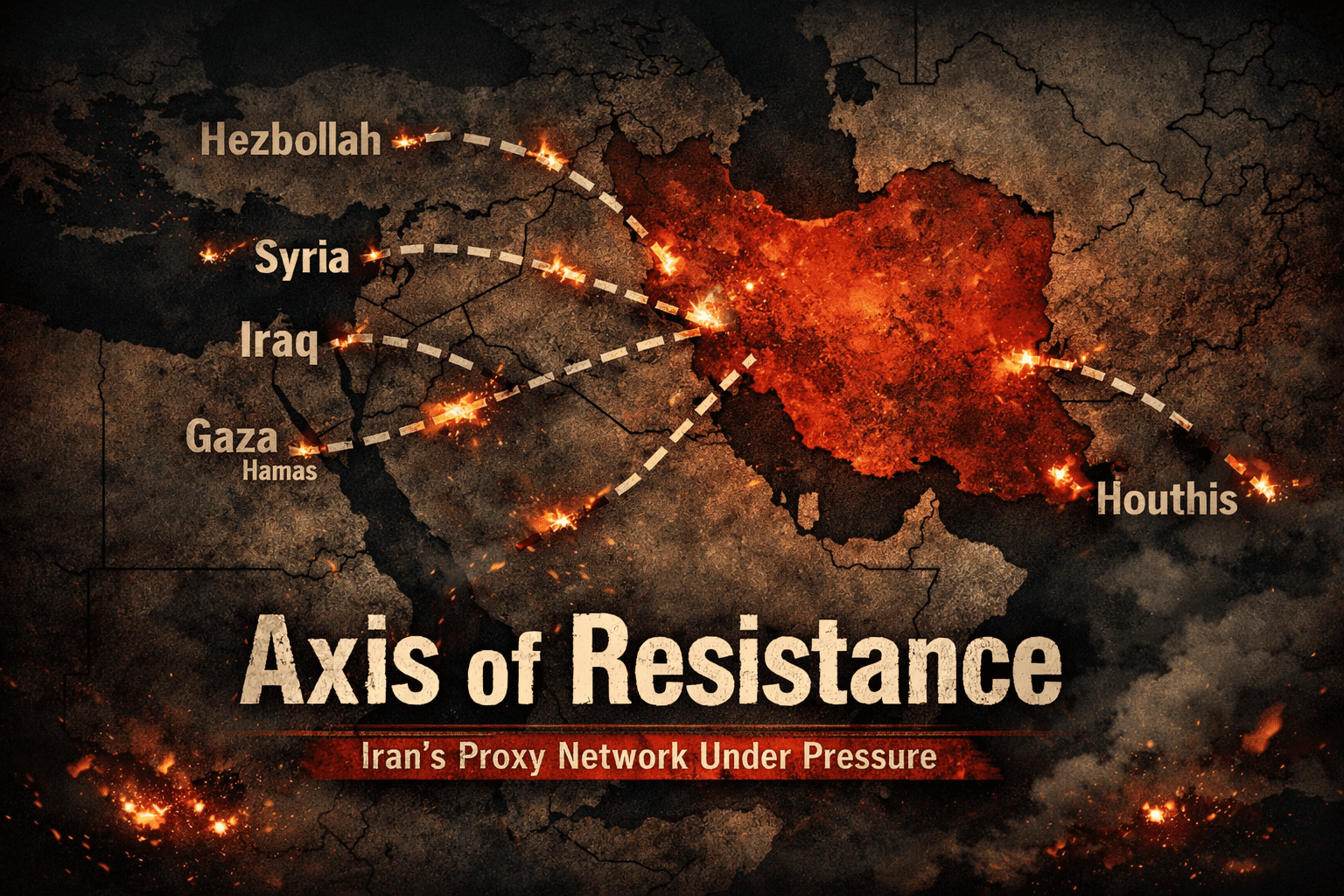
For decades, Iran pursued a regional strategy that differed sharply from traditional military alliances.
Tehran did not build overseas bases or expeditionary armies on the American model. Instead, it constructed a dispersed network of allied movements, militias, and political actors across the Middle East.
This network came to be known as the Axis of Resistance.
It was less an alliance and more a strategic ecosystem. Its members were not formally subordinate to Iran, yet they depended on Iranian funding, training, weapons transfers, and strategic guidance.
The network allowed Tehran to shape regional conflicts while limiting direct confrontation with stronger adversaries such as Israel and the United States.
At its height, the Axis stretched across the Middle East in a loose arc linking Lebanon, Syria, Iraq, Gaza, and Yemen.
It gave Iran influence in multiple conflict zones simultaneously and created the possibility of multi-front pressure on Israel.
Yet the same structure that made the Axis effective also made it fragile. Recent Israeli and American strikes across the region have exposed those structural weaknesses.
What once appeared to be a cohesive strategic network increasingly looks like a fragmented collection of actors with diverging priorities.
The Axis of Resistance may not disappear immediately. But the strategic architecture that sustained it may already be collapsing.
The Strategic Idea Behind the Axis
Iran’s regional doctrine developed under severe constraints. After the Iran-Iraq War in the 1980s, Tehran understood that it could not compete directly with technologically superior Western militaries or with Israel’s highly capable armed forces.
Instead, Iranian strategists adopted an asymmetric model.
Rather than matching conventional military strength, Iran focused on distributed deterrence.
The idea was simple but powerful. If Iran faced military pressure, its adversaries would have to confront multiple fronts across the region rather than a single battlefield.
This approach transformed geography into a strategic asset. Iran did not need to deploy large forces abroad. It only needed to cultivate local actors willing to confront shared adversaries.
Over time, this approach became institutionalized through the Islamic Revolutionary Guard Corps and particularly its external operations branch.
These organizations coordinated training, intelligence sharing, and weapons transfers to allied groups across the Middle East.
The goal was not merely influence. It was strategic depth.
If conflict erupted, Iran wanted its adversaries to face pressure simultaneously in Lebanon, Gaza, Iraq, and beyond. The battlefield would be regional rather than national.
Lebanon: The Prototype
The most successful example of this strategy emerged in Lebanon.
During the early 1980s, Iran helped shape and support Hezbollah, which grew from a militia into a highly organized political-military actor.
Over the decades Hezbollah developed extensive rocket and missile capabilities, intelligence networks, and a sophisticated command structure.
For Iran, Hezbollah served multiple strategic purposes.
It created a powerful deterrent along Israel’s northern border. It provided Tehran with a capable ally deeply embedded within Lebanese politics.
And it demonstrated that non-state actors could evolve into long-term strategic partners rather than temporary proxies.
The Lebanese model became the template for Iran’s broader regional strategy.
Expansion After the Iraq War
The US invasion of Iraq in 2003 created the next major opening for Iran’s strategy.
With the collapse of Saddam Hussein’s regime, Iraq’s political and security institutions fragmented. Iran moved quickly to cultivate relationships with various Shiite militias and political organizations that emerged in the aftermath.
These groups gradually became influential actors inside Iraq’s security apparatus and political system.
Their existence gave Iran considerable leverage inside a country that had once been its principal military adversary.
More importantly, Iraq became a geographic bridge connecting Iran to Syria and Lebanon.
This corridor significantly expanded Tehran’s ability to move weapons and personnel across the region.
Syria and the Logistics Corridor
Syria played a crucial role in the evolution of the Axis.
When the Syrian civil war erupted in 2011, Iran intervened heavily to support the government in Damascus.
The stakes were strategic rather than ideological. Syria served as the central transit point connecting Iran to Hezbollah in Lebanon.
Without Syria, the logistics architecture sustaining Hezbollah would become far more difficult to maintain.
Iran therefore committed advisors, funding, and allied militia fighters to ensure the survival of the Syrian state structure aligned with Tehran.
The Syrian conflict effectively militarized the Axis of Resistance, bringing together fighters from Iraq, Lebanon, Afghanistan, and other areas under a loosely coordinated framework.
For several years this structure functioned as a cross-border military network.
The Southern Extension: Yemen
The emergence of the Houthi movement in Yemen added a new geographic dimension to Iran’s strategy.
While the relationship between Iran and the Houthis differed from its ties with Hezbollah, the movement gradually acquired missile and drone capabilities that expanded its strategic significance.
From Yemen, the Houthis could threaten shipping routes in the Red Sea and exert pressure on regional rivals.
This southern node extended the reach of the Axis beyond the Levant into one of the world’s most critical maritime corridors.
A Network Built for Indirect War
By the early 2020s the Axis of Resistance functioned as a deterrence network.
Iran itself rarely needed to act directly. Pressure on Israel or US forces could emerge from multiple locations across the region.
Rocket fire from Lebanon, militia attacks in Iraq, and drone strikes from Yemen created a layered security challenge for Iran’s adversaries.
This network also provided Tehran with political leverage.
Many Axis actors developed local legitimacy through elections or governance roles.
This blurred the boundary between militia and state authority, making direct military responses by external powers politically complicated.
For years, this distributed model allowed Iran to influence regional conflicts without triggering full-scale war.
The Strategic Overextension
The strength of the Axis lay in its geographic spread. Yet that same spread created vulnerabilities.
A network dependent on multiple logistics routes and loosely aligned actors requires constant coordination. It also depends heavily on sustained material support from the central sponsor.
Israel gradually focused on exploiting these vulnerabilities.
Rather than confronting the entire network at once, Israeli strategy emphasized systematic degradation.
Logistics routes in Syria became frequent targets. Senior commanders linked to Iranian operations were eliminated. Weapons storage sites and transit corridors were repeatedly disrupted.
Over time this campaign created cumulative pressure on the network’s infrastructure.
The Axis could still function, but its operational environment became increasingly constrained.
The Multi-Front Moment
The regional crisis triggered by the Gaza war revealed both the power and the limitations of the Axis.
Multiple actors aligned with Iran applied pressure on Israel and US positions across the region.
Hezbollah opened a northern front. Iraqi militias targeted American facilities. Attacks on shipping in the Red Sea created global economic concerns.
For a moment the regional environment resembled the multi-front scenario Iranian planners had long envisioned.
Yet the escalation also triggered a decisive counter-response.
Israel expanded operations beyond Gaza. It targeted leadership structures across several theaters simultaneously.
What had previously been a shadow conflict became a far more direct confrontation involving Iranian territory and strategic assets.
The Structural Weaknesses Revealed
The recent phase of strikes across the region has revealed three core weaknesses in the Axis model.
The first is logistics dependence. The network relied heavily on routes running through Iraq and Syria. Disruptions to these corridors severely constrain weapons transfers and operational coordination.
The second weakness is centralized strategic guidance. Iranian military planners historically played a key role in aligning the activities of various groups.
When leadership structures are targeted, the network’s coherence declines.
The third weakness is divergent local interests.
Each member of the Axis operates within its own domestic political environment.
Lebanese actors must consider Lebanese stability.
Iraqi militias operate inside a complex political system.
Yemeni dynamics are shaped by a civil war with its own priorities.
These actors share broad ideological alignment with Iran, but their willingness to escalate conflict varies significantly.
A Fragmenting Network
The cumulative impact of recent strikes has not produced a single decisive collapse. Instead it has created fragmentation.
Some groups have reduced operational activity to avoid escalation.
Others remain engaged but with limited coordination. Logistics disruptions have slowed weapons flows that once moved more freely across the region.
In effect, the Axis is no longer functioning as a tightly interconnected strategic system.
What remains is a collection of actors that still maintain relationships with Iran but operate with increasing autonomy and caution.
Strategic Consequences
If this fragmentation continues, the regional balance could shift significantly.
Iran would lose its most effective mechanism for projecting influence across multiple theaters simultaneously. Israel would face fewer coordinated threats along its borders.
The United States could operate in the region with reduced exposure to proxy attacks.
However, the collapse of a network does not eliminate the underlying political forces that created it.
Militia organizations often evolve rather than disappear. Alliances shift, new actors emerge, and old ones adapt to changing conditions.
The Axis of Resistance may therefore be remembered not as a permanent alliance but as a phase in the evolution of Middle Eastern power politics.
The End of the Axis or Its Transformation
Iran’s proxy network represented one of the most ambitious asymmetric strategies pursued by a regional power in the modern era.
For decades it allowed Tehran to challenge stronger adversaries indirectly while extending its influence far beyond its borders.
Yet the recent escalation across the Middle East has exposed the structural limits of that model. Logistics corridors have been disrupted.
Leadership networks have been targeted. Member organizations are recalculating their own risks.
The Axis of Resistance may not disappear entirely.
But the era in which it functioned as a coherent strategic system may already be over.
What replaces it will shape the next phase of Middle Eastern geopolitics.

