































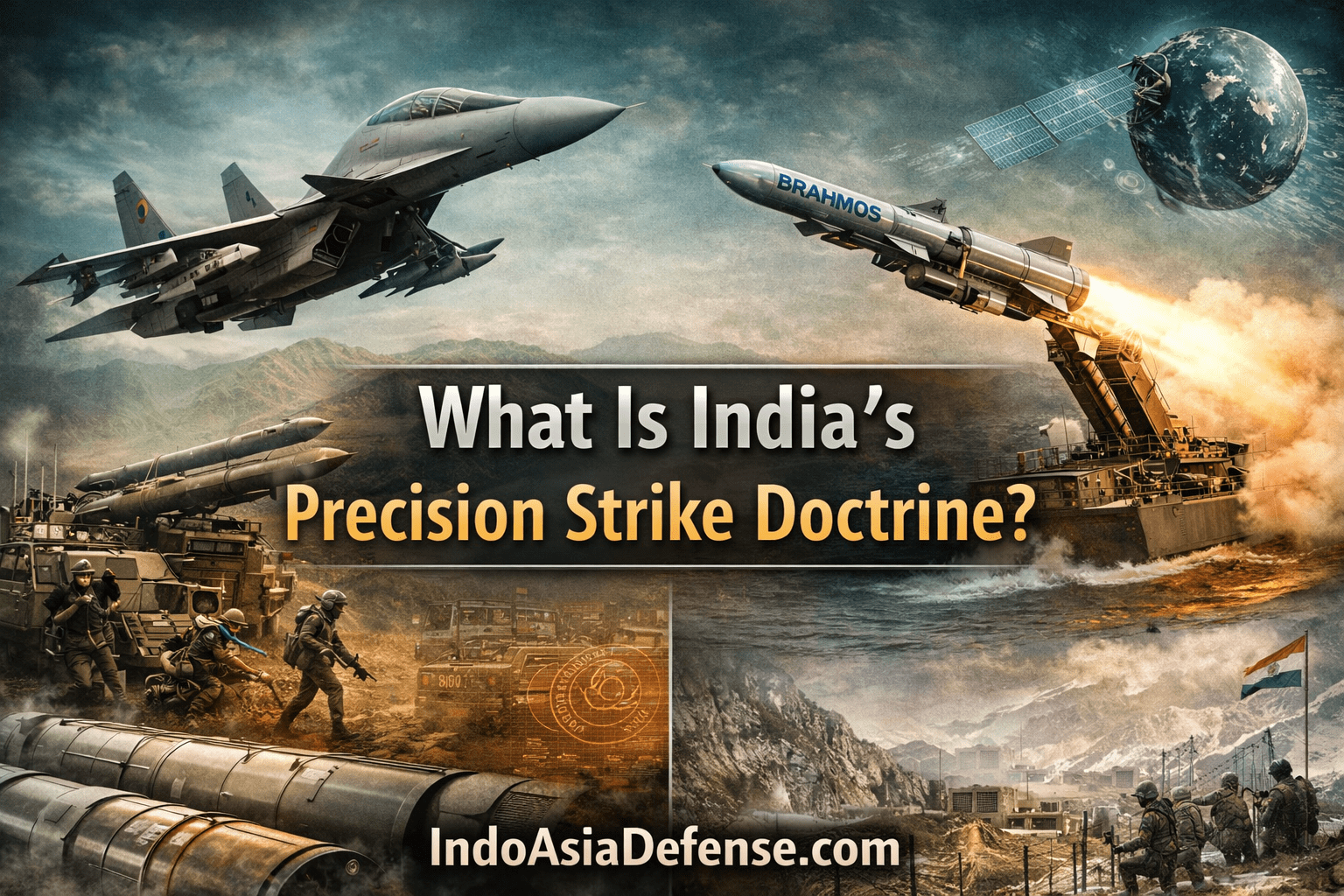
India precision strike doctrine has emerged not as a formally articulated doctrine but as a coherent operational logic shaped by technological maturation, nuclear constraints, and shifting threat geometries. It represents a transition from platform-centric warfare toward effects-based operations where the objective is to impose specific, measurable costs on an adversary without triggering uncontrolled escalation. This is a critical distinction in the South Asian context, where escalation ladders are compressed and miscalculation carries disproportionate consequences.
What most analyses overlook is that India precision strike doctrine is not simply about accuracy or stand-off capability. It is fundamentally about control. Control over escalation, control over timing, and increasingly, control over the information environment that shapes targeting decisions.
This places the doctrine at the intersection of military capability and political signaling. It is not designed to win wars in the traditional sense, but to shape adversary behavior within narrowly defined thresholds.
The search intent behind understanding India precision strike doctrine therefore lies in unpacking how India is attempting to reconcile two competing imperatives. On one side is the need for credible punitive options below the nuclear threshold.
On the other is the requirement to avoid rapid horizontal or vertical escalation, particularly in a two-front scenario. The doctrine is the mechanism through which this balance is being operationalized.
From Retaliation to Calibration: The Logic Behind India Precision Strike Doctrine
The evolution of India precision strike doctrine is inseparable from the nuclearized environment of South Asia. Unlike conventional theaters where escalation can be staged and managed over time, India operates within a framework where even limited conflict carries the risk of rapid escalation.
This has systematically constrained the utility of large-scale conventional offensives, particularly those envisioned under earlier doctrines such as Cold Start. Precision strike offers an alternative pathway by enabling calibrated, target-specific operations that signal resolve without crossing critical thresholds.
Geography further reinforces this shift. Along the northern borders, the Himalayan terrain imposes severe limitations on maneuver warfare. Logistics chains are fragile, infrastructure is sparse, and the window for operational mobility is narrow.
In such conditions, the ability to degrade adversary capabilities remotely becomes far more valuable than attempting territorial dominance through physical occupation. Precision strikes against logistics nodes, airfields, and command infrastructure allow India to impose operational friction without overextending its own forces.
A less discussed driver is the increasing transparency of the battlefield. With the proliferation of satellites, drones, and open-source intelligence, concealment has become more difficult for all actors. This reduces the viability of surprise mass mobilization while increasing the importance of speed and accuracy. India precision strike doctrine is therefore also a response to a more observable battlespace, where the side that can act faster on better information gains a decisive advantage.
Geography, Nuclear Thresholds, and the Death of Massed Warfare
Missiles constitute the most visible and often overemphasized component of India precision strike doctrine. However, their importance lies not just in their technical characteristics but in how they expand the spectrum of response options available to decision-makers. India’s missile inventory is deliberately diversified to allow for graduated responses across tactical, operational, and strategic levels.
| System | Range (km) | Type | Operational Utility |
|---|---|---|---|
| Prahar | ~150 | Tactical ballistic | Battlefield interdiction, rapid response |
| Pralay | 150–500 | Quasi-ballistic | Counter-force, hardened target engagement |
| BrahMos | 300–500 | Cruise missile | High-value, time-sensitive strike |
| Nirbhay | 1000+ | Cruise missile | Deep penetration, terrain-following strike |
The operational logic behind this mix is often misunderstood. It is not simply about range coverage but about escalation signaling. A short-range tactical strike conveys a very different message compared to a deep penetration cruise missile attack.
India precision strike doctrine leverages this spectrum to create ambiguity that complicates adversary response calculations. However, this ambiguity also introduces risks, particularly in distinguishing between conventional and nuclear signaling in a crisis.
Another underappreciated aspect is survivability. Canisterized launch systems, mobile platforms, and dispersed deployment reduce vulnerability to preemptive strikes. This enhances second-strike credibility in the conventional domain, which is essential for sustaining deterrence under conditions of high tension. The implication is that missiles are not just tools of offense but instruments of strategic stability when integrated correctly.
Missiles as Messaging: Range, Speed, and the Politics of Precision
Precision without timely intelligence is operationally irrelevant. The true center of gravity in India precision strike doctrine lies in the sensor-to-shooter chain, where the objective is to compress the time between detection and engagement. India’s expanding ISR architecture, including satellites, airborne early warning systems, and unmanned platforms, is central to this effort.
These systems collectively generate a high-resolution picture of the battlespace, but the challenge lies in integrating this data into actionable intelligence.
The bottleneck is not collection but processing and dissemination. Data latency, interoperability gaps between services, and vulnerabilities in communication networks can degrade effectiveness.
India’s push toward network-centric warfare aims to address these constraints by linking sensors, decision nodes, and strike platforms into a unified architecture. Artificial intelligence and automated analytics are increasingly being explored to prioritize targets and reduce human decision lag.
A useful visual concept here would map the sensor-to-shooter loop, showing how reductions in processing time translate into operational advantage. Even marginal improvements in this cycle can determine whether a mobile target is successfully engaged or escapes. The strategic implication is that future competition will be less about who has more missiles and more about who can close the decision loop faster.
The Real Battlespace: Sensor Fusion and the Race to Close the Kill Chain
While missiles dominate the discussion, air and maritime platforms significantly extend the operational reach of India precision strike doctrine. The integration of stand-off weapons with aircraft such as the Su-30MKI and Rafale allows India to conduct deep strikes while remaining outside dense air defense zones. This reduces platform vulnerability and increases flexibility in target selection, particularly against time-sensitive or mobile targets.
Air power also provides adaptability that fixed missile systems cannot. Aircraft can be retasked mid-mission, abort strikes based on updated intelligence, or conduct battle damage assessment in real time. This makes them a critical component of a dynamic precision strike ecosystem. The combination of manned platforms and unmanned systems further enhances persistence over contested areas.
In the maritime domain, precision strike capabilities are reshaping India’s approach to sea control. Naval platforms equipped with cruise missiles can threaten both surface vessels and coastal infrastructure, extending deterrence into the Indian Ocean.
The integration of maritime surveillance assets, including long-range patrol aircraft and drones, ensures that targets can be identified and engaged with minimal delay. This creates a distributed strike network that complicates adversary planning and enhances India’s ability to secure critical sea lanes.
Air and Sea as Strike Multipliers: Extending Reach Without Exposure
A central premise of India precision strike doctrine is that escalation can be managed through calibrated use of force. However, this assumption deserves scrutiny. Precision strikes are designed to be limited, but their political and psychological effects can be disproportionate. A strike on a high-value target, even if militarily justified, can trigger retaliation cycles that are difficult to contain.
The doctrine attempts to mitigate this risk through a combination of signaling and ambiguity. Certain capabilities are deliberately publicized to reinforce deterrence, while others remain opaque to preserve strategic uncertainty.
This calibrated transparency is intended to shape adversary perceptions without locking India into predictable response patterns. However, it also introduces the possibility of misinterpretation, particularly in fast-moving crises where decision time is compressed.
An often overlooked contradiction is that as precision increases, the perceived threshold for use may decrease. If strikes can be conducted with minimal collateral damage, political leaders may be more willing to authorize them. This could lead to more frequent but limited engagements, increasing the overall volatility of the security environment. India precision strike doctrine must therefore continuously balance capability expansion with escalation discipline.
Precision Without Predictability: Managing Escalation in a Compressed Battlespace
In a two-front scenario involving simultaneous pressures from Pakistan and China, India precision strike doctrine would face its most demanding test. The key challenge would not be the availability of strike platforms but the prioritization of targets under conditions of resource constraint and information overload. India would need to identify which targets offer the highest strategic payoff while ensuring that operations in one theater do not inadvertently escalate the other.
A plausible scenario involves localized high-intensity engagements along the Line of Actual Control combined with limited escalation along the western front. In such a situation, India could employ precision strikes to disrupt logistics networks, degrade air defense systems, and isolate forward-deployed forces.
The objective would be to impose operational paralysis rather than territorial gains. This approach relies heavily on accurate intelligence and resilient communication networks, both of which are vulnerable to cyber and electronic warfare.
The second-order effect is that resilience becomes as important as strike capability. The ability to sustain operations under degraded conditions, including loss of satellites or communication nodes, will determine the effectiveness of the doctrine. India’s ongoing efforts to build redundancy into its ISR and command networks are therefore as strategically significant as its investments in missiles and platforms.
When Two Fronts Converge: Stress-Testing India Precision Strike Doctrine
India precision strike doctrine reflects a deeper transformation in how India conceptualizes the use of force in a constrained strategic environment. It moves away from mass and attrition toward precision and control, where the objective is not simply to destroy but to shape outcomes.
This shift aligns with broader global trends but is uniquely shaped by the realities of South Asia’s nuclear dynamics and geographic constraints.
The doctrine’s success will depend on its integration across domains and its ability to adapt to technological change. Advances in artificial intelligence, hypersonic systems, and electronic warfare will continue to reshape the precision strike landscape. At the same time, the risks associated with escalation and misinterpretation will remain constant, if not increase.
India precision strike doctrine is therefore not a static framework but an evolving system that must continuously reconcile capability with restraint. Its long-term significance lies in how effectively it can provide decision-makers with credible, flexible options while preserving strategic stability in an increasingly contested Indo-Pacific.
———————————-
FAQs
What is India precision strike doctrine?
India precision strike doctrine is an evolving operational framework that emphasizes accurate, limited-force strikes to achieve specific objectives while managing escalation risks in a nuclearized environment.
Why has India developed precision strike capabilities?
India has developed these capabilities to operate within nuclear constraints, address geographic challenges, and exploit advances in surveillance and targeting technologies.
What role do missiles play in this doctrine?
Missiles provide scalable strike options across tactical and strategic levels, enabling rapid and precise engagement of high-value targets.
How does sensor fusion enhance precision strikes?
Sensor fusion integrates data from multiple platforms to create a real-time operational picture, reducing decision time and improving targeting accuracy.
Can precision strikes remain limited in a crisis?
While designed to be controlled, precision strikes can still trigger escalation depending on how they are interpreted by adversaries, making escalation management a critical challenge.

