





















Beyond Rafale: How Drones Are Rewriting India’s Airpower Playbook
Let’s admit something upfront. India’s airpower story has always revolved around fighters.
First the MiGs. Then the Sukhois. Now the Rafales.
The recent clearance for 114 more Rafales may dominate headlines, but that’s the visible layer — the part that photographs well.
The real transformation is happening in the shadows.
By 2026, the India UCAV program is emerging as the most consequential shift in the country’s combat doctrine. This is not about buying “more drones.” It is about restructuring how India fights its first 48 hours of war — where pilots may not be the first to cross the border. Machines will.
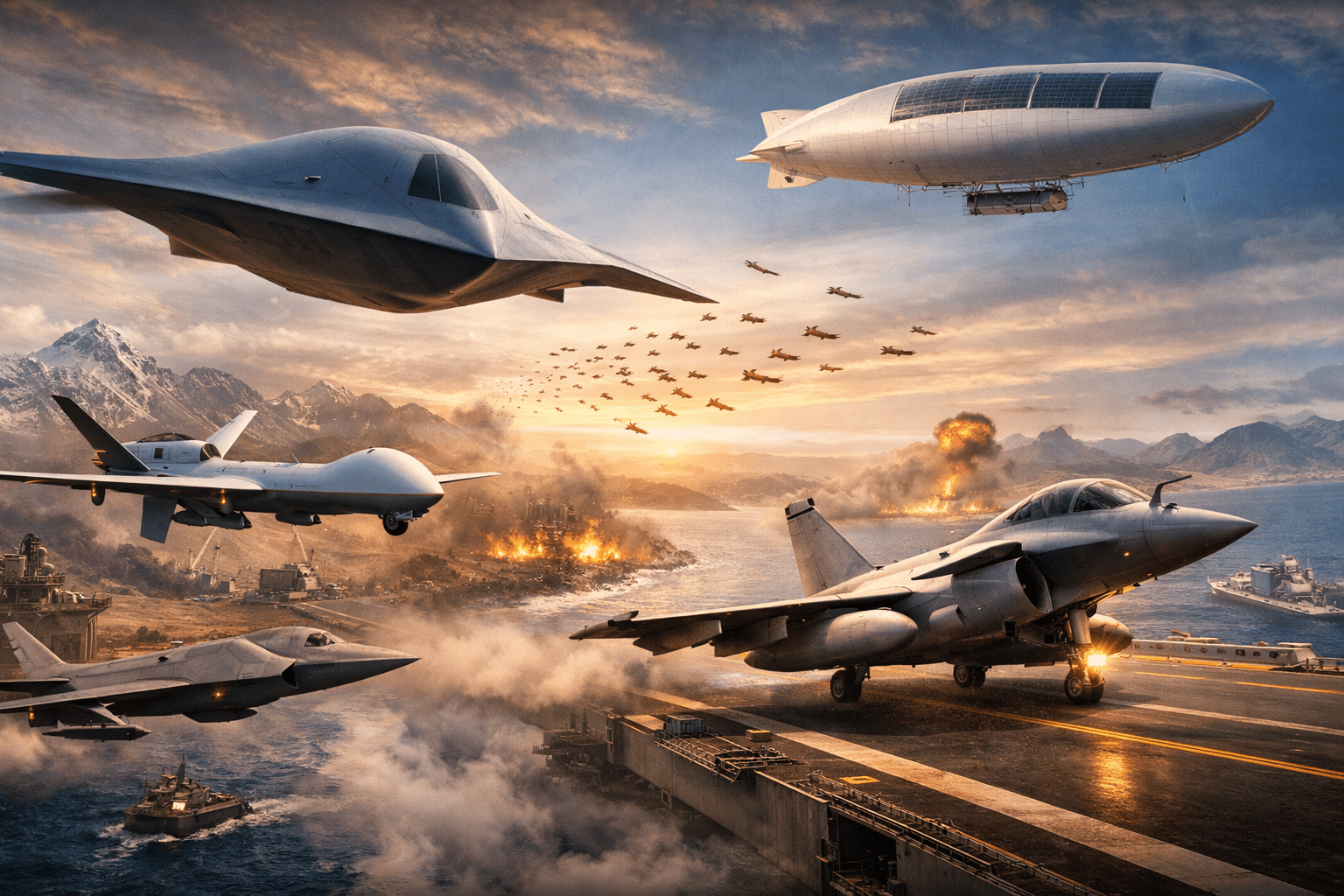
If you step back and look at the numbers being discussed — roughly 150 stealth UCAVs, 350 multi-mission drones, high-altitude pseudo-satellites, and autonomous saturation strike systems — you’re looking at the skeleton of a new kind of air campaign.
One where persistence, autonomy, and attritability matter as much as raw speed. And at the center of that transformation sits the expanding India UCAV program.
The Stealth Layer: Ghatak, CATS Warrior, Abhimanyu


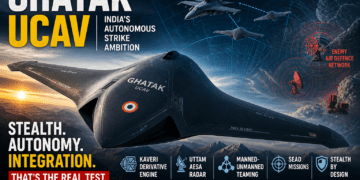
The crown jewel of the India UCAV program is the Ghatak initiative under the Defence Research and Development Organisation. At around 13 tonnes, with a flying wing configuration and internal weapon bays, this is not a tactical drone. It is a deep penetration strike platform designed to survive inside contested airspace.
Its scaled demonstrator, SWiFT, has already validated aerodynamic stability and autonomous flight logic. The leap from demonstrator to operational stealth UCAV is still significant, but the direction is clear: the India UCAV program is designed to neutralize enemy air defenses before manned aircraft even enter the fight.
And that matters, because both China and Pakistan operate layered air-defense networks. Across the Line of Actual Control, there are HQ-9 derivatives and overlapping radar grids. Across the western front, integrated Chinese-origin systems complicate strike planning. Sending a pilot first is no longer the default option.
That’s where HAL’s CATS Warrior enters the picture. Designed as a loyal wingman, it flies alongside Su-30MKIs or Tejas aircraft, extending radar coverage and absorbing risk. Within the broader India UCAV program architecture, this system represents distributed lethality — spreading risk across machines instead of concentrating it in a cockpit.
Then there’s Abhimanyu, the naval UCAV concept designed for carrier operations. Launching and recovering autonomously from INS Vikrant is technologically demanding. But if operationalised, it would give the Navy a forward strike buffer — expanding reach without exposing Rafale-M pilots in high-threat maritime zones.
Still, timelines matter. These systems are not yet fielded at scale. Engine sourcing, stealth material production, and AI autonomy refinement will determine whether the India UCAV program reaches squadron strength by the end of the decade.
The Workhorse Fleet: Multi-Mission Drones
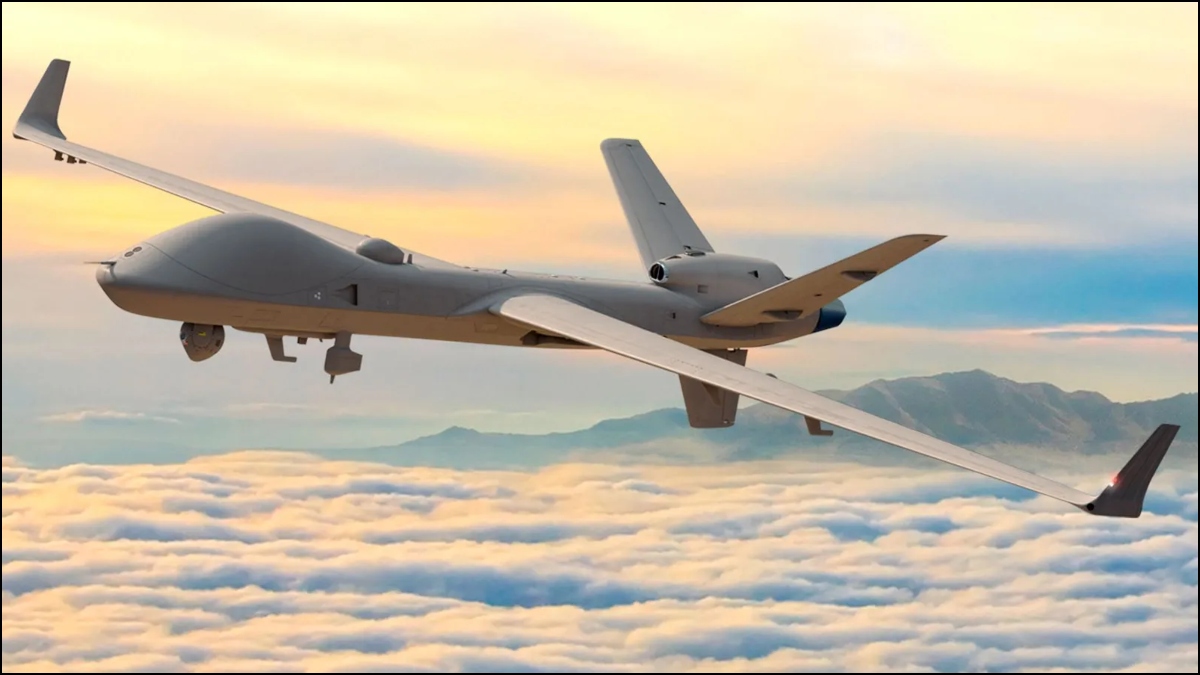
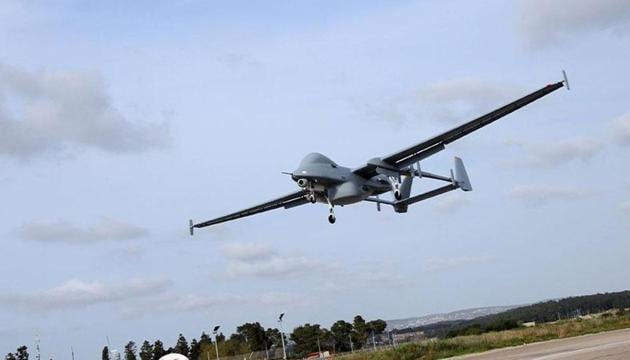
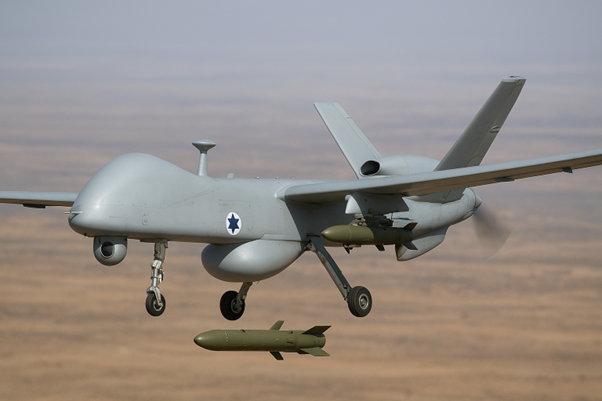
While stealth platforms dominate headlines, operational tempo is driven by multi-mission drones.
India’s experience with long-endurance systems like the MQ-9B Sea Guardian has demonstrated the value of persistence — 40+ hours airborne over the Indian Ocean, monitoring maritime corridors and choke points.
In Ladakh, ISR drones are already indispensable. Terrain restricts visibility; endurance compensates for it.
These platforms complement the India UCAV program by feeding real-time targeting data into strike networks. Without persistent ISR, stealth UCAVs operate in partial blindness. With it, they operate as precision instruments.
The planned induction of roughly 350 multi-mission drones signals that India is not betting on a single breakthrough platform. It is building layers — reconnaissance, strike, relay, and electronic warfare — that reinforce each other.
The Edge-of-Space Layer: AS-HAPS
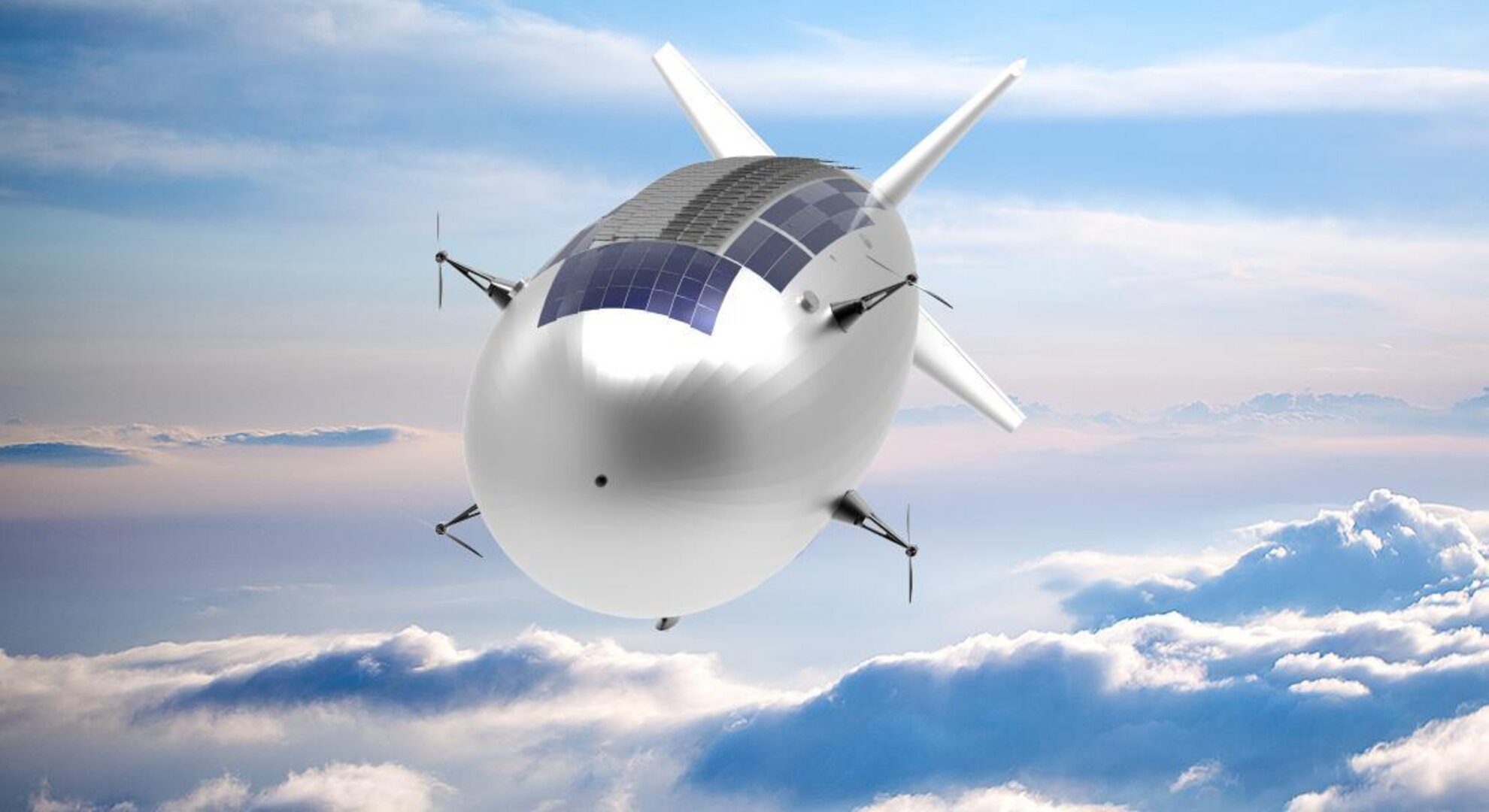


The Air-Ship Based High-Altitude Pseudo Satellite program adds a vertical dimension to the India UCAV program ecosystem.
Operating at roughly 20 kilometers altitude, these solar-powered platforms can loiter for months. Unlike satellites that pass overhead briefly, they remain fixed over priority sectors.
This could mean continuous ISR over sensitive border regions or maritime approaches.
But survivability in a peer conflict remains a concern. High-altitude interceptors and anti-satellite style countermeasures cannot be ignored.
Even so, when integrated into the broader India UCAV program framework, these pseudo-satellites provide resilience through redundancy.
The Autonomous Strike Shift: CLRTS/D and Saturation Warfare
The Defence Acquisition Council’s clearance for autonomous long-range precision strike systems signals another doctrinal evolution.
Instead of relying solely on cruise missiles or manned bombers, India is developing swarm-based systems capable of overwhelming air defenses through coordinated saturation.
Within the India UCAV program’s long-term trajectory, these autonomous strike systems represent the opening wave — softening hardened targets before stealth platforms follow.
Modern air-defense batteries can intercept limited threats. They struggle when dozens approach simultaneously from multiple vectors.
And that struggle creates windows of opportunity.
For a country preparing for potential two-front escalation, speed of paralysis matters.
The Real Missing Layer: The Combat Cloud
Here’s the part that rarely makes headlines.
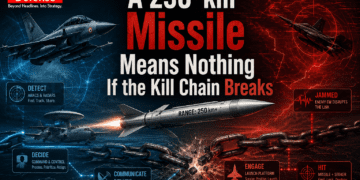
All of this — Ghatak, CATS Warrior, Sea Guardians, AS-HAPS — means very little if they don’t talk to each other securely.
The real modernisation challenge isn’t airframes. It’s data fusion. It’s networking.
Manned-Unmanned Teaming requires resilient, encrypted, jam-resistant communication networks. It requires AI that can assist but not overstep rules of engagement. It requires distributed decision-making without losing command authority.
In a high-intensity conflict, adversaries will attempt to blind, jam, spoof, and disrupt.
If the network collapses, autonomy becomes liability instead of advantage.
So the real benchmark for the India UCAV program by 2030 will not be raw platform numbers, but combat cloud resilience.
2026–2030: What the Force Could Actually Look Like
If procurement pipelines remain stable and funding priorities hold, a realistic projection toward 2030 might look like this:
By 2026–27, India could field a limited operational batch of loyal wingman systems for testing in squadron-level exercises — perhaps 12 to 18 operational prototypes integrated with Su-30MKI or Tejas units.
By 2028, early production Ghatak variants could begin limited induction, possibly in the range of 10–15 aircraft for operational evaluation.
By 2030, if production stabilises and indigenous engine programs progress as planned, a credible force of 40–60 stealth UCAVs is feasible. The originally envisioned 150-unit figure would likely extend into the early-to-mid 2030s.
Multi-mission drones, however, will scale faster.
India is already operating high-endurance systems like the MQ-9B Sea Guardian. Assuming continued procurement and domestic manufacturing push, the 350 multi-mission drone figure could realistically reach 250–300 operational units by 2030 across all three services. These would include maritime ISR platforms, high-altitude border surveillance drones, and tactical armed variants.
Stratospheric Air-Ship Based High-Altitude Pseudo Satellites — AS-HAPS — will likely begin with a small cluster, perhaps 3–5 platforms deployed over priority sectors by 2028–29. Scaling to 8–10 operational airships by 2030 would already represent a major ISR transformation.
Autonomous swarm strike systems such as CLRTS/D are likely to mature faster because they are modular and attritable. By 2027–28, India could realistically deploy hundreds of coordinated loitering systems capable of saturation attacks on airfields, radar arrays, and logistics nodes.
Taken together, by 2030 India may not yet have 150 stealth UCAVs — but it could possess a layered unmanned strike ecosystem capable of conducting suppression, saturation, ISR dominance, and deep-precision operations without exposing pilots in the opening hours of conflict.
That’s the real shift.
Ground Reality: 2026 Is a Transition Year
India is not yet fielding these systems in mass numbers. What we are seeing is capability scaffolding.
Rafales provide the credible manned strike edge. Drones expand ISR and limited strike options. UCAV prototypes mature. Autonomous swarm doctrines are being shaped.
This is a transition from platform-centric thinking to system-of-systems warfare.
And that transition will define whether India can strike first, strike deep, and strike without risking pilots in the opening hours of a conflict.
The revolution isn’t loud. It doesn’t roar like a fighter jet. It hums. It loiters. It watches.
And when required, it strikes before anyone sees it coming.

