































Defence Ecosystem Mapping Across India
India’s defence debate often centers on procurement numbers and industrial corridor announcements. These are visible and politically salient. But they do not fully explain how military capacity is generated or sustained.
A more useful lens is geographic.
India’s defence industrial base is not organized around a single dominant hub. It has evolved as a network of regional specializations.
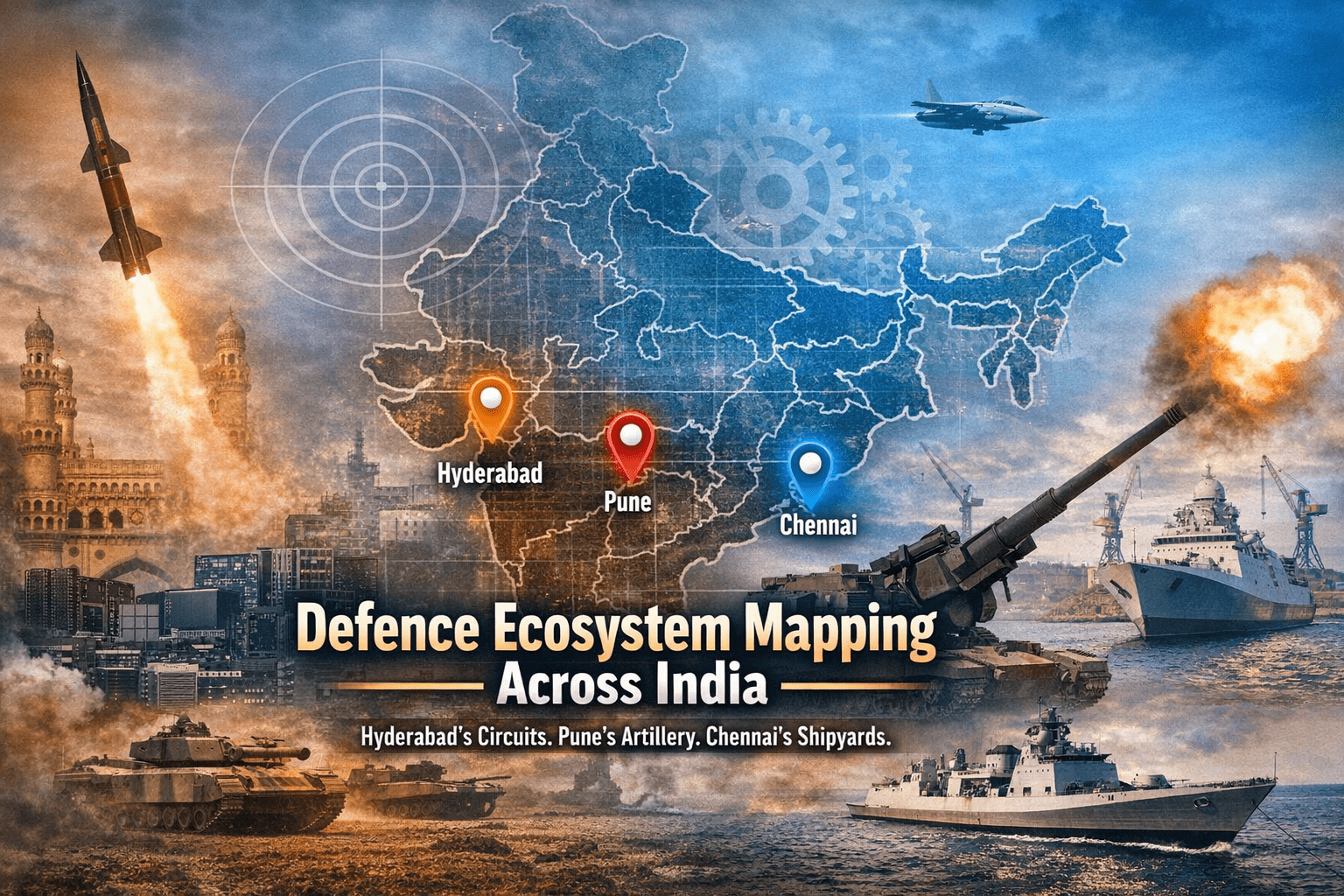
Hyderabad anchors missile electronics and electronic warfare.
Pune remains central to artillery systems and heavy land equipment.
Chennai, along with Visakhapatnam and Kochi, underpins naval shipbuilding and sustainment. Bengaluru leads in aerospace integration and avionics.
Supporting nodes in Coimbatore, Nashik, Nagpur, Gujarat, and Maharashtra provide machining, composites, aircraft production, and subsystem manufacturing.
This distribution was not originally designed as a unified strategic architecture.
It emerged from decades of public sector investment, academic ecosystems, private industry growth, and gradual policy reform. However, its strategic implications are becoming clearer.
Industrial geography now shapes military endurance.
Industrial Distribution as a Strategic Variable
In contemporary warfare, force levels alone do not determine outcomes. Sustainment capacity matters equally.
Missiles must be replenished. Artillery barrels wear out. Aircraft require avionics upgrades and overhaul cycles. Naval platforms demand periodic refits and repairs.
If industrial capacity is geographically concentrated, it becomes vulnerable to disruption. If it is distributed, risk is diffused but coordination becomes more complex.
India’s defence ecosystem is geographically dispersed across southern, western, and parts of central India. That dispersion does not eliminate vulnerability. But it reduces single-point failure risks and complicates coercive targeting strategies.
At the same time, dispersion requires strong inter-cluster connectivity. Production in Hyderabad may depend on machining inputs from Coimbatore. Aerospace integration in Bengaluru may rely on electronics from Telangana. Naval combat systems integrated in Chennai often incorporate components from multiple states.
Resilience depends not only on dispersion, but on the strength of these linkages.
Hyderabad: Missile Electronics and Electronic Warfare Capacity
Hyderabad has developed into India’s principal cluster for missile electronics, radar subsystems, and electronic warfare components. This includes seeker integration, guidance electronics, and command-and-control modules.
These technologies influence escalation management. Electronic warfare resilience, software adaptability, and radar performance increasingly shape operational effectiveness.
Domestic capability in these areas provides greater flexibility in system upgrades and reduces long-term dependence on external vendors for certain subsystems. However, complete autonomy has not yet been achieved.
High-end semiconductors and some specialized components continue to rely on global supply chains. Assembly, integration, and much of the software stack are increasingly domestic, but upstream chip fabrication remains externally sourced.
This layered structure offers partial insulation against supply disruptions. It does not eliminate exposure. Strategic planning must therefore account for semiconductor dependencies alongside system-level localization.
From a regional perspective, Hyderabad’s cluster also benefits from proximity to engineering talent, testing facilities, and a growing private-sector base. That competence density is more important than nominal factory counts.
Pune: Artillery and Heavy Land Systems
Pune remains a central node in India’s land systems manufacturing ecosystem. It combines legacy ordnance infrastructure with modern metallurgy and precision engineering.
Artillery modernization programs have reinforced this role. Barrel manufacturing, ammunition assembly, and related machining capabilities are concentrated here and in adjacent industrial zones.
In a high-intensity conflict scenario, artillery expenditure rates can be significant. Sustained operations place stress on barrel life cycles and ammunition stocks.
The key variable is not only stockpiled inventory, but the rate at which production and refurbishment can scale.
Pune’s ecosystem is relevant in this context because it houses both production lines and technical expertise for maintenance and upgrades.
However, supply chains for explosives, specialty metals, and chemical inputs remain partly dependent on imports. Industrial resilience therefore requires mapping upstream raw material flows, not just final assembly capacity.
The interaction between land doctrine and industrial capability is often understated. If regenerative capacity is limited, operational planning must adjust accordingly. If it is robust, planners retain greater flexibility.
Chennai, Visakhapatnam, and the Maritime Industrial Base
India’s maritime industrial capacity is anchored along its coastline. Chennai, Visakhapatnam, and Kochi play distinct but interconnected roles in shipbuilding, propulsion integration, and platform refits.
Naval strength is not defined only by fleet size. It depends on sustainment cycles.
Dry dock availability, repair timelines, and combat system upgrades directly affect operational availability rates.
Domestic integration of combat management systems, radars, and propulsion components reduces repair dependency on foreign suppliers. It also allows incremental upgrades over a vessel’s lifecycle.
This is particularly relevant in the Indian Ocean context, where sustained deployments require predictable maintenance schedules.
Maritime industrial depth also interacts with broader geoeconomic realities.
Shipbuilding inputs such as specialty steel, propulsion components, and electronic systems draw from national supply chains. Ensuring continuity of these inputs during disruption is part of maritime strategy, even if rarely framed that way.
Bengaluru and Aerospace Integration
Bengaluru continues to anchor India’s aerospace design and integration ecosystem. Avionics, flight control systems, radar integration, and unmanned systems development are concentrated here.
Modern air power is increasingly software-driven.
The ability to integrate new sensors, weapons, and electronic warfare configurations through domestic engineering capacity enhances operational flexibility.
However, as with electronics elsewhere, aerospace manufacturing still intersects with global supply chains for engines, certain avionics components, and materials.
The strategic value of Bengaluru lies in system integration and design competence.
That competence supports lifecycle upgrades and reduces total dependence on external configuration control.
Interdependence remains a defining feature.
Aerospace integration draws on electronics from Hyderabad, machining from Tamil Nadu and Maharashtra, and testing infrastructure across multiple states.
Procurement and Industrial Signaling
Procurement decisions influence regional industrial weight.
Indigenous artillery orders strengthen Pune’s cluster. Naval platform construction deepens coastal shipyard ecosystems.
Radar and electronic warfare modernization reinforce Hyderabad and Bengaluru.
Over time, procurement patterns can either reinforce specialization or create fragmentation.
The challenge is coordination. Without cross-ministerial and inter-service alignment, industrial investments risk duplication or uneven scaling.
Industrial geography therefore reflects policy coherence as much as market forces.
Comparative Perspective: India and China
China’s defence industry is characterized by scale, central coordination, and vertical integration.
India’s model is more distributed and mixed, combining public sector enterprises, private firms, and state-level initiatives.
China’s centralized structure can accelerate large-scale production. India’s distributed system diffuses risk but requires greater coordination.
Neither model is inherently superior. Each carries trade-offs.
India’s key requirement is integration across clusters, not replication of another country’s structure.
Cybersecurity and Industrial Vulnerability
Modern defence manufacturing is digitally networked. Computer-controlled machining, software-based design environments, and supply chain management systems create efficiency but also exposure.
Cybersecurity must therefore be treated as part of industrial resilience.
A geographically distributed ecosystem reduces vulnerability to physical disruption. It does not automatically protect against cyber intrusion.
Protection of design data, production controls, and logistics networks is integral to sustaining defence output under stress.
Industrial resilience now extends beyond factory walls.
Regional Ripple Effects
A maturing defence ecosystem has implications beyond national boundaries.
Selective exports of subsystems, artillery components, naval modules, or radar packages could strengthen defence partnerships in parts of Southeast Asia, Africa, and the Middle East.
Such exports would likely be gradual and capability-specific rather than platform-dominant in the near term.
This would incrementally enhance India’s role as a supplier within the Indo-Pacific security architecture.
However, export ambitions must be aligned with domestic requirements. Sustained internal capacity takes precedence over external commitments.
The Real Test: Integration, Not Announcement
India’s defence industrial base is expanding. Regional specialization is visible. But the decisive issue is integration.
Are supply chains mapped comprehensively?
Are inter-cluster dependencies understood?
Are raw material vulnerabilities addressed?
Is cyber protection embedded at the industrial level?
Defence Corridor announcements alone do not answer these questions.
If coordination improves and cluster linkages strengthen, India’s distributed defence ecosystem will support greater operational endurance. If integration lags, specialization may exist without full resilience.
The strategic significance lies not in headline numbers, but in structural coherence.
India’s defence power is increasingly tied to its industrial geography. Understanding that map, with its strengths and its constraints, is essential for assessing the country’s long-term military capacity.

