















There is a quiet number that should haunt every serious military planner in New Delhi.
Thirty.
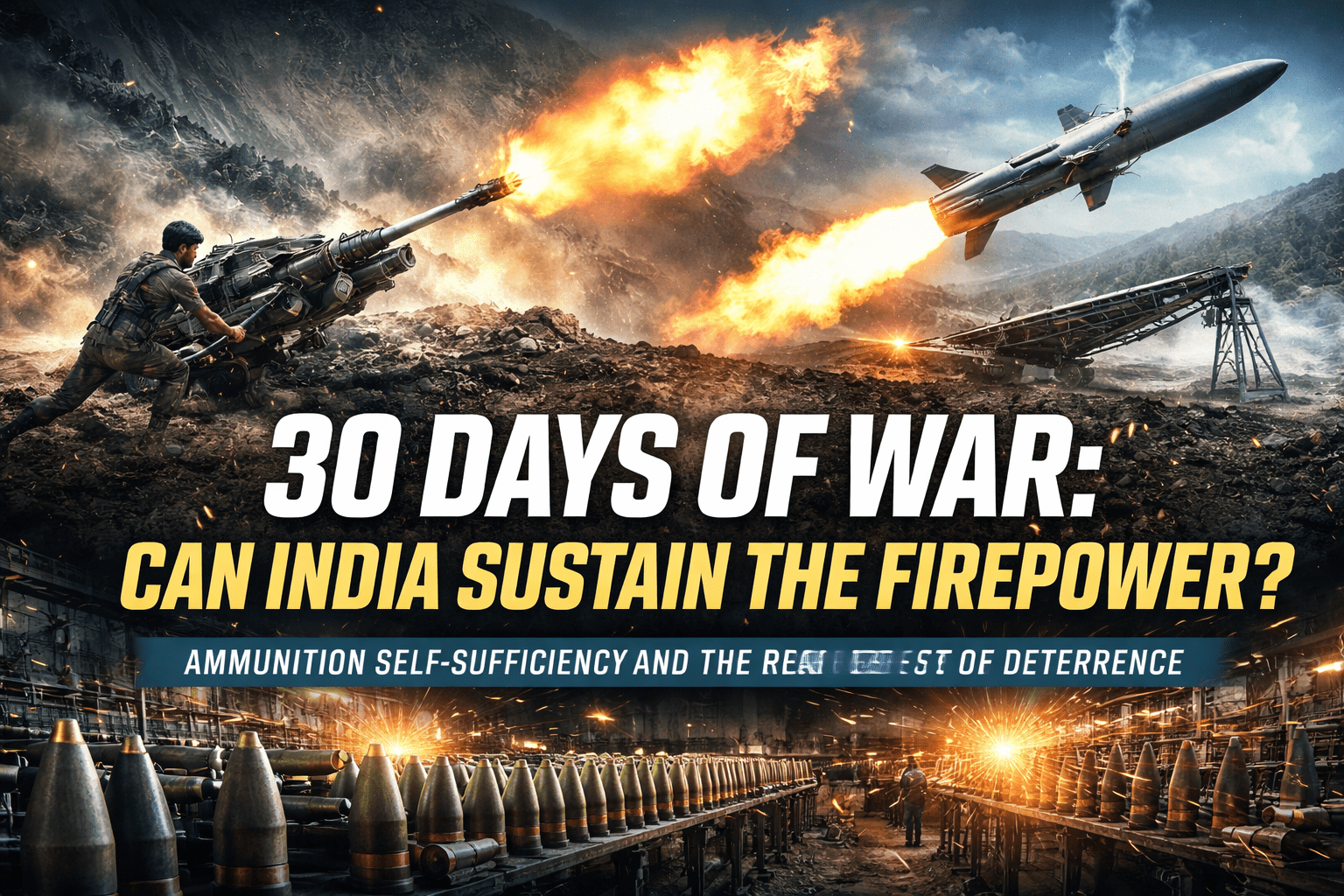
Thirty days of sustained, high-intensity combat. Not a symbolic skirmish. Not a limited punitive strike. But sustained, artillery-intensive, missile-driven, drone-saturated warfare across two fronts.
The question is not whether India has modern platforms. It does.
The question is whether India has ammunition self-sufficiency sufficient to sustain them.
That distinction is not bureaucratic. It is existential.
This perspective examines whether India is structurally prepared for a 30-day conflict defined by massive artillery shell expenditure, high missile turnover, and loitering munition saturation.
More importantly, it examines what ammunition self-sufficiency reveals about India’s doctrine, industrial depth, geopolitical posture, and deterrence credibility.
Because in modern war, inventory is strategy.
The Real Metric of Power Is Not Platforms. It Is Consumption.
Military discourse in India remains platform-centric. Rafale numbers. Destroyer tonnage. Fighter squadrons. Rocket artillery regiments.
But look at Ukraine. Look at Gaza. Look at the Red Sea. Look at Taiwan contingency planning.
Wars today are defined by rates of expenditure.
In Ukraine, 155mm shells are expended in the thousands per day. Russia reportedly fired up to 20,000 artillery rounds daily in peak phases.
Israel’s Iron Dome interceptors deplete rapidly under saturation. Missile salvos are measured not in symbolism but in production throughput.
A 30-day high-intensity conflict involving China on the northern frontier and Pakistan on the western front would likely see:
• Heavy 155mm artillery expenditure in mountainous sectors
• Rocket artillery saturation from both sides
• Long-range missile exchanges targeting logistics hubs
• Loitering munitions hunting armor and artillery
• Air defense interceptors consumed in large numbers
The operational question is simple: Can India replenish at wartime rates?
Ammunition self-sufficiency becomes the difference between deterrence and depletion.
The Structural Weakness No One Likes to Discuss
India’s ammunition challenge is not about zero capacity. It is about scale and surge. Historically, stockpiles were calibrated around limited-duration conflicts.
The Kargil War lasted roughly two months, but it was geographically constrained and logistically focused.
A two-front high-intensity war would be far more consumption-intensive.
Artillery shells remain heavily dependent on domestic production by entities like Munitions India Limited and private players such as Tata Advanced Systems Limited.
Yet peacetime production rates often fall short of what wartime consumption would demand.
Missile inventories present a similar paradox. India possesses credible systems developed by Defence Research and Development Organisation, including BrahMos-class cruise missiles and various surface-to-air systems.
But production throughput remains finite. Scaling rapidly under conflict pressure requires pre-existing industrial redundancy.
Loitering munitions are an emerging domain.
India has begun procurement and indigenous development, but domestic mass production ecosystems are still maturing.
China, by contrast, has integrated drone production into a far broader commercial-industrial base.
Ammunition self-sufficiency is not about having some capability. It is about surviving exponential consumption.
Procurement to Doctrine: The Invisible Chain
This is where most analysts stop at stockpile figures.
But ammunition self-sufficiency is doctrinal.
India’s military planning historically emphasized controlled escalation and limited war under nuclear overhang. That assumption limited the need for deep ammunition reserves.
But what if escalation control fails? What if conflict expands horizontally into maritime theaters or vertically into precision missile exchanges?
Procurement decisions now reflect a subtle doctrinal evolution. The induction of rocket artillery, expansion of precision-guided munitions, and increased emphasis on standoff weapons indicate preparation for sustained kinetic exchanges.
Yet doctrine and industrial depth must align.
If doctrine envisions punitive deep-strike campaigns across 1,000 kilometers, missile stockpiles must reflect that ambition. If the Army envisions massed artillery duels in Ladakh, shell production must match attrition modeling.
Otherwise, doctrine becomes aspirational rather than executable.
Ammunition self-sufficiency determines whether operational concepts survive first contact.
Two-Front Sustainment: The Hard Scenario
Let us consider a realistic 2028 scenario.
Simultaneous friction along the Line of Actual Control and escalatory pressure from Pakistan’s western front. China employs precision long-range rocket artillery.
Pakistan launches missile strikes targeting logistics nodes.
India responds.
Within the first 10 days:
• Heavy artillery expenditure in eastern Ladakh
• Air defense interceptors deployed against incoming salvos
• BrahMos and other cruise missiles used against high-value targets
• Loitering munitions deployed for counter-battery operations
By day 15, the critical question is no longer tactical. It becomes industrial.
Are replenishment cycles adequate?
If ammunition self-sufficiency is insufficient, strategic choices narrow. Commanders begin conserving firepower. Political leadership begins weighing ceasefire pressures.
Deterrence credibility erodes not because of battlefield defeat, but because of inventory exhaustion.
That is the strategic nightmare.
Indo-Pacific Implications: Ammunition as Signal
India’s ammunition self-sufficiency also shapes Indo-Pacific perceptions.
China monitors production capacity as much as troop deployments.
In a Taiwan contingency, Beijing would assess India’s ability to sustain pressure along the Himalayan frontier.
If India’s ammunition depth appears shallow, Chinese planners gain confidence in endurance superiority.
Similarly, Quad partners evaluate industrial resilience. Japan and Australia are expanding munitions production precisely because they understand that industrial capacity equals strategic autonomy.
India’s credibility as a long-term balancing power depends not only on naval expansion but on the ability to sustain prolonged land conflict.
Ammunition self-sufficiency becomes a geopolitical signal.
The Geoeconomic Layer: Supply Chains and Sanctions Exposure
Another dimension often overlooked is external dependence in critical subcomponents.
Propellants, electronic guidance components, microelectronics for missile seekers, and specialized alloys are not always fully indigenous.
Global supply chains are increasingly weaponized.
Semiconductor export controls and maritime chokepoints can disrupt production pipelines.
In a prolonged conflict, external suppliers may hesitate. Insurance premiums rise. Shipping routes become contested.
Ammunition self-sufficiency must therefore include raw material independence, domestic electronics ecosystems, and distributed manufacturing.
War is industrial economics under time pressure.
The Power Dynamic: Who Benefits From India’s Constraint?
If India’s ammunition self-sufficiency remains limited, adversaries benefit asymmetrically.
China possesses vast industrial depth and centralized mobilization capacity. Pakistan relies on Chinese supply pipelines.
A prolonged war favors the side with deeper manufacturing reserves.
However, if India succeeds in scaling domestic ammunition production through public-private integration, the balance shifts. Indigenous manufacturing becomes a deterrent multiplier.
Private sector participation is not merely economic reform. It is strategic insurance.
What Most Analysts Are Missing
Most discourse frames ammunition shortages as a logistical issue.
It is not.
It is a structural indicator of whether India has completed its transition from import-dependent power to industrial military state.
India has invested heavily in platforms. Less attention has been paid to consumption economics.
Loitering munitions, for example, represent a relatively low-cost method to offset expensive artillery shells.
But scaling them requires integration of AI-enabled targeting, secure communication networks, and mass production lines.
The conversation should not be “how many shells exist.”
It should be “what is India’s daily surge capacity?”
Without that answer, readiness claims remain incomplete.
The Next 3–5 Years: Three Plausible Trajectories
1. Incremental Improvement, Persistent Gap
India gradually increases artillery shell output, expands missile production lines, and deepens private participation. However, surge capacity remains below full 30-day requirements. Deterrence holds but under strain.
2. Industrial Breakthrough
Major reforms integrate private sector players, decentralized manufacturing hubs emerge, and digital supply chain tracking enhances efficiency. Ammunition self-sufficiency becomes a core pillar of military doctrine. India signals long-duration conflict endurance.
3. Crisis-Driven Acceleration
A limited conflict exposes shortfalls. Emergency production contracts are issued. War-economy reforms follow. India emerges stronger but only after costly lessons.
Which path India takes will define its deterrence credibility by 2030.
The Deeper Shift: From Procurement State to War Economy Thinking
India is at a structural inflection point.
For decades, procurement cycles dominated defense planning. Now, industrial continuity and war economy modeling must take precedence.
Ammunition self-sufficiency is the connective tissue between industrial policy and operational doctrine.
It influences whether India can sustain maritime denial in the Indian Ocean while fighting a land campaign in the Himalayas.
It shapes whether escalation remains controlled or becomes forced by depletion. It determines whether alliances see India as a durable balancing power or a short-burst responder.
This is not about shells alone. It is about strategic endurance.
Final Insight: The War That Is Never Fought
True deterrence is not measured by parade displays or missile tests.
It is measured by whether adversaries believe India can absorb 30 days of punishment and still fire back at scale.
If ammunition self-sufficiency remains incomplete, adversaries may gamble on short, intense wars designed to exhaust inventories quickly.
If ammunition self-sufficiency becomes robust, the calculus shifts. The threshold for aggression rises.
India’s strategic future will not be decided solely by aircraft carriers or stealth fighters.
It will be decided in production lines, propellant factories, and missile assembly units operating quietly long before any shot is fired.
Because in modern conflict, endurance is power. And endurance begins with ammunition self-sufficiency.

