









Context
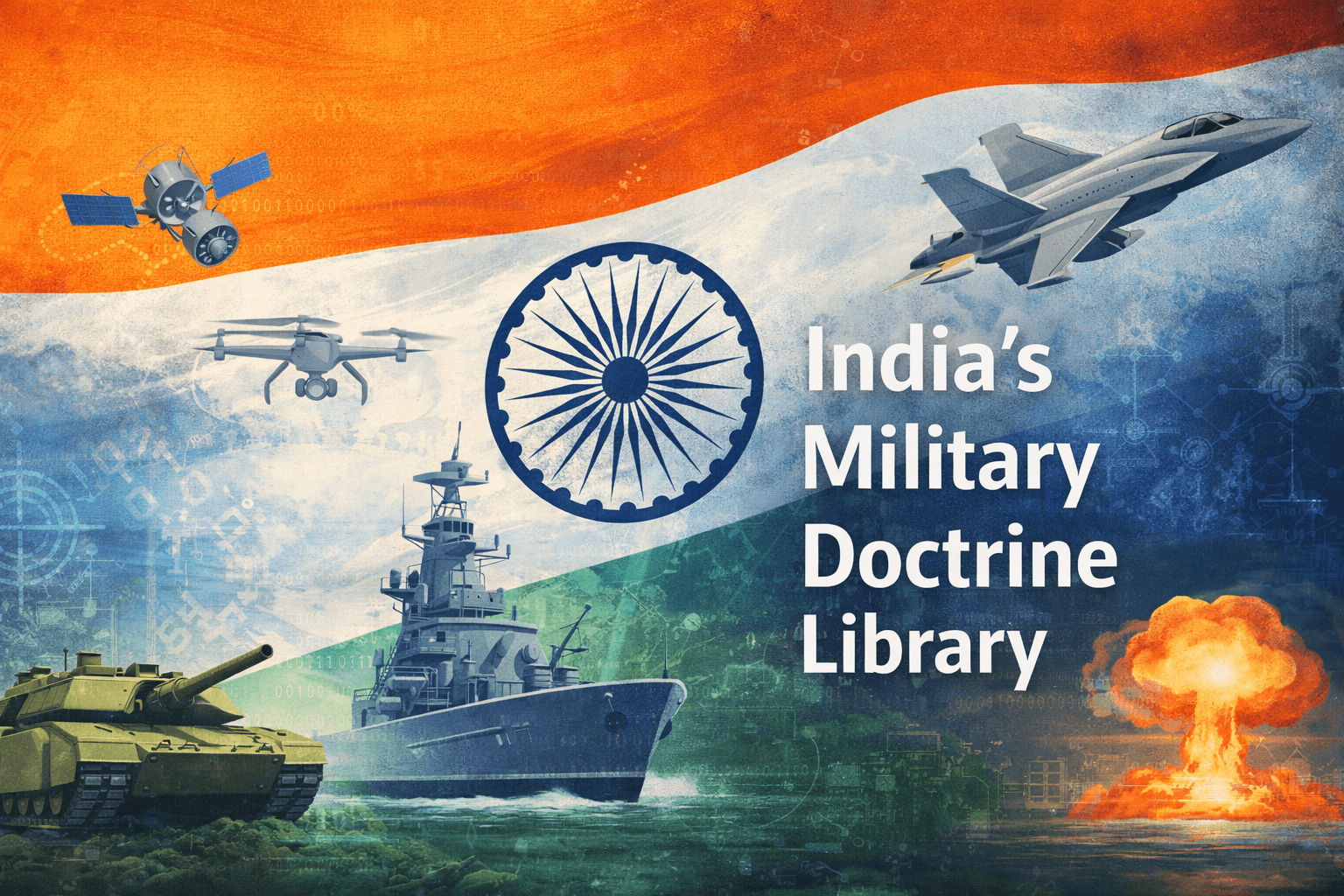
Military doctrine provides the intellectual framework through which armed forces understand conflict, organize military capabilities, and plan operations. India’s military doctrine has evolved over decades in response to wars with Pakistan and China, the introduction of nuclear deterrence in South Asia, and the expanding geopolitical competition in the Indo-Pacific.
Today, India’s strategic thinking combines conventional military doctrine, nuclear deterrence, maritime strategy, and emerging multi-domain warfare concepts. The sections below outline the key layers of this doctrinal framework.
India’s Military Doctrine Ecosystem
India’s military doctrine operates across several interconnected strategic layers. At the highest level are national security objectives and strategic concepts, which then shape operational doctrines, joint warfare frameworks, and future military capabilities.
| Debate | Key Question | Strategic Implication |
| Cold Start Doctrine | Can escalation remain controlled? | India–Pakistan crisis stability |
| No First Use Policy | Should nuclear doctrine evolve? | Nuclear deterrence credibility |
| Two-Front War Concept | Can India sustain dual-front conflict? | Defense planning and force structure |
| Theatre Command Reform | Will integration improve joint operations? | Institutional military reform |
| Airpower vs Missile Strategy | Which capability should dominate strike doctrine? | Procurement priorities |
| Maritime Strategy | Sea denial vs power projection | India’s Indo-Pacific posture |
Strategic Layer |
Key Elements |
Purpose |
|---|---|---|
National Strategy |
Strategic autonomy, regional stability |
Define long-term national security goals |
Strategic Concepts |
Credible minimum deterrence, NFU, net security provider |
Establish India’s deterrence posture |
Operational Doctrines |
Cold Start, Integrated Battle Groups, stand-off strike |
Guide conventional military operations |
Joint Warfare |
Joint operations, theater commands, network-centric warfare |
Improve coordination across services |
Future Warfare Domains |
Cyber, space, AI, hypersonics |
Prepare for next-generation conflict |
This layered framework reflects the increasing complexity of modern warfare and the need to integrate strategic, operational, and technological dimensions.
Evolution of India’s Military Doctrine
India’s military doctrine has evolved gradually in response to geopolitical shocks, wars, and technological developments. Each phase introduced new doctrinal priorities and operational approaches.
Period |
Strategic Context |
Doctrinal Development |
|---|---|---|
1947–1962 |
Early post-independence security environment |
Territorial defense doctrine |
1965–1971 |
Wars with Pakistan |
Combined arms warfare |
1980s–1990s |
Mechanization and modernization |
Strike corps doctrine |
1998 |
Nuclearization of South Asia |
Credible minimum deterrence |
Early 2000s |
Lessons from Operation Parakram |
Cold Start / Proactive Operations |
2010s |
Technological modernization |
Joint warfare doctrine |
2020s |
Rising China challenge |
Two-front war planning |
This evolution illustrates how India’s military doctrine increasingly balances conventional warfare with nuclear deterrence and regional power competition.
Key Strategic Concepts
India’s military doctrine is anchored in several foundational strategic concepts that define the country’s security posture and defense planning priorities.
Concept |
Core Idea |
Strategic Role |
|---|---|---|
Credible Minimum Deterrence |
Maintain survivable nuclear arsenal |
Prevent nuclear coercion |
No First Use |
Nuclear weapons used only in retaliation |
Strategic stability |
Strategic Autonomy |
Independent defense policy |
Flexible diplomacy |
Net Security Provider |
Stabilize Indian Ocean region |
Regional security leadership |
Proactive Operations |
Rapid offensive response capability |
Punitive conventional operations |
Two-Front War Concept |
Prepare for conflict with China and Pakistan |
Force restructuring |
Multi-Domain Operations |
Integrate land, sea, air, cyber, space |
Future battlefield integration |
Hybrid Warfare Response |
Counter grey-zone tactics |
Sub-threshold conflict management |
Together, these concepts shape India’s approach to deterrence, crisis management, and regional security.
Core Military Doctrines
Operational doctrines translate strategic concepts into practical military planning and battlefield operations.
| Doctrine | Domain | Strategic Objective |
|---|---|---|
| Cold Start Doctrine | Land | Rapid punitive offensive operations |
| Integrated Battle Groups | Land | Agile combined-arms maneuver warfare |
| Limited War Under Nuclear Conditions | Strategic | Controlled escalation during conventional conflict |
| Stand-Off Strike Doctrine | Air | Precision strikes beyond enemy air defenses |
| Sea Control Doctrine | Maritime | Maintain dominance in strategic sea lanes |
| Sea Denial Strategy | Maritime | Prevent adversary naval operations |
These doctrines aim to provide flexible operational options while maintaining escalation control in a nuclearized regional environment.
Tri-Service Doctrine Comparison
While the Indian Army, Navy, and Air Force share national strategic objectives, their operational priorities differ according to their respective domains.
| Service | Strategic Focus | Doctrinal Priority | Core Capabilities |
|---|---|---|---|
| Indian Army | Land warfare | Integrated Battle Groups, maneuver warfare | Armored units, artillery, infantry |
| Indian Navy | Maritime security | Sea control, sea denial | Aircraft carriers, submarines |
| Indian Air Force | Air superiority | Precision strike, air dominance | Fighter aircraft, ISR systems |
India’s push toward integrated theater commands is intended to improve coordination among these services.
Emerging Warfare Domains
Technological innovation is rapidly transforming military strategy. India’s military planners increasingly recognize that future conflicts will involve new domains such as cyber operations, space security, and artificial intelligence.
| Domain | Strategic Objective | Current Developments | Future Direction |
|---|---|---|---|
| Cyber Warfare | Protect digital networks | Defence Cyber Agency | Cyber deterrence integration |
| Space Warfare | Secure satellite infrastructure | Defence Space Agency | Counter-space capabilities |
| Unmanned Warfare | Surveillance and precision strike | Drone programs | Drone swarm operations |
| Artificial Intelligence | Decision support and intelligence | Defence AI initiatives | Autonomous warfare systems |
| Hypersonic Weapons | Advanced long-range strike | Hypersonic Technology Demonstrator | Strategic hypersonic deterrence |
| Information Warfare | Influence perception and narrative | Psychological operations | Cognitive warfare |
These technologies are expected to play a central role in shaping India’s future military doctrine.
Multi-Domain Warfare Structure
Future military operations will increasingly involve coordinated action across multiple operational domains.
| Domain | Operational Role | Key Assets |
|---|---|---|
| Land | Territorial defense and maneuver warfare | Tanks, artillery, IBGs |
| Air | Air superiority and precision strike | Fighter aircraft, drones |
| Maritime | Sea control and power projection | Aircraft carriers, submarines |
| Cyber | Digital warfare and network defense | Cyber command systems |
| Space | Surveillance and communications | Satellite networks |
The ability to integrate these domains will define the effectiveness of modern military operations.
Strategic Debates in Indian Military Doctrine
Several aspects of India’s military doctrine remain the subject of debate among analysts and policymakers.
| Debate | Key Question | Strategic Implication |
|---|---|---|
| Cold Start Doctrine | Can escalation remain controlled? | India–Pakistan crisis stability |
| No First Use Policy | Should nuclear doctrine evolve? | Nuclear deterrence credibility |
| Two-Front War Concept | Can India sustain dual-front conflict? | Defense planning and force structure |
| Theater Command Reform | Will integration improve joint operations? | Institutional military reform |
| Airpower vs Missile Strategy | Which capability should dominate strike doctrine? | Procurement priorities |
| Maritime Strategy | Sea denial vs power projection | India’s Indo-Pacific posture |
These debates reflect the broader challenges of adapting doctrine to changing geopolitical and technological conditions.