















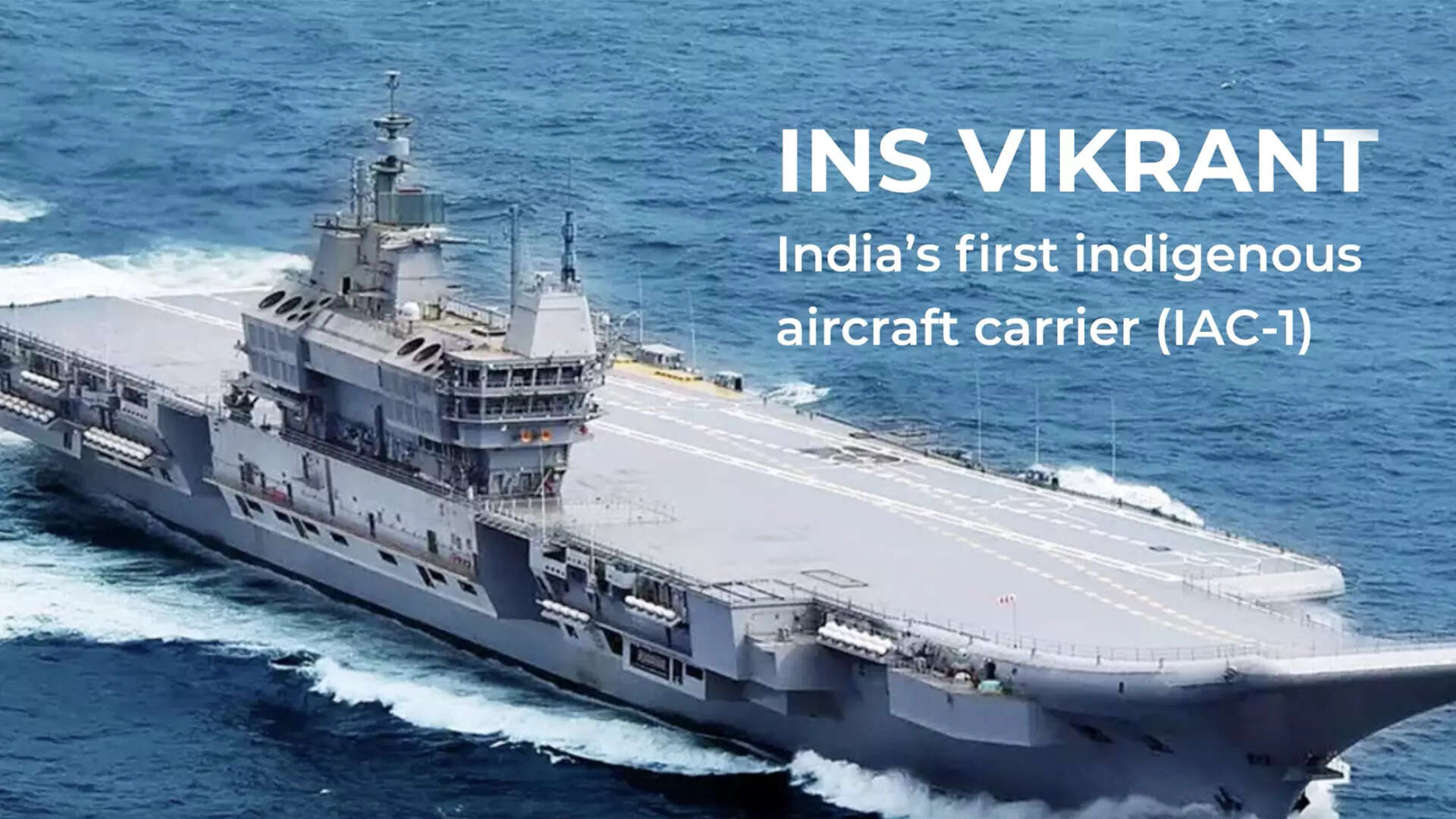
A surface-level comparison between India’s INS Vikrant and China’s Liaoning often gravitates toward displacement, aircraft numbers, or deck geometry. That approach obscures the deeper strategic story.
These two carriers are not merely platforms. They are institutional milestones embedded within distinct naval trajectories. To assess them meaningfully, we must integrate three layers:
- Current quantitative capability
- Operational employment logic
- Forward-looking trajectory toward 2035
Only then does the real balance emerge.
Baseline Capability: A Structured Comparison
Category |
INS Vikrant |
Liaoning |
Strategic Interpretation |
Displacement |
~45,000 tons |
~60,000 tons |
Liaoning has larger aviation support capacity |
Launch System |
STOBAR (ski-jump) |
STOBAR (ski-jump) |
Both limited vs CATOBAR |
Air Wing (theoretical max) |
~30 aircraft |
~40+ aircraft |
Liaoning marginal sortie advantage |
Primary Fighter |
MiG-29K (interim) |
J-15 |
J-15 larger but payload-constrained |
Operational Focus |
Indian Ocean Region |
Western Pacific / Blue-water expansion |
Divergent theater logic |
Carrier Experience |
Decades of carrier aviation |
Rapid institutional scaling |
Different maturity curves |
The STOBAR Constraint
Both carriers rely on ski-jump launch systems. This imposes a physics-based limitation:
- Fighters cannot launch at maximum fuel and maximum payload simultaneously.
- Strike radius and combat persistence are therefore constrained.
- Sortie generation rate becomes the key performance metric.
Neither platform matches catapult-equipped carriers in sustained high-intensity warfare. Both are transitional architectures.
Operational Context: Geography as Strategy
Indian Ocean Scenario
In its primary theater, Vikrant benefits from:
- Interior lines of communication
- Shore-based ISR and maritime patrol aircraft
- Logistical depth close to home ports
Its role is defensive sea control—ensuring maritime domain awareness and denying adversary dominance.
If Liaoning were deployed into this theater, it would operate at the end of extended supply chains, vulnerable to submarine interdiction and chokepoint constraints.
Western Pacific Scenario
Within the Western Pacific, Liaoning operates inside China’s layered anti-access ecosystem:
- Dense shore-based missile coverage
- Integrated ISR networks
- High escort density
Vikrant operating eastward would face enormous logistical and political escalation risks.
The operational conclusion is clear:
Each carrier is strongest within its primary geography. Cross-theater deployment reduces survivability and increases escalation exposure.
Carrier Vulnerability in the Missile Age
Modern naval warfare is dominated by:
- Long-range anti-ship ballistic missiles
- Supersonic and hypersonic cruise missiles
- Submarine-launched torpedoes
- Networked ISR targeting
Aircraft carriers are high-value units. Their survivability depends less on hull size and more on:
- Integrated air and missile defense
- Electronic warfare resilience
- Escort density
- Submarine screening
Here, differences narrow. Platform characteristics matter less than strike group ecosystem maturity.
2035 Projection Scenario: Diverging Trajectories
The more consequential comparison is not Vikrant vs Liaoning today.
It is India vs China in 2035.
China’s Likely 2035 Posture
By 2035, Liaoning will no longer represent China’s frontline capability. It will likely function as:
- Training and secondary deployment platform
- Institutional memory carrier
- Aviation proficiency builder
China’s trajectory points toward:
- Multiple catapult-equipped carriers
- Higher sortie generation capacity
- Integrated space-enabled ISR
- Mature expeditionary logistics
Liaoning’s historical significance will exceed its combat relevance. It was the bridge.
India’s Likely 2035 Posture
India’s strategic decision will hinge on:
- Whether to expand beyond two carriers
- Whether to adopt catapult launch systems
- Indigenous fighter integration timelines
- Escort fleet scaling
If India transitions toward CATOBAR architecture and next-generation naval aviation, Vikrant becomes the foundation of a scaled maritime deterrent.
If expansion stalls, Vikrant remains a powerful regional asset—but not a blue-water competitor.
2035 Balance Assessment
By 2035:
- China likely fields a multi-carrier blue-water force with global presence capacity.
- India likely retains strong regional sea-control capability in the Indian Ocean.
This is not a symmetric competition. It is asymmetric maritime geometry. India consolidates dominance in its near seas. China expands influence outward.
Escalation Implications for Indo-Pacific Stability
Aircraft carriers are political instruments.
- Deploying Vikrant communicates sovereign maritime assertion.
- Deploying Liaoning communicates normalized power projection.
However, in a high-intensity conflict:
- Carriers become priority targets.
- Loss or damage carries massive prestige and political consequences.
- Escalation thresholds rise sharply.
Thus, carriers simultaneously deter and destabilize.
Their visibility enhances signaling—but increases vulnerability in total war.
Integrated Strategic Conclusion
A narrow technical comparison suggests Liaoning holds modest advantages in displacement and theoretical air wing size.
A systemic comparison reveals something different:
- Vikrant represents industrial sovereignty and regional sea control.
- Liaoning represents institutional acceleration toward global naval ambition.
Both are transitional carriers constrained by STOBAR design.
The decisive variables are not deck size or fighter type. They are:
- Theater geometry
- Industrial scaling speed
- Escort ecosystem integration
- Logistics sustainability
- Political risk tolerance
In the Indo-Pacific competition, trajectories outweigh tonnage. Vikrant secures a maritime core. Liaoning enabled expansion beyond one.
By 2035, the comparison will not be about these two ships. It will be about which navy translated its transitional carrier into strategic leverage.

