













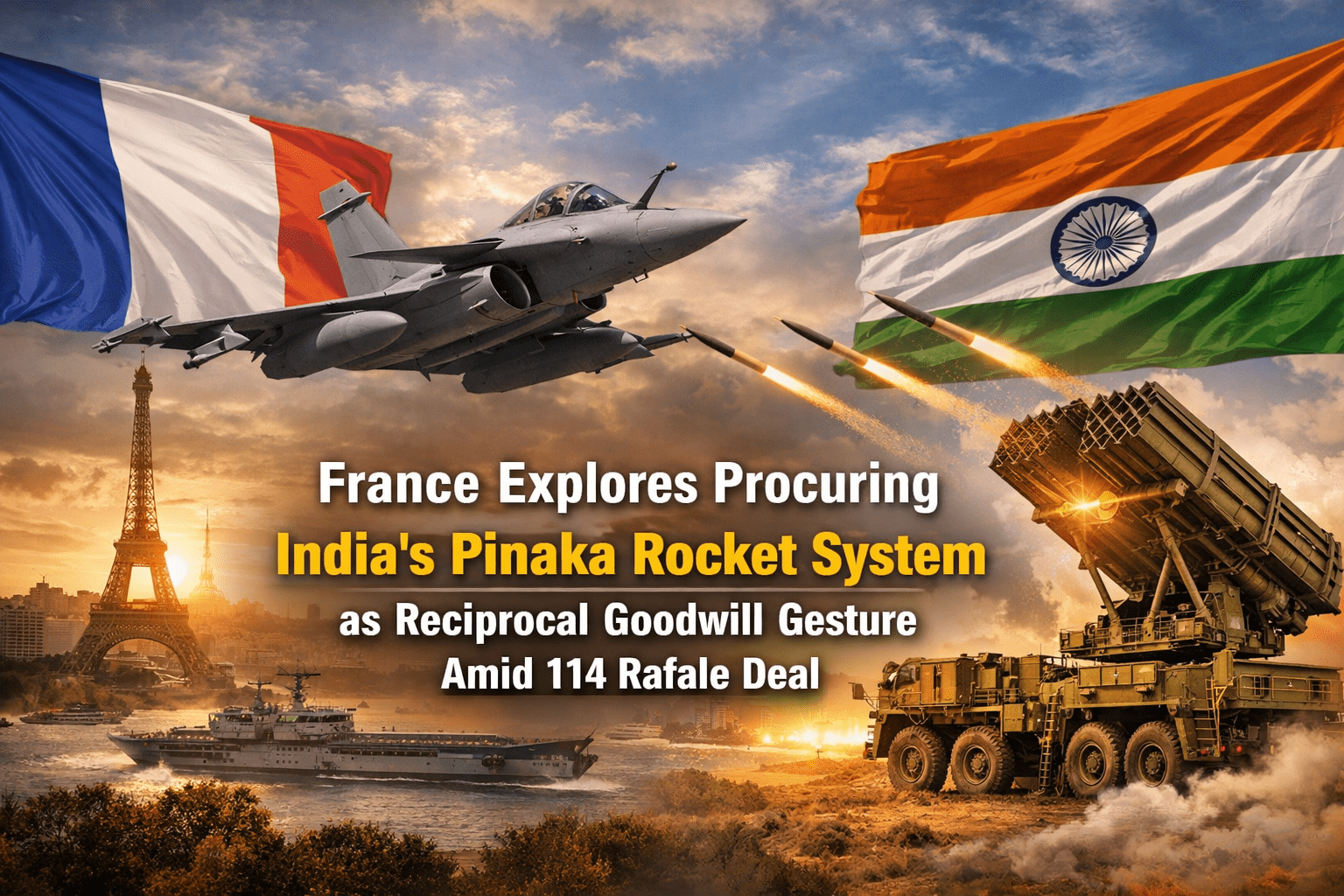
There’s a headline doing the rounds that sounds almost symbolic at first glance: France is exploring India’s Pinaka rocket system.
Most people read it as a diplomatic nicety — a polite counterbalance to India’s potential 114-jet Rafale acquisition. A gesture. A reciprocal nod.
That interpretation misses the point entirely.
If France is seriously evaluating the Pinaka multi-barrel rocket launcher system, this is not about courtesy. It’s about capability, supply chain resilience, and the quiet reordering of defence industrial hierarchies.
And to understand why, you have to zoom out to Europe’s artillery problem.
Europe’s Artillery Reset After Ukraine
The war in Ukraine fundamentally altered European defence thinking. Artillery — long dismissed in some Western circles as secondary to airpower and precision strikes — has reasserted itself as the dominant instrument of industrial warfare.
European stockpiles have been depleted. Production lines have been stressed. Replacement cycles that once seemed manageable are now urgent.
France, like many European militaries, is modernising its long-range fires ecosystem. It has relied on a limited number of rocket artillery systems, and replacements are planned — but timelines stretch toward the latter half of the decade. Indigenous European solutions are under development, but they are not plug-and-play fixes. They require funding stability, political consensus, and industrial scaling.
Then there’s the American option: HIMARS.
The M142 HIMARS system has become something of a gold standard after its performance in Ukraine. But it comes with geopolitical implications, cost structures, and U.S. export frameworks that not every European capital wants to be fully dependent on. It is precise, combat-proven and NATO-integrated — but it is also expensive and tied into U.S. supply chains.
This is where Pinaka enters the frame.
Pinaka does not compete with HIMARS on brand perception or global footprint. What it does offer is a layered firepower architecture: area saturation capability, extended-range variants, and guided munitions under development. It is rugged, modular, and comparatively cost-efficient.
Crucially, it is available from a country that is strategically aligned but not structurally embedded within NATO politics.
That positioning matters.
Let’s not oversell compatibility. Integrating Pinaka into French service would require significant interoperability assessments — ammunition standards, fire-control systems, command-and-control integration, data links, and NATO compliance testing. None of that is trivial.
But the fact that those conversations are even plausible tells you something about how Indian systems are now perceived.
The Rafale Context: Industrial Leverage Is Real
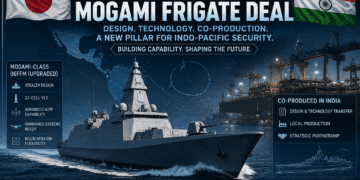
India’s fighter squadron strength remains below sanctioned levels. The potential acquisition of 114 Rafales would be one of the largest fighter procurements globally in this decade.
This time, New Delhi is not negotiating from a purely buyer’s standpoint. The emphasis is unmistakable: greater indigenous manufacturing, deeper supply chain integration, and more meaningful technology transfer.
If France were to procure or co-develop Pinaka in parallel, it transforms the equation from transactional to interdependent.
Instead of a linear supply chain flowing from France to India, you begin to see bidirectional industrial flows. That shifts leverage subtly but permanently.
And that is strategically significant.
Can India Even Meet Export Commitments?
Now let’s address the uncomfortable but necessary question.
Can India realistically meet domestic Army induction schedules while exporting to a European military?
The Indian Army has already placed large orders for Pinaka regiments, including upgraded and extended-range variants. Induction timelines are ongoing. Production capacity is expanding — with private sector players increasingly involved alongside state-owned entities.
But scaling production for export, especially for a Western military with strict quality and delivery benchmarks, would test that ecosystem.
India would need:
-
Assured production ramp-up without delaying domestic deliveries
-
Stringent quality certification processes aligned with European standards
-
Reliable long-term ammunition supply chains
-
After-sales support frameworks in Europe
This is not impossible. But it would require industrial discipline and possibly new joint production models.
Which brings us to the more interesting possibility.
This May Not Be About Direct Sales at All
The real strategic upside may lie in co-development or co-production.
India and France already have deep industrial linkages — from aerospace cooperation to missile manufacturing arrangements and joint ventures in avionics and propulsion components.
A Franco-Indian configuration of Pinaka — modified for French doctrine, integrated with European communications systems, perhaps even incorporating European sub-systems — could emerge as a joint product rather than a simple export.
That would change everything.
It would mean shared intellectual capital, shared supply chains, and potentially even joint export marketing to third countries.
In other words, not “India selling to France,” but “India and France building together.”
That model aligns far more closely with how advanced defence partnerships evolve.
The Trust Argument — But Grounded in Reality
There’s been a lot of romantic framing around “trust.”
Yes, trust matters. A European military evaluating an Indian-designed artillery system signals confidence in engineering maturity.
But trust in defence procurement is built on testing, certification, and operational validation — not sentiment.
If Pinaka progresses beyond exploratory discussions, it will be because it meets performance benchmarks under French evaluation standards.
And that would be the true milestone.
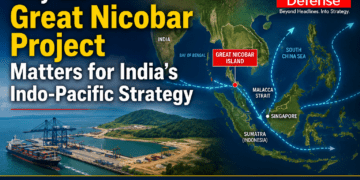
The Indo-Pacific and Strategic Diversification
France is not just another European buyer. It is an Indo-Pacific resident power with territories, military presence, and maritime interests stretching from the Indian Ocean to the Pacific.
Strengthening defence industrial ties with India serves multiple objectives:
- It deepens Indo-Pacific alignment.
- It diversifies supply chains beyond the U.S. industrial orbit.
- It embeds France more deeply into India’s long-term military planning.
At the same time, Europe is quietly acknowledging a structural truth: defence industrial resilience now requires diversification. Sole reliance on one transatlantic supplier is strategically risky in an era of political volatility.
India, geographically distant from European conflict zones but industrially expanding, represents an attractive hedge.
So What Is This Really About?
Strip away the headlines and this is what remains:
For decades, India’s defence relationship with France was defined by imports.
Now there is a plausible scenario where France evaluates an Indian system as part of its own force planning calculus.
That is not symbolism. That is structural evolution.
Whether or not a contract materialises, the hierarchy is changing. Indian systems are entering serious conversations inside Western procurement frameworks.
The Rafale deal may dominate the news cycle. But the Pinaka conversation — if it matures — may ultimately say more about where this partnership is heading.
This isn’t about rockets. It’s about parity.

