























India is not building defence corridors.
It is testing whether it can build a war economy without calling it one.
For decades, India’s military strength was hardware-deep but industry-shallow.
Platforms were imported, assembled, or licensed.
Supply chains stretched outward.
Doctrine quietly adjusted to inventory fragility.
Escalation calculations were shaped by stockpile anxiety more than strategy.
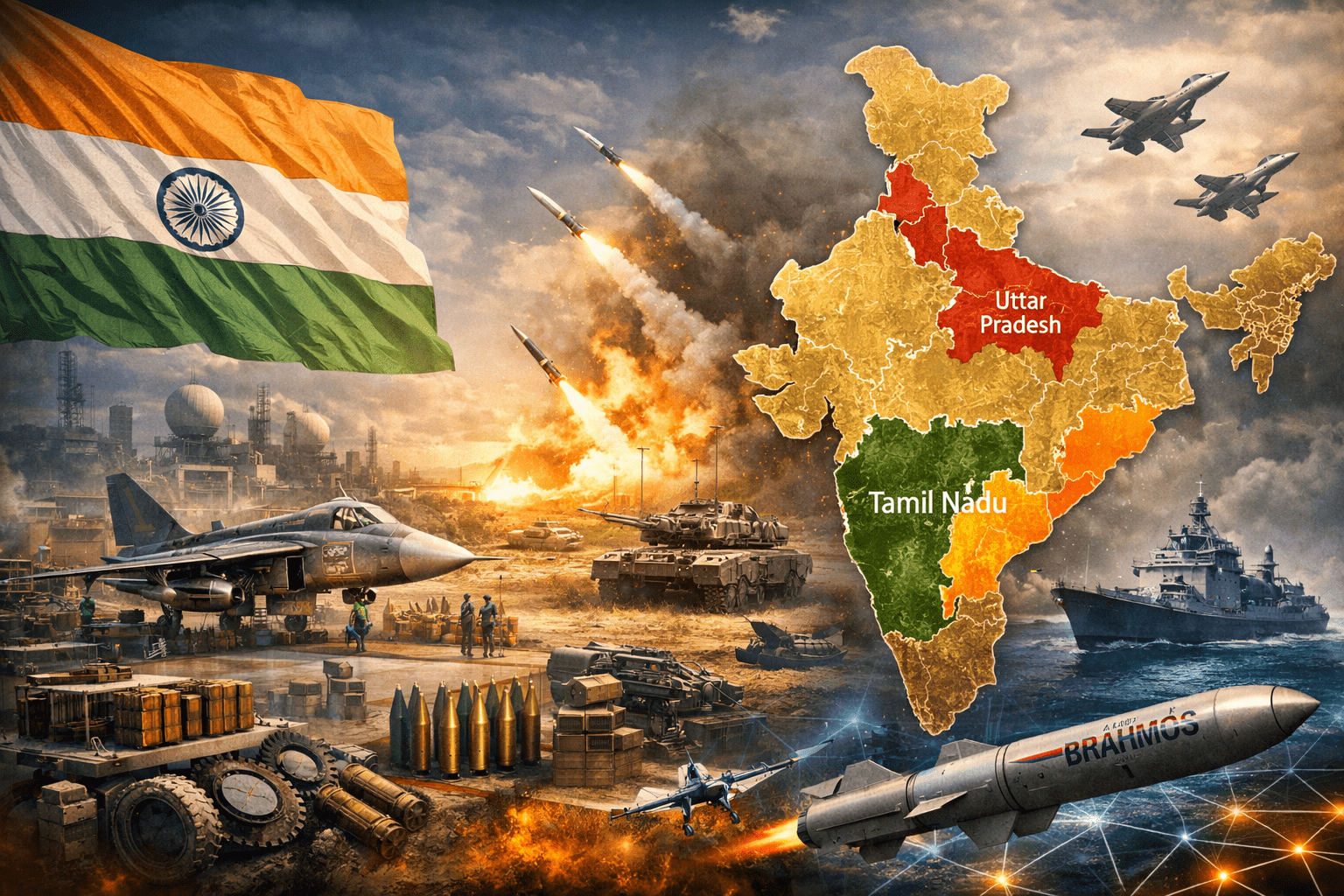
The defence corridors in Tamil Nadu and Uttar Pradesh represent an attempt to change that equation.
But the real question is not whether factories are opening.
The real question is whether these corridors can transform procurement into industrial depth, industrial depth into operational confidence, and operational confidence into geopolitical leverage.
Because if they cannot survive stress, they do not alter strategy.
Industrial Geography Is Strategic Geography
The placement of the corridors is not administrative coincidence.
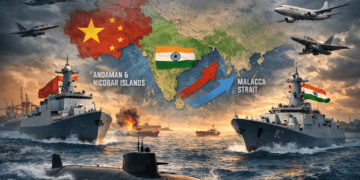
Tamil Nadu sits along India’s eastern maritime arc, within operational proximity of the Bay of Bengal and Andaman Sea approaches.
Uttar Pradesh sits within strategic depth behind the northern and western land theatres.
In peacetime, this looks like regional development planning.
In wartime, it becomes a survivability calculation.
Industrial concentration increases efficiency. It also creates target density. A maturing military-industrial node becomes a priority strike objective.
– Have these corridors been hardened against long-range missile attack?
– Are they integrated into layered air defence grids?
– Is redundancy built across multiple states?
India is concentrating capacity. That concentration must be survivable.
China deliberately relocated segments of its military industry inland to enhance resilience.
The United States distributes its defence industrial base across geographically separated clusters.
Israel embeds redundancy into tight ecosystems.
India’s corridors will have to answer the same survivability question.
Procurement Is Doctrine in Disguise
For decades, Indian doctrine adjusted to external dependency.
Limited stockpiles encouraged limited-war thinking. Cautious escalation logic reflected replenishment uncertainty.
If artillery ammunition can be produced at scale domestically, the Army can plan sustained firepower operations rather than inventory-constrained exchanges.
If anti-ship missile components are locally sourced, the Navy can assume higher sortie tempos.
Industrial depth expands doctrinal confidence.
This is rarely stated openly, but it is structurally true: the size of your production lines shapes the ceiling of your operational imagination.
The corridors are therefore not economic projects. They are doctrinal enablers.
Or they will be, if integration succeeds.
Tamil Nadu: Maritime Arsenal or Mid-Chain Assembly Zone?
Tamil Nadu’s corridor has attracted aerospace, missile, electronics, and unmanned systems investments. Its proximity to ports gives it logistical fluidity.
But the strategic question is vertical integration.
Is the corridor producing:
-
Complete missile systems including guidance and propulsion?
-
Indigenous avionics?
-
AI-enabled ISR components?
-
Electronic warfare modules?
Or is it assembling subcomponents sourced externally?
In an Indo-Pacific crisis scenario, external semiconductor supply disruption could halt production lines regardless of local assembly capacity.
If Tamil Nadu evolves into a design and integration hub with upstream material depth, it strengthens India’s maritime deterrence posture.
If it remains mid-chain, it shifts dependency rather than eliminating it.
The distinction matters.
Uttar Pradesh: Sustainment Spine for a Two-Front Reality
Uttar Pradesh’s corridor is closer to the land theatres that define India’s most immediate risks.
Artillery shells, armored vehicle components, air defence units, small arms, loitering munitions.
These systems are consumed, not showcased.
In a two-front contingency involving simultaneous high-altitude friction in Ladakh and kinetic exchanges along the western border, sustainment rates would determine operational endurance.
Inventory depletion is not linear. It accelerates under high-intensity conflict.
If UP achieves scalable ammunition production with surge capability, India’s escalation ladder stretches.
If not, escalation compression returns.
The corridor’s true test lies in wartime ramp-up speed.
Financial Architecture: Can India Fund a War Economy in Peacetime?
Factories require capital. War readiness requires financial insulation.
India does not yet possess a defence production financing mechanism equivalent to a Defense Production Act structure. MSMEs embedded in defence supply chains often operate on thin margins and depend on delayed government payments.
What happens during budget compression?
What happens if procurement cycles slow?
If smaller suppliers collapse, wartime surge collapses with them.
Industrial resilience is financial resilience.
India may need:
-
Dedicated defence industrial credit lines.
-
Sovereign-backed working capital guarantees.
-
Defence bond instruments.
-
Structured procurement payment reforms.
Without financial architecture, industrial ambition remains fragile.
Technology Sovereignty: The Upstream Question
Even if final systems are produced locally, upstream dependencies persist.
Jet engine cores. Semiconductor wafers. Rare earth magnets. Advanced composite materials. Guidance chips.
True military-industrial nodes require vertical control.
Otherwise, sanctions or export controls can cripple production indirectly.
The corridors must integrate with India’s semiconductor ambitions, rare earth processing initiatives, advanced metallurgy programs, and AI development ecosystems.
If they do not, they remain horizontally connected but vertically hollow.
Human Capital: The Workforce Dimension
War production is not merely machinery. It is specialized talent.
Are universities in Tamil Nadu and Uttar Pradesh aligned with corridor requirements?
Is there aerospace metallurgy training capacity?
Are classified engineering pipelines expanding?
Is there industrial cybersecurity specialization?
China integrates academia and military industry seamlessly. India’s ecosystem remains fragmented.
Without skilled workforce militarization in the technical sense, production ceilings will remain lower than strategic ambition.
Civil-Military Integration Deficit
India’s corridors still revolve around traditional defence firms and state-linked enterprises.
Modern war is software-saturated.
Are AI startups integrated into weapons manufacturing cycles?
Are telecom and cyber firms embedded into defence production?
Is dual-use technology flowing seamlessly into military applications?
If the corridors focus only on hardware without embedding software and cyber ecosystems, they will produce platforms without network dominance.
Future war is about systems-of-systems integration.
Export Strategy: Industrial Capacity as Diplomacy
If the corridors scale, exports follow.
Supplying artillery to Southeast Asia. UAV systems to Indian Ocean states. Air defence systems to Africa.
Exports are not just revenue. They are influence. But export doctrine must be deliberate.
Does India have structured:
-
Logistics support frameworks?
-
Interoperability standards?
-
Long-term maintenance commitments?
-
Training ecosystems?
Industrial nodes can evolve into geopolitical leverage points. Or they can remain domestic suppliers.
The difference lies in strategic export design.
Nuclear Doctrine Interface: Industrial Depth and Escalation Stability
This layer is rarely discussed.
If India develops sustained conventional production capacity, the buffer below nuclear escalation widens.
A state confident in prolonged conventional endurance is less likely to face rapid vertical escalation pressure.
Conversely, adversaries observing industrial scaling may adjust their calculations.
China may interpret corridor maturation as India preparing for protracted competition.
Pakistan may view increased conventional sustainment as reducing its deterrence leverage.
In other words, industrial growth alters deterrence signaling.
Political Economy: Federal Friction and Strategic Coherence
India is a federal democracy. Defence corridors are state-driven projects within a national framework.
Tamil Nadu and UP may compete for allocations.
Political cycles may distort industrial continuity.
Unlike centralized systems, India must negotiate alignment.
Can a democratic federal structure produce coherent war-industrial planning over a decade?
This is not a trivial question. It is a structural test.
Comparative Lens: Where Does India Stand?
The United States developed its Sun Belt defence industrial complex through sustained federal contracts and Cold War urgency.
China relocated and expanded inland defence clusters to enhance survivability and scale.
Israel fused tech startups, military R&D, and rapid iteration cycles.
India’s corridors are early-stage clusters seeking ecosystem depth.
The question is whether they will evolve toward integration or plateau at assembly.
The Strategic Stress Test: A 2029 Crisis Simulation
Let us run a hypothetical scenario.
Year: 2029.
Simultaneous events unfold:
-
Maritime confrontation in the eastern Indian Ocean.
-
Artillery-intensive standoff in Ladakh.
-
Cyber disruptions targeting industrial supply chains.
-
Global semiconductor supply contraction.
-
Sanctions pressure triggered by geopolitical alignment.
Now test the corridors.
Can Tamil Nadu replenish anti-ship missiles within 30 days?
Can UP ramp artillery shell production beyond peacetime levels?
Are MSMEs financially solvent under stress?
Can factories operate under cyber assault?
Is workforce redundancy available?
If the answer to these questions is uncertain, then strategic maturity is incomplete.
War-gaming industrial capacity should become standard policy.
Are We Building for the Wrong War?
Another uncomfortable question: Are the corridors aligned with the next war or the last one?
Heavy armor production versus drone swarms.
Shell volume versus precision loitering munitions.
Fighter platform focus versus ISR network depth.
Industrial inertia can lock doctrine into outdated assumptions. The corridors must be future-adaptive.
Indo-Pacific Ripple Effects
If India succeeds in building resilient military-industrial nodes, regional states recalibrate.
Southeast Asian states facing Chinese pressure may see India as a more reliable security partner.
The United States may treat India less as a buyer and more as a co-developer.
China may adjust military planning to account for India’s enhanced sustainment capacity.
Industrial growth quietly reshapes regional power equations.
What Most Analysts Miss
The corridors are not about self-reliance rhetoric.
They are about whether India can transition from episodic military readiness to sustained strategic endurance.
India historically fought short conflicts. The psychological shift toward preparing for prolonged confrontation is subtle but profound.
Factories reflect expectation.
If India builds for endurance, it signals anticipation of extended competition in the Indo-Pacific.
That alone carries geopolitical weight.
Three Realistic 3–5 Year Trajectories
Gradual Consolidation
Industrial depth increases incrementally. Sustainment improves but remains constrained by upstream dependencies.
Accelerated Integration
Crisis-driven reforms integrate semiconductor, rare earth, AI, and defence production ecosystems. Export pipelines expand. India emerges as a selective regional supplier.
Stagnation Through Fragmentation
Supply chain bottlenecks, financial fragility, and bureaucratic inertia prevent scale. Corridors remain symbolic.
The Structural Question
India is experimenting with something ambitious.
Can a federal democracy create resilient, surge-capable military-industrial nodes without centralized command economics?
If it succeeds, it alters its escalation confidence, deterrence credibility, and geopolitical leverage.
If it fails, it will continue to field impressive platforms while remaining inventory-conscious under pressure.
The defence corridors will not be judged by ribbon cuttings.
They will be judged by whether, five years from now, India’s war planners can assume domestic replenishment under fire without hesitation.
When that assumption becomes credible, India’s strategic posture changes.
Not loudly.
But permanently.

