

























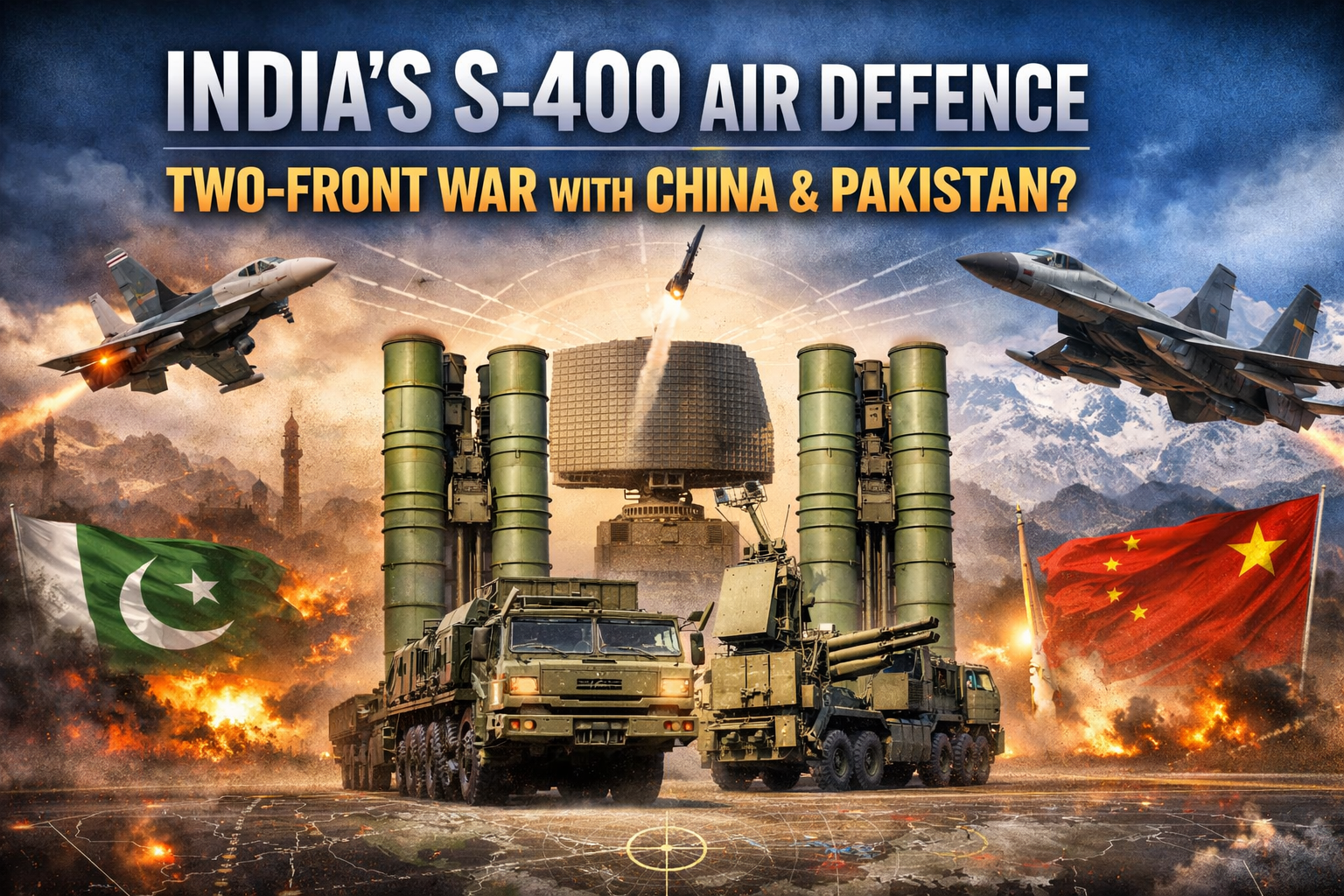
India’s decision to clear the purchase of five additional S-400 air defence systems from Russia did not dominate international headlines.
Yet strategically, the move may prove more consequential than the original acquisition.
The first batch introduced capability. The next batch reveals intent.
India currently operates three S-400 systems, with two additional units expected to be inducted into the armed forces later this year.
When the newly approved purchase is completed, the country could operate a network of ten systems, forming the backbone of a national long-range air defence architecture.
This shift matters because once a state begins expanding strategic air defence beyond a handful of units, the purpose changes.
The system is no longer filling a capability gap. It is reshaping how the country plans to fight.
In India’s case, the emerging architecture suggests a gradual transition from a fighter-centric approach to a layered air denial strategy.
That shift becomes even more significant when viewed through the lens of India’s long-standing two-front war planning against China and Pakistan.
Missile-based air denial reduces the burden on fighter squadrons.
It allows India to hold defensive airspace across one front while concentrating offensive aircraft on the other. In a simultaneous conflict scenario, that flexibility becomes strategically valuable.
A Combat Demonstration Few Analysts Noticed
India’s S-400 systems already experienced their first operational stress test.
During Operation Sindoor in May 2025, the system played a decisive role in shaping the air domain.
The S-400 shield reportedly forced Pakistan’s air force to keep its fighters, airborne warning aircraft and electronic intelligence platforms grounded during a critical phase of the operation.
This operational denial had cascading effects.
Early on the morning of May 10, 2025, Indian forces launched a precision BrahMos strike that destroyed the Northern Command and Control network of the Pakistan Air Force at Chaklala Airbase in Rawalpindi.
With its airborne surveillance and command systems unable to operate safely under the S-400 threat envelope, Pakistan lost the ability to coordinate air operations effectively.
The result was strategic paralysis.
Within hours of the strike, Islamabad moved toward de-escalation and sought diplomatic off-ramps.
For Indian planners, the episode offered a practical lesson for a larger contingency.
If a defensive missile shield can neutralize an adversary’s air operations long enough to execute precision strikes, the same concept could be scaled in a broader two-front conflict where rapid suppression of enemy command networks becomes critical.
From Air Superiority to Air Denial
For decades, the Indian Air Force built its doctrine around offensive air superiority. Fighters would penetrate enemy airspace, dominate the skies, and suppress hostile air defence systems.
But the China front presents a different problem.
The Tibetan plateau allows the People’s Liberation Army Air Force to operate from high-altitude bases with expanding infrastructure.
Over the last decade China has developed hardened airfields, extended runways and deployed advanced fighters such as the J-16 and J-10C across Tibet and Xinjiang.
Attempting to dominate this environment purely with offensive aircraft becomes risky and expensive.
Air denial becomes more attractive.
The S-400 fits this doctrine well. Its long-range missiles can theoretically engage targets up to 400 kilometers away depending on the interceptor used.
More importantly, the radar ecosystem can track large numbers of targets simultaneously.
Deployed along the Himalayan arc, these systems create overlapping air defence zones that complicate Chinese air operations.
In a two-front war scenario, this architecture could serve a dual purpose. S-400 batteries positioned in northern India could deny Chinese airspace access while simultaneously shielding key Indian airbases from Pakistani missile or aircraft attacks.
This layered protection preserves India’s ability to launch offensive operations on both fronts.
The aim is not necessarily constant interception. The aim is to make offensive air operations unpredictable and dangerous.
That uncertainty changes the calculus of escalation.
Radar Coverage and the Himalayan Geometry Problem
Air defence in mountainous terrain is never straightforward.
The Himalayas create severe radar limitations because peaks block lines of sight. Aircraft flying low through valleys can evade detection until very late in their approach.
The S-400 partially mitigates this challenge through a multi-radar architecture.
The long-range 91N6E surveillance radar detects targets hundreds of kilometers away, while additional radars such as the 96L6 improve tracking of low-altitude targets.
When these sensors connect to airborne early warning aircraft and ground-based radar stations, they create a layered surveillance environment.
However, the true advantage emerges only when multiple S-400 batteries operate together.
With ten systems potentially spread across key sectors in northern and western India, overlapping radar arcs can extend deep into contested airspace.
The network could monitor air corridors across Tibet while simultaneously covering vulnerable sectors near Pakistan.
For a military preparing for a two-front contingency, such distributed radar coverage matters enormously.
It allows India to maintain situational awareness across two theaters without relying solely on airborne surveillance assets that could be targeted early in a conflict.
The coverage will never be perfect. Mountains prevent that.
But it dramatically reduces safe operating corridors for hostile aircraft.
The Network Fusion Challenge
Possessing advanced air defence systems is one challenge. Integrating them into a national combat network is another.
India’s air defence ecosystem includes a mixture of Russian, Israeli and indigenous systems. S-400 batteries operate alongside Barak-8 interceptors, Akash surface-to-air missiles and multiple radar networks.
Each system originates from different technological ecosystems.
The key to effectiveness lies in fusion. Sensor data must flow instantly between radars, fighter aircraft, missile batteries and command nodes. India’s Integrated Air Command and Control System is designed to achieve precisely that.
However, integrating the S-400 into this architecture is technically complex.
Russian export systems often operate within relatively closed software environments. Achieving seamless interoperability requires substantial engineering work to ensure data from S-400 sensors can be shared across India’s wider defence network.
In a two-front conflict, this fusion becomes even more critical.
Data from northern radar stations must be instantly available to western command nodes and vice versa. Without such network integration, India would risk fighting two disconnected air wars simultaneously.
If India successfully achieves this fusion, the S-400 becomes far more powerful. It ceases to be a stand-alone missile battery and becomes part of a national sensor grid.
Why Pantsir Matters More Than It Appears
Long-range systems such as the S-400 are powerful but expensive. Using them against inexpensive drones or rockets would be strategically inefficient.
This is where layered defence becomes critical.
India is now considering the acquisition of thirteen Pantsir S-1 self-propelled air defence systems from Russia.
Ten of these would be operated by the Indian Air Force to protect the eventual fleet of ten S-400 systems. The remaining three would be operated by the Indian Army along sensitive border sectors.
The Pantsir performs a different role.
It counters cruise missiles, attack helicopters, rockets, loitering munitions and low-cost drones. Essentially, it acts as the protective shield around high-value air defence assets.
The procurement model also reveals an industrial shift. While initial Pantsir units may be purchased through the fast-track route, later systems could be manufactured in India by private firms.
Similarly, the new S-400 systems may be acquired outright, but maintenance, overhaul and repair responsibilities are expected to be transferred to Indian private sector players.
This industrial dimension becomes particularly important in a two-front war. Sustaining air defence operations for weeks would require rapid maintenance cycles, spare parts availability and domestic technical support.
The Drone Saturation Era
Recent conflicts across West Asia have demonstrated a stark reality.
Modern warfare increasingly involves swarms of inexpensive drones and loitering munitions rather than only sophisticated aircraft.
Turkey’s defense industry has been exporting low-cost kamikaze drones and loitering ammunition to several countries including Pakistan, Azerbaijan, Bangladesh and even smaller regional players. These systems are designed for saturation attacks.
The logic is simple. Instead of defeating an air defence system technologically, overwhelm it numerically.
Pantsir systems have already demonstrated their value in countering such threats. Forces in the United Arab Emirates have used them effectively to shoot down Iranian-origin kamikaze drones.
For India, this capability matters deeply in a two-front scenario.
Pakistan could deploy drone swarms along the western front while China simultaneously tests air defences with cruise missiles or electronic warfare along the northern front.
Without a layered defensive shield, such simultaneous saturation attacks could overwhelm isolated missile systems.
Layering prevents that.
Geography Is Driving the Air Defence Strategy
India’s geographic reality also shapes its air defence planning.
The country faces adversaries on both western and northern borders while simultaneously guarding an 11,000 kilometer coastline.
Only a few years ago the official coastline figure was widely cited as around 7,500 kilometers, but updated government calculations now place it much higher.
This vast geography demands distributed air defence coverage.
Missile defence systems must protect major population centers, airbases, naval infrastructure and strategic industrial zones.
They must also defend against aircraft, cruise missiles, ballistic missiles and increasingly drones.
Long-range systems such as the S-400 provide the outer shield.
Short-range systems such as Pantsir and indigenous interceptors form the inner layers.
In a two-front war, this distributed defence network becomes the only realistic way to protect multiple theaters simultaneously.
Lessons From the Missile Wars of West Asia
Another factor shaping India’s thinking is the growing prominence of ballistic missile warfare.
The ongoing Iran-US conflict has illustrated how missile exchanges can dominate modern conflict dynamics. Ballistic missiles, cruise missiles and drones are increasingly used as tools of strategic coercion.
Many of these systems originate from Chinese missile technologies that have proliferated across West Asia and the Indian subcontinent.
Pakistan has benefited from Chinese missile development assistance for decades. Meanwhile, Iran’s missile arsenal continues to expand and influence regional military doctrines.
For India, this environment reinforces the need for credible anti-ballistic missile capability.
The S-400 provides a partial answer, although it must operate alongside India’s indigenous ballistic missile defence programs.
In a two-front conflict, missile defense becomes even more critical. Pakistan’s short and medium-range ballistic missiles could target airbases and command centers while China deploys longer-range systems capable of striking deeper strategic targets.
A layered missile defense architecture is therefore not a luxury. It is a requirement for survival in high-intensity warfare.
Strategic Signaling Toward Beijing
India’s expanding S-400 network inevitably influences Chinese military calculations.
China already operates one of the world’s most sophisticated integrated air defence systems. Networks of HQ-9 and HQ-22 missiles protect major bases across Tibet and Xinjiang.
India’s expanding S-400 shield creates a similar defensive environment on the southern side of the Himalayas.
The result could be a form of defensive symmetry.
If both sides operate dense missile defence networks, the risks of early air strikes increase dramatically. Aircraft losses become more likely, escalation becomes harder to control and planners must rethink the value of offensive air campaigns.
For India, such defensive symmetry is valuable in a two-front scenario. It reduces the probability that China could exploit air superiority quickly while India is engaged with Pakistan.
What Most Analysts Are Missing
Much of the discussion around the S-400 still focuses on technical metrics.
Range. Radar power. Missile speed.
But the deeper transformation is structural.
India appears to be building an integrated air denial architecture that combines long-range interceptors, short-range drone defenses, fighter aircraft and sensor networks into a unified defensive ecosystem.
This structure has a specific strategic purpose.
It reduces India’s dependence on large numbers of fighter squadrons during a simultaneous China–Pakistan conflict.
Missile networks can hold defensive airspace while offensive aircraft concentrate on critical strike missions.
Within such a system, no single platform dominates.
The network itself becomes the decisive capability.
The Next Five Years: How a Two-Front Air War Could Look
Over the next five years several scenarios could emerge.
One scenario involves gradual maturation of India’s missile defence architecture.
S-400 systems integrate with national command networks while indigenous interceptors fill lower tiers. In such a framework India could maintain defensive air denial across two fronts simultaneously.
Another scenario involves rapid Chinese countermeasures. Stealth aircraft, electronic warfare systems and hypersonic weapons could be deployed specifically to penetrate dense air defence networks along the Himalayas.
A third possibility involves coordinated pressure from China and Pakistan.
Simultaneous missile strikes, drone swarms and electronic warfare operations could attempt to overwhelm India’s defensive architecture during the opening hours of conflict.
India’s expanding S-400 network represents an attempt to prepare for precisely such scenarios.
The Strategic Insight Behind the Missile Shield
Air power once revolved around speed and offensive reach.
Today the balance is shifting.
Sensors are multiplying. Missiles travel farther. Airspace is becoming increasingly lethal.
Under these conditions, air denial strategies gain importance.
India’s expanding S-400 network reflects this evolving reality.
It signals a future where controlling airspace may depend less on the number of fighter aircraft in the sky and more on the resilience of the defensive networks beneath it.
And in a potential two-front conflict against China and Pakistan, that quiet transformation may prove far more important than the purchase of any single missile system.

