























There is a peculiar rhythm to the way India announces its military ambitions.
It usually happens on a Thursday, buried under layers of ministerial jargon, and by Monday, the national conversation has moved on to something more digestible—a cricket score, a film release, a political gaffe.
But every once in a while, the rhythm breaks. February 12, 2026, was one of those days.
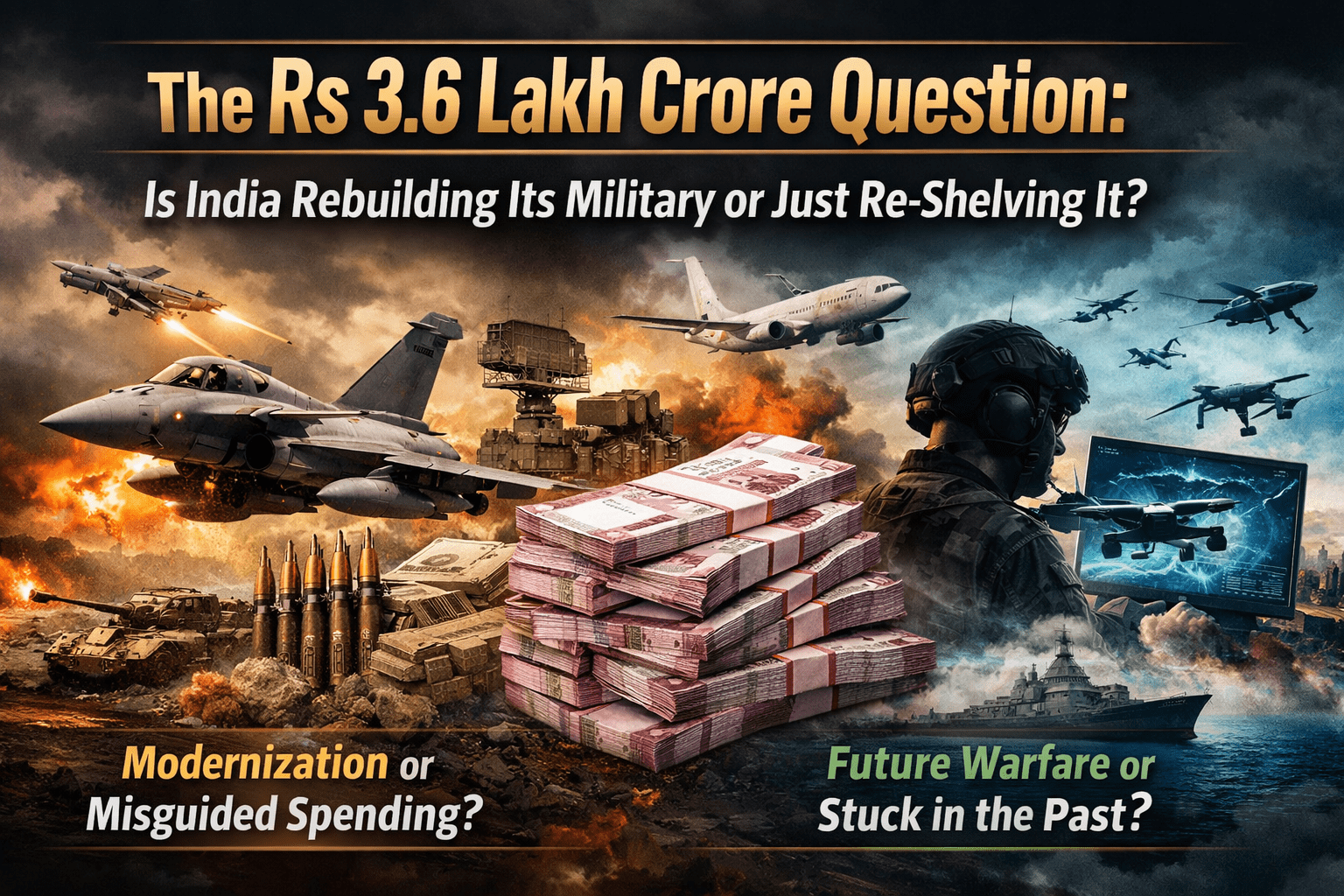
When the Defence Acquisition Council cleared proposals worth Rs 3.60 lakh crore, the number was so large it felt abstract.
It’s the kind of figure that makes your eyes glaze over because the human brain isn’t wired to comprehend what 3.6 trillion rupees actually looks like.
Let me try to frame it differently: that sum could fund the entire annual education budget of India for two years. It could build 15 new airports.
It is, by any measure, a declaration of intent so loud that it should have echoed through every strategic corner of South Asia.
And yet, as the press releases faded and the social media hot-takes cooled down, a more unsettling question began to surface. Not “can we afford this?” but rather, “do we know what we’re actually buying?”
Because if you look closely at what was cleared—the 114 Rafales, the P-8I maritime patrol aircraft, the high-altitude pseudo satellites, the anti-tank munitions, you start to notice something strange.
This isn’t a shopping list for a future war. It’s a shopping list for the last one. And that distinction, subtle as it may seem, is where the real story lies.
It is the heart of what we might call the Indian Airpower Modernization Paradox: the tendency to solve for yesterday’s gaps while tomorrow’s battlefields demand something entirely different.
The Architecture of Procrastination
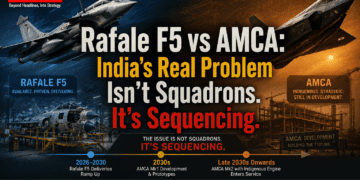
Let’s talk about the Rafale deal first, because it’s the sexiest line item and the easiest to misunderstand. On the surface, it’s a no-brainer.
The IAF already flies Rafales. They love them. They performed admirably during the Balakot aftermath and the more recent Operation Sindoor.
Standardizing the fleet around a single, proven platform is logistics 101. If you have a Ferrari that works, why buy a Lamborghini?
But here’s the twist that nobody in the briefing rooms wants to address: the Rafale is a 1980s design philosophy wrapped in 21st-century composites.
It is magnificent, yes. It is agile, lethal, and battle-hardened.
But it is also the last great gasp of an era where airpower meant a man in a cockpit pulling Gs.
The problem is, the future of air warfare doesn’t involve a man in a cockpit at all.
We are hurtling toward a reality where the sky will be filled not with pilots, but with algorithms. Where the decisive blow isn’t delivered by a daredevil fighter jock but by a swarm of autonomous drones that cost less than the fuel on that fighter.
And in that future, pouring $40 billion into a manned platform feels less like preparation and more like nostalgia.
This is the Indian Airpower Modernization Paradox in its purest form: investing heavily in proven platforms while the nature of warfare shifts beneath our feet.
This isn’t to say the Rafale is a bad buy. It’s to say that we are treating the symptom and ignoring the disease. The disease is that our entire force structure is built around the idea of “platforms” rather than “networks.”
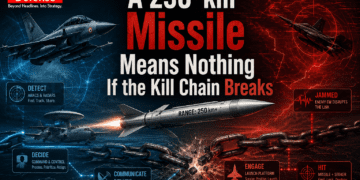
We think in terms of squadrons, not kill chains. We measure our strength by counting tails, not by measuring data fusion.
And this is where the Rs 3.6 lakh crore clearance becomes a fascinating psychological document. It tells us that the Indian strategic mind, for all its talk of transformation, is still fundamentally conservative.
It still believes that the next war will look like the last one, just with better equipment.
But if you look at what’s happening in Ukraine, in Nagorno-Karabakh, in the Red Sea, the lesson is unambiguous: the platform is dying.
The network is king. Resolving the Indian Airpower Modernization Paradox requires us to internalize that lesson, not just acknowledge it in PowerPoint presentations.
The Ghost Airfields of the Future
There’s another aspect of this modernization that nobody is talking about, and it has nothing to do with the aircraft themselves. It has to do with where they will live.
India’s forward airbases in the northern and western sectors are, for the most part, sitting ducks. They are static, they are known, and in the opening hours of any conflict with a peer adversary, they will be the first thing to burn.
Chinese and Pakistani doctrine has evolved to prioritize precisely this, not just killing your aircraft, but killing your ability to generate sorties.
They will target runways, fuel depots, hangars, and command centers with ballistic missiles and cruise missiles before a single dogfight ever happens.
Now, here’s the uncomfortable question: does buying 114 Rafales solve that problem?
It does not.
In fact, it exacerbates it. Because if those 114 Rafales are concentrated on a handful of vulnerable airbases, you are essentially parking your most expensive assets inside the enemy’s targeting reticule.
The IAF knows this. They’ve been experimenting with dispersed operations, highway strips, and austere landing pads for years.
But the bureaucracy of basing, the land acquisition, the political clearances, the infrastructure budgets – hasn’t kept pace with the tactical reality.
What we need isn’t just more jets. What we need is a radical reimagining of how and where those jets operate. We need a system where the airbase is not a fixed location but a concept.
Where fuel, ammunition, and maintenance can be pushed forward on demand, and where the enemy never knows which patch of tarmac you’ll be using tomorrow.
That kind of agility doesn’t come from a procurement file. It comes from a doctrinal shift that we are still too hesitant to make.
This gap between tactical necessity and bureaucratic inertia is yet another layer of the Indian Airpower Modernization Paradox.
The Man vs. Machine Debate We Aren’t Having
There’s a quieter, more uncomfortable conversation lurking beneath all of this, and it’s about the pilot.
India has always fetishized the fighter pilot. And rightly so, they are the best of us, the creme de la creme, the ones with the gleaming wings and the quiet confidence that comes from sitting atop 20,000 pounds of afterburning thrust.
But the fetishization has come at a cost. It has made us structurally averse to unmanned systems.
We talk about drones, sure. We buy Herons and Predators and toy with the idea of swarms.
But deep down, in the war rooms and the air staff corridors, there is a profound discomfort with the idea of a machine making kill decisions.
The pilot community, understandably, sees itself as the soul of airpower. And they aren’t wrong.
But the soul doesn’t matter if the body is dead.
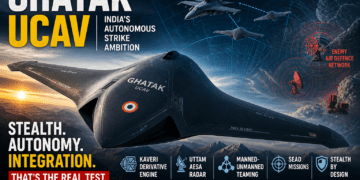
The Chinese have no such hang-ups. Their air force is being built around the idea of “manned-unmanned teaming” from the ground up.
Their next-generation fighters are designed not just to be flown by pilots but to act as mother ships for loyal wingman drones.
The pilot in that scenario becomes less of a shooter and more of a quarterback, calling plays, managing assets, directing a swarm of cheaper, expendable systems to do the actual dying.
Where is India’s loyal wingman program?
Where is our equivalent of the CATS Warrior or the Boeing Airpower Teaming System?
We have bits and pieces, scattered across different labs and private startups, but we lack a coherent vision.
We are still designing our future air force around the pilot, when the future belongs to the quarterback.
This cultural resistance to letting go of the cockpit is a deeply human dimension of the Indian Airpower Modernization Paradox.
The 114 Rafales, magnificent as they are, will need to be retrofitted and upgraded within a decade to talk to drones.
And if we haven’t built those drones by then, or if we haven’t figured out the data links and the AI protocols, those Rafales will be flying blind in the most important sense—they will be alone.
The Industrial Conundrum: Build Here or Die Here?
Let’s talk about the “Make in India” angle, because it’s the part of the press release that gets the most applause and deserves the most scrutiny.
The government has been careful to frame the Rafale deal as a victory for indigenous manufacturing. The headline says 80% of these jets will be built in India.
And technically, that’s true.
There will be an assembly line in Nagpur, Indian workers will rivet French aluminum, and the flag will fly over the factory.
But “built in” is not “invented in.” And that distinction is the difference between strategic autonomy and strategic dependency.
The Russians taught us this lesson the hard way. We built Su-30MKIs under license for decades, yet when we needed to upgrade them with indigenous weapons or avionics, we ran into brick walls. The source code was locked. The intellectual property was guarded. We were assemblers, not owners.
The Rafale deal, if it follows the same pattern, will be a repeat performance with a different accent.
Dassault is not going to hand over the crown jewels. They will sell us the jets, they will let us bolt them together, but the deep knowledge, the ability to modify, adapt, and evolve the platform independently—will remain in Paris.
Now, there are whispers that this time might be different. Whispers that the deal includes unprecedented access to source codes, particularly for integrating the Astra missile and the BrahMos-NG.
If those whispers are true, then this isn’t just a procurement; it’s a transfer of capability. It’s the difference between buying a car and learning to become a mechanic.
But whispers are not contracts. And until we see the fine print, the prudent assumption is that we are buying a very expensive assembly kit.
The danger is that we become so enamored with the “built in” rhetoric that we forget to demand the “owned by” reality. This tension between assembly and ownership is the industrial heart of the Indian Airpower Modernization Paradox.
The Theatre Command Vacuum
Finally, we have to address the elephant that never leaves the room: the failure to create integrated theatre commands.
It has been years since the Chief of Defence Staff position was created.
Years of committees, studies, and recommendations. And yet, the Army, Navy, and Air Force still operate in their own bubbles, with their own budgets, their own doctrines, and their own parochial interests.
The Rs 3.6 lakh crore package does nothing to fix this. In fact, it reinforces the silos. The Navy gets its P-8Is. The Air Force gets its Rafales.
The Army gets its anti-tank munitions. Everyone gets a toy, but nobody gets told to share the sandbox.
This is not sustainable. In a future conflict, the difference between victory and defeat will be measured in seconds. The time it takes to translate a naval sensor cue into an air force strike package, or an army ground request into an air support mission, will determine who lives and who dies.
If we are still passing paper forms between services while the enemy is firing, we have already lost.
The theatre command concept isn’t just a management fad. It is the essential architecture for the kind of warfare we are about to fight. And its absence is the single biggest vulnerability in our entire defence posture.
You can buy all the Rafales in the world, but if they can’t talk to the soldiers on the ground in real-time, they are just very expensive noise-makers.
This inability to integrate across domains is perhaps the most dangerous facet of the Indian Airpower Modernization Paradox, because it renders our hardware less effective than the sum of its parts.
The Long View
So where does this leave us?
It leaves us at a crossroads that looks, from the outside, like a victory lap. Rs 3.6 lakh crore is a lot of money, and it will buy a lot of capability.
The IAF will grow its fleet, the Navy will extend its surveillance reach, and the Army will get its teeth.
But the deeper truth is that we are still playing catch-up.
We are still reacting to yesterday’s threats with today’s solutions. The real transformation, the one that would make us genuinely future-ready – isn’t about how many jets we buy. It’s about how we fight.
It’s about whether we can finally break down the silos between the services. It’s about whether we can embrace unmanned systems without trying to turn pilots into drone operators.
It’s about whether we can build an industrial base that doesn’t just assemble foreign designs but creates its own. And it’s about whether we can reimagine our airbases, our logistics, and our command structures for a world where the first move is digital, not physical.
The Rs 3.6 lakh crore question isn’t whether we spent the money wisely.
It’s whether we spent it on the future, or on a more expensive version of the past. Until we resolve the underlying tensions that create the Indian Airpower Modernization Paradox, we will continue to find ourselves in this loop—spending magnificently, yet transforming incrementally.
And the answer, for now, is that we won’t know until the next war tells us.

